


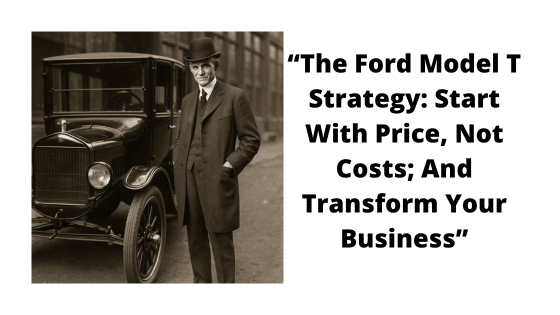
Why Henry Ford Ignored Costs, And Why You Should Too: The Strategic Pricing Blueprint.
1. Why Most Businesses Get Pricing Completely Backwards.
I’ve worked with hundreds of small business owners over the years, and I can tell you this with absolute certainty: most people get pricing the wrong way round. They start with their costs, add a bit of margin, check what the competition is charging, and call it a day.
On paper, it sounds sensible.
In practice, it’s a trap.
When you start with costs, you’re already limiting your thinking. You anchor yourself to what your current operation can deliver rather than what the market wants and is willing to pay for. You tie your price to your inefficiencies, your outdated processes, and your own internal bottlenecks.
I see this every week. A consultant tells me, “John, I charge £75 an hour because that’s what I need to make the numbers work.” A tradesperson says, “I mark up materials by 20%, that’s just how we’ve always done it.” A coach explains, “My competitors are charging £997 for their course, so I’m at £897 to be competitive.” You know what all these approaches have in common?
“They’re all inside-out, not outside-in.”
They’re based on your needs, your costs, your fears, and your market assumptions, none of which matter to the customer.
And here’s the uncomfortable truth:
“When you price from your costs, you’re building a strategy around your inefficiencies.”
Let me give you an example.
A company I worked with a few years ago produced specialist equipment. Their prices were high because their manufacturing process was slow. They told me, “We can’t reduce the price; our costs are too high.” When I asked, “Why are your costs so high?” the answer was “Because that’s how we make it.”
Exactly.
Their pricing was being held hostage by a process designed decades earlier. The moment we reframed the conversation around What would customers happily pay if we solved their problem brilliantly?, everything changed. They redesigned the product, streamlined production, and ended up selling at a lower price while making higher margins.
This mirrors one of the great misunderstandings in business:
“Price should lead strategy. Most people let costs dictate it.”
But the real breakthrough, the blue oceans, comes when you flip that logic on its head.
And no one demonstrated this more powerfully than Henry Ford, which we’ll explore shortly. He didn’t decide the price of the Model T based on what it cost him to make. Instead, he started with the price that would unlock mass adoption, roughly the same as a horse and carriage, and then worked backwards to make that price possible.
Most businesses today do the opposite, and that’s why they stay stuck in the red ocean.
2. What Is a “Strategic Price” in Blue Ocean Strategy?
When I first read Blue Ocean Strategy, one idea hit me like a brick: strategic pricing isn’t about covering your costs, it’s about unlocking demand. A strategic price is the price that makes your offer irresistible to the largest possible group of your ideal customers. It’s the price that opens up new demand, pulls people away from outdated alternatives, and positions your solution as the obvious choice in the market.
And here’s the key:
“A strategic price is not based on what you need. It’s based on what customers value.”
That’s a massive mindset shift.
Let me give you a practical example from my own experience.
A client in professional services once came to me frustrated because they couldn’t grow. They insisted their pricing “had to be” £1,200 a month to cover their overheads. But when we dug deeper, that price wasn’t based on market appetite; it was based on their bloated internal costs, half of which added no value to the customer at all. When we asked, “What would be a breakthrough price that makes clients stop and immediately say yes?”, the answer was closer to £850.
That strategic price instantly opened the door to customers who previously wouldn’t even consider them. The lesson? Strategic pricing forces innovation. They stripped out unnecessary services, tightened delivery, and redesigned how they worked. They ended up more profitable at £850 than they ever were at £1,200.
This is the essence of strategic pricing:
- You start with the price that will create the biggest wave of customers.
- Then you build your business model around delivering value profitably at that price.
It’s the opposite of cost-plus thinking, which says:
- Total our costs
- Add a margin
- Hope customers are willing to pay for it
Hope is not a pricing strategy.
One thing the authors of Blue Ocean Strategy make clear is that price is central to unlocking new demand. Not by being the cheapest, far from it, but by pricing at the sweet spot where high value meets high adoption.
Think of companies like Netflix in the early days. Or Southwest Airlines. Or even budget gyms that revolutionised the fitness industry. All of them identified a strategic price that appealed to millions of non-customers… and then redesigned their entire business around delivering value at that price.
That’s what Henry Ford did. And it’s what most small business owners never do, because they’re stuck pricing from the inside out, based on costs, fear, and “what everyone else charges.”
The strategic price is the exact opposite: It’s a price rooted in customer reality, not business tradition. And when you get it right, everything else becomes easier: sales, growth, positioning, innovation, and profitability.
3. Why Cost-Plus Pricing Is Dangerous.
If there’s one pricing habit that keeps small businesses stuck, it’s cost-plus thinking. You know how it goes: Add up your costs, stick a margin on top, look over your shoulder at the competition, and convince yourself the number is “about right.”
But here’s the brutal truth I’ve learned after more than a decade in business and mentoring: Cost-plus pricing is one of the most dangerous assumptions you can make. It feels safe, but it quietly destroys your margins, your innovation, and your strategic thinking.
Let me explain why.
3.1 Cost-Plus Pricing Locks You Into Your Inefficiencies.
When you base your price on your costs, your costs suddenly become fixed, even when they shouldn’t be.I worked with a service business once who were convinced they had to charge £95 an hour. When I asked why, the owner said:
“Because that’s what we need to cover our overheads.”
But their overheads were ridiculous, huge office, bloated admin, processes held together with duct tape. Their price wasn’t strategic… it was a reflection of their inefficiency. Costs should never dictate price. Price should dictate the level of efficiency required.
That’s exactly what Ford understood.
3.2 You’re Making the Customer Pay for Your Internal Problems.
And customers don’t care about your rent, your staff, or your ageing machinery. They care about value, outcomes, speed, convenience, and results.
Yet cost-plus pricing essentially says:
“Here are all our inefficiencies and internal issues. We’d like you, the customer, to pay for them.”
That’s backward logic. When you price strategically, you’re forced to ask:
- “What would the customer happily pay?”
- “What must the offer look like to justify that?”
- “How do we innovate so we can deliver it profitably?”
That is a completely different mindset.
3.3 Cost-Plus Encourages Commoditisation.
Most businesses using cost-plus end up within 10–20% of their competitors. And because they look, act, and price the same, customers conclude:
“They’re all basically identical.”
That’s how you get dragged into price wars you never wanted to fight. Strategic pricing, by contrast, is built around value and differentiation. It forces you to break out of the pack rather than blend into it.
This is where our Desirability Index concept fits perfectly, because customers don’t buy the cheapest; they buy the most desirable. Cost-plus pricing ignores desirability completely.
3.4 Cost-Plus Removes Any Chance of Creating a Blue Ocean.
Blue Oceans are created by focusing on value innovation, doing something radically better for a strategically chosen price that unlocks new demand. Cost-plus is the opposite of value innovation.
It’s value-reduction: “What’s the least we can do while still covering our costs?”
No breakthrough ever came from that mindset.
Ford didn’t create a revolution by adding a margin on top of his early production costs. The Model T would have been priced for the wealthy elite, just like every other car at the time.
Instead, he started with a price that could transform transportation for the masses, and then challenged every assumption behind costs. That is the difference between strategic pricing and cost-plus guessing.
3.5 Cost-Plus Creates Fear-Based Pricing Decisions.
Let’s be honest: a lot of people use cost-plus because they’re scared to charge anything different.
- Scared customers won’t pay more.
- Scared to repackage their offer.
- Scared to change their delivery model.
- Scared to innovate.
- Scared to be judged by competitors.
To hide that fear, they cling to spreadsheets and margins.
But spreadsheets don’t build Blue Oceans. Clear strategic thinking does.
- Cost-plus pricing is comfortable, and comfort creates stagnation.
- Strategic pricing is uncomfortable, and discomfort creates innovation.
And no one proved that more convincingly than Henry Ford. In the next section, we’ll explore how he flipped pricing on its head and created one of the biggest commercial revolutions of the 20th century.
4. Henry Ford and the Model T: A Masterclass in Strategic Pricing.
When people think of Henry Ford, they think of mass production, assembly lines, and the rise of the American automobile. But the real genius of Ford wasn’t his engineering; it was his strategic pricing.
Ford didn’t start with manufacturing. He didn’t begin by asking, “What does it cost to build a car?” He didn’t benchmark competitors and then add a little margin. He started with a single, bold, customer-driven question:
“What price must this car be so that the average American can afford it?”
And that question changed everything.
At the time, cars were luxury toys for the wealthy. They cost more than a house. For ordinary families, the practical alternative wasn’t another car; it was the horse and carriage.
So Ford set his strategic benchmark: The car must be priced at the level of a horse and carriage. Not based on what it cost him to make… but based on what customers were already paying for the thing they wanted to replace.
From day one, Ford knew the price he needed to hit. And instead of adjusting the price to fit the costs, he adjusted the entire business to fit the price.
That is strategic pricing in its purest form.
“Ford Used Price to Drive Innovation, Not the Other Way Around.”
Most businesses innovate first and price second. Ford priced first and innovated because of that price. To hit the strategic price, Ford had to reinvent how cars were built. His cost target forced creativity.
Here’s what he challenged:
- Why do we need 12 colours? One will do.
(Hence “any colour you want as long as it’s black.”) - Why build bespoke parts? Standardise everything.
- Why move the workers to the car? Move the car to the workers.
(Birth of the moving assembly line.) - Why rely on multiple suppliers? Bring production in-house.
- Why train craftsmen for years? Break work into simple, repeatable steps.
These were not engineering improvements; they were cost innovations born out of a pricing decision. The result?
Ford slashed production time from 12.5 hours per car to about 90 minutes.
- Costs plummeted.
- Quality improved.
- And demand exploded.
All because he started with the price.
The Strategic Price Created a Blue Ocean.
By setting a price that matched the horse-and-carriage market, Ford didn’t compete with other car manufacturers… he made them irrelevant. His strategic price unlocked a completely new mass of buyers, people who previously couldn’t dream of owning a car.
This is the core point most entrepreneurs miss:
“Your price is a strategic weapon.”
It’s not a number on a spreadsheet; it’s a doorway into new markets, new customers, and new growth. Ford’s Model T eventually captured over 50% of the U.S. car market. Not because it was the best car technically. But because it was the best car at the right price for the biggest market.
Ford Built His Entire Business Backwards From Price.
This is what I want every small business owner to understand:
- Ford didn’t price to his costs.
- He forced his costs to obey his strategic price.
That means:
- Price dictated design.
- Price dictated operations.
- Price dictated systems.
- Price dictated scale.
- Price dictated innovation.
Most businesses today do the opposite:
- They design inefficient delivery,
- Build bloated infrastructure,
- Over-customise everything,
- Add unnecessary complexity…
…and then wonder why they “have to charge so much.”
Ford flipped the script.
He proved that when you commit to a strategic price first, you innovate your way to profitability. That’s Blue Ocean thinking. And it may be the most important shift a modern business can make.
5. Cost Innovation: Working Backwards From Price.
One of the biggest misconceptions about pricing is the idea that costs are fixed. They’re not. They’re elastic, completely changeable, once you commit to a strategic price. This is what Ford understood better than almost anyone in business history.
He didn’t ask, “How do we reduce costs?” He asked, “How do we design our entire operation so we can profitably deliver at the price customers must pay?”
That one shift created the foundation of cost innovation, not cutting corners, not cheapening the product, but re-engineering the entire value chain.
Ford Treated Cost as a Creative Challenge.
When Ford set the price of the Model T, he knew he wasn’t anywhere close to being able to produce it profitably. That didn’t stop him; it inspired him. By starting with the price, he forced himself to rethink how cars were built from scratch. And that led to some of the most important cost innovations in industrial history.
Let me break these down, because these lessons are directly applicable to small businesses today.
5.1. Standardisation: The Power of Doing One Thing Well.
Ford realised that endless variations and customisations created massive inefficiencies. Every change required different parts, different skills, and different assembly steps, all of which added unnecessary cost. So he made a bold decision:
“Any customer can have a car painted any colour he wants… so long as it’s black.”
One model. One colour. One specification. Standardisation is one of the most powerful levers available to small businesses, yet most resist it because they think customers crave customisation.
In reality, customers crave clarity, reliability, and speed, all of which come from standardisation.
5.2. The Moving Assembly Line: Speed as a Cost Weapon.
Before Ford, cars were built like bespoke furniture, slow, manual, and artisan-led. Ford turned craftsmanship into an industrial, repeatable system. Instead of workers moving around the car, the car moved past the workers. This simple shift reduced production time from 12.5 hours to 90 minutes. That wasn’t just operational efficiency; it was a strategic breakthrough directly tied to his cost target.
5.3. Breaking Work Into Simple, Repeatable Steps.
Ford didn’t want to rely on highly skilled artisans who were expensive, slow to train, and inconsistent. So he broke complex tasks into simple steps that anyone could learn quickly.
This:
- Reduced wage costs
- Reduced errors
- Reduced variability
- Increased speed
- Increased throughput
- And ensured predictable quality
Small businesses can do the same by building workflows, SOPs, templates, and automation, yet most never attempt it because they don’t see how it connects to pricing. It connects directly.
5.4. Vertical Integration: Controlling Inputs to Control Costs.
Ford looked at his supply chain and asked:
“Where are we vulnerable? Where are we paying too much?”
Then he systematically brought production in-house: steel, glass, parts, even rubber. That level of control allowed him to meet his cost targets with precision.
Most small businesses can’t vertically integrate like Ford, but they can:
- Renegotiate suppliers
- Simplify materials
- Batch processes
- Reduce unnecessary waste
- Use automation and technology to replace manual labour
These are forms of modern cost innovation.
5.5. Eliminating Anything That Didn’t Add Value.
Ford was ruthless about cutting anything that didn’t contribute directly to the goal: delivering a high-quality car at a strategic price.
Small businesses often resist this level of discipline. They hang onto:
- Services no one values
- Features no one uses
- Processes that slow them down
- Custom work that drains their profitability
- Legacy systems that no longer make sense
Cost innovation begins when you start asking:
- “Does the customer genuinely value this?”
- “Would they pay more for it?”
- “Does it meaningfully improve their outcome?”
If the answer is “no,” it’s a candidate for removal.
Cost Innovation Isn’t Cutting Costs; It’s Redesigning the Business.
Here’s the key insight I want you to take from this section:
“Cost innovation is not about spending less; it’s about designing better.”
Ford didn’t build a cheaper car. He built a better, more accessible, more desirable one, at a price millions of people could afford. He didn’t “cut costs”; he redesigned production so costs were no longer a limitation.
This is the lesson most small business owners never learn:
- Your costs aren’t fixed.
- Your systems create your costs.
- Change the systems, and you change the economics of your entire business.
And once you change the economics, new price points become possible, price points that allow you to grow, differentiate, and dominate.
6. The Strategic Pricing Formula for Modern Small Businesses.
One of the biggest breakthroughs I see when I work with business owners is this realisation:
“You don’t set your price based on what it costs you.
You set your price based on the value the customer experiences.”
Once you embrace that, everything about your pricing becomes clearer, simpler, and far more profitable. Strategic pricing is not complicated, but it is counterintuitive, because it forces you to flip your entire mental model. Most people start with cost and move forward. You’re going to start with the customer and work backwards.
Let me walk you through the exact formula I teach my clients, the same formula Ford unknowingly followed over 100 years ago.
Step 1: Identify the Price That Makes Your Offer a No-Brainer.
This is the foundation of strategic pricing: What price would make your ideal customer say, “I’d be crazy to say no to this”?
- Not bargain-basement cheap.
- Not competitor-matching.
- Not “industry standard.”
But genuinely compelling.
To find it, you need to understand:
- The pain you’re solving
- The value you’re delivering
- The alternatives they’re using
- What they’re currently paying
- What they wish they could get for that money
This requires empathy, research, and sometimes uncomfortable conversations. Most small businesses skip this entirely. They grab a price they’ve seen somewhere else and hope for the best. But strategic pricing is intentional. It’s deliberate. It’s built from the outside in.
Step 2: Map Out the “Horse-and-Carriage” Equivalent
Every industry has a default solution, a traditional option people choose because it’s familiar, not because it’s great. For Ford, it was the horse and carriage. For a fitness coach, it might be a gym membership. For a marketing consultant, it might be Fiverr. For a modular building company, it might be containers or traditional construction. For accountants, it might be DIY spreadsheets. For coaches, it might be free YouTube videos.
Your goal is to understand:
- What people are currently paying
- What frustrates them
- What they’re trying to avoid
- What they dream of instead
Because your strategic price must sit at a point where switching to you is a no-brainer upgrade.
Step 3: Set the Strategic Price That Unlocks the Largest Pool of Buyers
This part is crucial. A strategic price isn’t the highest price you can get away with. And it isn’t the lowest price you can offer. It’s the price that:
- removes friction
- expands demand
- communicates value
- positions you above commodity alternatives
- still aligns with your long-term profitability
This is where our Desirability Index becomes incredibly powerful. You want to sit in the zone where desirability is high and perceived value is crystal clear. Price is a signal, and your strategic price should signal confidence, quality, and accessibility all at once.
Step 4: Build and Package Your Offer Around That Strategic Price.
Ford didn’t build a bespoke, handcrafted car and then force it to hit a low price. He built a car for the price. That meant:
- standardising
- simplifying
- focusing on the highest-value features
- eliminating anything the customer wouldn’t pay for
In your business, this might mean:
- removing low-value services
- creating fixed packages
- productising your expertise
- improving delivery speed
- introducing automation
- setting clearer boundaries
- eliminating complexity that drains profitability
Price isn’t something you slap on the end. It’s something you design for.
Step 5: Innovate Your Cost Structure to Fit the Price. Not the Other Way Around.
Once you commit to a price that unlocks demand, you can begin the work Ford did:
- make processes leaner
- remove what doesn’t add value
- improve efficiency
- increase throughput
- reduce handholding
- minimise customisation
- streamline operations
Most small businesses overcomplicate everything. They think “more” means “better.”
In reality, “Better” is better and “More” is expensive.
Strategic pricing forces you to be disciplined about what matters.
Step 6: Validate, Test, Measure, Refine.
Strategic pricing isn’t a guess. It’s a hypothesis you test in the real world.
You should be measuring:
- conversion rates
- objections
- closing speed
- repeat purchases
- churn (for services)
- profitability
- perceived value feedback
The goal isn’t perfection, it’s optimisation. Small pricing tweaks can unlock huge gains.
The Outcome: A Price That Makes Growth Easier, Not Harder.
When you follow this formula, several things happen:
- Sales get easier
- Marketing becomes clearer
- Operations become smoother
- Your offer becomes more desirable
- Profitability increases
- You get out of the red ocean
This is the power of strategic pricing: It forces you to build a business that customers want, and one you can scale.
7. Why Most Businesses Will Never Do This (But You Should).
Whenever I teach strategic pricing, people nod along enthusiastically. They love the idea of starting with the customer, setting a bold price, and then innovating the business model to meet it. It sounds exciting. It sounds smart. It sounds liberating.
But here’s the truth I see every single week:
Most businesses will never do it.
They’ll read about Ford, they’ll agree with Blue Ocean Strategy, and then they’ll go right back to cost-plus pricing and competitor-watching.
Why?
Because strategic pricing forces you to confront uncomfortable truths, and most business owners want comfort, not clarity. Let me explain.
7.1. It Requires Challenging Your Own Assumptions
When you set a strategic price, you have to be willing to ask:
- “Why do we do it this way?”
- “Does this add real value?”
- “Is this complexity necessary?”
- “Is this feature actually for the customer… or just for us?”
- “Could we deliver this in half the time?”
- “Could we simplify this without reducing value?”
Most businesses avoid these questions because they expose inefficiencies, outdated habits, and legacy processes that no one wants to admit are broken. Working backwards from price forces you to look in the mirror. And not everyone enjoys that view.
7.2. It Forces You to Innovate, Not Just Tinker.
Cost-plus thinking leads to tinkering: “Let’s shave a bit off here… add a bit on there… tweak this… fiddle with that.”
Strategic pricing forces real innovation:
- redesigning the offer
- simplifying delivery
- standardising outputs
- automating workflows
- eliminating wasted effort
- rebuilding processes from scratch
Innovation requires courage, creativity, and commitment. Tinkering only requires comfort. It’s not hard to see which path most people choose.
7.3. It Breaks the Safety Blanket of Being ‘Normal’.
Let me be blunt: many business owners price based on what everyone else charges because it feels safe.
When you match the market:
- You avoid criticism
- You avoid judgement
- You avoid sticking your neck out
- You avoid taking responsibility for your decisions
But safety creates mediocrity.
Blue Oceans aren’t built by following the herd. Strategic pricing forces you to step out of the pack, and that scares people.
When you set a strategic price, you’re making a statement. You’re saying:
“I choose my positioning.
I choose my economics.
I choose my value creation.”
Many business owners don’t want that level of accountability.
7.4. It Demands You Stop Over-Customising Everything.
Over-customisation is one of the biggest profit killers in small businesses. I see it constantly:
- “We tailor everything to each client.”
- “We like to be flexible.”
- “No two jobs are the same.”
But here’s the reality: Customisation destroys margin. Standardisation creates profit.
Most business owners know this intellectually, but emotionally, they can’t let go of the belief that “custom work proves our value.” Strategic pricing forces you to package, productise, and professionalise your offer, and many people simply don’t want to change the way they work.
7.5. It Requires Confidence, And Many Don’t Have It Yet.
Strategic pricing says:
- “I choose the market I want to serve.”
- “I know the value I create.”
- “I’m designing my offer for demand, not insecurity.”
- “I’m willing to improve my business to meet the strategic price.”
To do that, you must believe in your ability to deliver value. And belief is a muscle many business owners haven’t exercised. It’s far easier to hide behind numbers like:
- “That’s what the spreadsheet says.”
- “This is the going rate.”
- “This is industry standard.”
Strategic pricing eliminates those excuses.
7.6. The Hardest Reason of All: It Means You Must Change.
Change is uncomfortable. Even positive change is disruptive. Strategic pricing requires you to:
- Rethink your offer
- Remove waste
- Simplify delivery
- Restructure processes
- Refine your positioning
- Challenge long-held habits
- Redesign your entire value chain
It is work. But it is also transformational. Most businesses choose the illusion of control over the reality of opportunity.
But Here’s Why You Should Do It Anyway.
While most businesses avoid strategic pricing, the ones that embrace it unlock advantages their competitors can only dream of:
- clear market differentiation
- higher demand
- higher margins
- simpler delivery
- stronger positioning
- more desirable offers
- a business that scales without chaos
And this is where you step out of the red ocean.
Strategic pricing isn’t just a pricing choice; it’s a business strategy, a mindset shift, and a competitive weapon. Most people won’t do it. That’s exactly why you should.
8. The Desirability Factor: Price as a Signal.
One of the most misunderstood truths in business is this: Price doesn’t just reflect value; it signals value. In other words, your price isn’t just a number.
- It communicates meaning.
- It shapes perception.
- It positions your offer before you’ve said a single word.
And here’s what most business owners don’t realise: Your price tells the customer how desirable your product or service is. This is why strategic pricing is so powerful. It isn’t about being cheap. It isn’t about being “competitive.” It’s about sending the right signal, the signal that says:
“This is exactly what you want, and it’s absolutely worth it.”
Let me explain.
Customers Don’t Buy the Cheapest; They Buy the Most Desirable.
People love a good deal, but they don’t buy solely based on price. If that were true, Rolex, Dyson, Patagonia, and Peloton wouldn’t exist. Customers buy:
- What makes them feel confident
- What reduces risk
- What makes their life easier
- What gives them status or credibility
- What solves the real problem
- What feels like the “right choice”
That’s desirability, the heart of your Desirability Index framework.
You can have the best offer in the world, but if your price signals the wrong thing, customers won’t trust it.
I’ve seen businesses undercharge because they think they’re being “competitive,” only to scare customers away because the price didn’t match the promise. Low price often says:
- “low quality”
- “amateur”
- “high risk”
- “no support”
- “inconsistent results”
And customers run. Strategic pricing avoids this entirely because it aligns price with perceived value.
Price Positions You Before You Even Make Your Pitch.
Think about how you personally react to different price points. For example:
If you saw two modular buildings, one at £12,000 and one at £35,000, you would make assumptions before reading a single specification:
- One is basic.
- One is of higher quality.
- One comes with better support.
- One probably lasts longer.
- One looks more premium.
You haven’t seen either building. But your mind has already decided. That’s the power of price as a signal. And it applies everywhere:
- coaching
- consulting
- online courses
- trades
- professional services
- marketing agencies
- accountants
- modular buildings
- SaaS products
- everything
Before the customer sees the offer, the price frames the value.
Strategic Pricing Ensures the Signal Matches the Value.
Now, this is where most people get confused. Strategic pricing is not about charging more just for the sake of it. It’s about setting a price that sends the correct signal based on the desirability of your offer. If your offer is:
- clearer
- faster
- simpler
- more reliable
- more effective
- expertly delivered
- beautifully packaged
- better supported
…then your price must reflect that. Because if it doesn’t, customers doubt the value. This is why you don’t start with costs; you start with desirability.
Price must express:
- the outcome
- the quality
- the confidence
- the promise
- the position you want in the market
That’s strategic pricing.
How This Connects to the Desirability Index.
In our Desirability Index framework, a business becomes more desirable when it:
- solves the real problem (not the loud problem)
- delivers outcomes clearly
- reduces customer risk
- communicates value effectively
- signals credibility and confidence
Price is part of that story.
- A desirable business has a price that reinforces the value.
- An undesirable business has a price that contradicts it.
Strategic pricing and desirability are inseparable. One informs the other.
This Is Why Ford’s Price Worked.
The Model T’s price didn’t just make it affordable; it made it desirable. The signal it sent was:
“The world of automobiles is now open to you.”
It wasn’t a rich man’s toy anymore. It became everyone’s car, and the price told them that before they even saw it. That’s how strategic pricing creates Blue Oceans.
9. Practical Steps to Create Your Own Strategic Price.
Up to this point, we’ve looked at the principles behind strategic pricing, why cost-plus thinking holds you back, and how Ford used strategic pricing to create an entire Blue Ocean. Now I want to get practical. This section is where you take the theory and translate it into action, specifically, into a price and offer structure that transforms your business.
I’ll walk you through the exact process I use in my Pricing Audits and mentoring sessions. Follow these steps and you’ll think about your price in a completely new way.
Step 1: Identify the Largest Pool of Potential Buyers.
Strategic pricing starts with reach, not cost, not competitors, not industry norms.
Ask yourself:
- Who could buy this if the offer and price were right?
- Who is currently priced out of the market?
- Who is tolerating inferior alternatives?
- Who is frustrated but feels trapped?
- Who wants what you do, but can’t justify it yet?
This is your equivalent of Ford’s mass-market driver, the “everyone else” who hasn’t been able to buy until now. I do this exercise with business owners all the time, and the realisation is powerful: Your biggest growth opportunity usually lies with people who aren’t buying from anyone.
Not your competitors’ customers. Not bargain hunters. The people who want a solution but haven’t found the right price/value mix yet.
Step 2: Understand What Customers Are Really Paying For.
Customers don’t buy your product or service; they buy outcomes. They buy:
- time saved
- certainty
- confidence
- reduced frustration
- status
- clarity
- convenience
- simplicity
- reliability
Your job is to map the true drivers of value. Ask:
- What pain are they trying to escape?
- What outcome are they trying to achieve?
- What alternatives exist (free, DIY, cheap, traditional, high-end)?
- What are they already paying for those alternatives?
This tells you what your strategic price must compete against, not with. Ford didn’t compete with premium car manufacturers; he competed with a horse.
That’s the difference.
Step 3: Decide the Strategic Price That Unlocks Demand.
Now you bring it together.
Ask yourself:
- What price makes switching to your solution a no-brainer?
- What price is compelling, not just acceptable?
- What price aligns with the value customers expect?
- What price signals desirability without triggering fear or scepticism?
Your strategic price should sit at the intersection of:
- high perceived value
- broad market appeal
- strong desirability
- clear competitive advantage
This is the price that maximises adoption. It’s not the highest price you can charge; it’s the smartest.
Ford didn’t choose the cheapest price. He chose the right price for the largest possible market.
Step 4: Redesign Your Offer to Deliver Profitably at That Price.
This is where most businesses fail, but it’s exactly where Ford succeeded. Once you choose your strategic price, you must reshape your offer around it.
That might mean:
- simplifying what you deliver
- standardising processes
- reducing variations
- packaging your service
- removing low-value elements
- improving delivery efficiency
- productising your expertise
- streamlining customer onboarding
- automating manual tasks
You may discover that some parts of your current service are actually costing you margin without adding value. Good. This is the moment to fix it. Strategic pricing forces you to build a business that is fit for purpose.
Step 5: Perform a “Value Engineering” Review of Your Costs.
This is the Ford moment.
Look at every cost, every resource, every process, and ask:
- “Does this help deliver the outcome the customer values?”
- “Would they pay extra for this?”
- “Can we deliver the same outcome with less?”
- “Can we simplify, remove, or streamline this step?”
- “Can we automate this?”
- “Can we standardise this?”
You’re not cutting costs, you’re realigning costs to value. This is cost innovation, not cost reduction.
Step 6: Test, Get Feedback, Refine.
A strategic price isn’t a guess; it’s a hypothesis.
You test it.
Look for:
- customer reactions
- speed of sales conversations
- objection patterns
- conversion rates
- willingness to pay
- How confidently can customers respond
- Which offer structures work best
I often tell clients:
“Your customers will teach you your price, if you’re willing to listen.”
Use these signals to adjust your messaging, packaging, and pricing until your offer feels irresistible.
Step 7: Commit to the Positioning Your Price Creates.
Strategic pricing isn’t a tactic. It’s a positioning statement. Once you’ve set your strategic price, everything else must align:
- Your marketing
- Your messaging
- Your delivery
- Your value proposition
- Your customer experience
- Your sales process
- Your Desirability Index score
Don’t be tempted to wobble. Don’t water down your offer. Don’t try to be everything to everyone. Price is a leadership decision, and customers follow confidence.
The Outcome: A Business Built for Growth, Not Guesswork.
When you create your strategic price properly:
- Your offer becomes more desirable
- Your conversion rate increases
- Your operations become simpler
- Your margins improve
- Your market expands
- Your differentiation becomes obvious
- and your business becomes easier to scale
This is what Ford achieved. This is what Blue Ocean Strategy teaches. And it’s exactly what modern small business owners can tap into once they stop letting costs dictate price.
10. The Final Word: When You Start With Price, You Start With the Customer.
If there’s one thing I want you to take from this entire article, it’s this:
“Strategic pricing is not about numbers. It’s about leadership.”
It’s about choosing to build your business intentionally rather than accidentally. It’s about deciding, just like Henry Ford did, that you’re not going to let outdated processes, inherited habits, or internal inefficiencies dictate your destiny.
Most businesses start with costs because it feels safe. They look at what they’re spending, add a margin, and hope the customer agrees. But safety rarely leads to growth. And hope is a terrible business strategy.
When you start with a strategic price, the price that unlocks demand, creates desirability, and positions your offer powerfully, you instantly become a different sort of business owner.
You become the kind of leader who asks:
- “What would make customers feel they’d be crazy to say no?”
- “What value do they truly want, and at what price would they choose us without hesitation?”
- “How do we redesign our business so we can deliver exceptional value at that price?”
You shift from:
- reactive to proactive
- tactical to strategic
- fear-driven to value-driven
- red-ocean survival to blue-ocean creation
And that’s when things change.
This is exactly how Ford created an entirely new market. And it’s exactly how modern businesses create breakthroughs today.
- You’ll never innovate by looking at your costs.
- You’ll innovate by committing to a strategic price that forces you to build a better business.
- You’ll never differentiate by matching the competition.
- You’ll differentiate by designing an offer that stands in a category of one.
- You’ll never create desirability by staying “competitive.”
- You create desirability by having the courage to lead.
And that’s what strategic pricing is: courage, clarity, and customer focus wrapped into one powerful decision. Now, if you’re reading this and thinking, “I need to rethink my pricing… but I don’t know where to start,” you’re not alone.
This is exactly why I created the Pricing Audit.
Your Next Step: Get a Pricing Audit That Brings Strategic Clarity
If you want to:
- Stop guessing your prices
- Stop relying on competitors for direction
- Stop letting costs trap your business
- Stop leaking profit without realising it
…and instead:
- Identify your true strategic price
- uncover hidden value you’re not charging for
- Simplify your offer
- increase desirability
- improve margins
- and redesign your pricing around the customer (not your costs)
…then a Pricing Audit is the next logical step.
In this session, we’ll look at:
- Your current offer
- Your customer segments
- Your pricing signals
- Your value drivers
- Your Desirability Index
- Your margins
- Your opportunities for cost innovation
- and your strategic price point
This is not a generic review. It’s a deep, personalised audit that shows you exactly where your pricing is holding you back, and what to do instead. Because your price is not just a number.
- It’s a story.
- It’s a signal.
- It’s your strategy.
And when you get it right, everything else becomes easier.
Click below to request your Pricing Audit and take the first step towards building a more profitable, more desirable, and more strategically aligned business.
Let’s fix your pricing and unlock your next stage of growth.


