


Listen to the Audio version of this blog here.

Watch a brief summary video of this blog.
The Distorted Triangle: Why Most Projects Fail Before The Work Even Starts.
Jump To Section
Explore how the project management triangle changes shape depending on time, cost and quality priorities.
1. Introduction – The Myth of the Perfect Project Triangle.

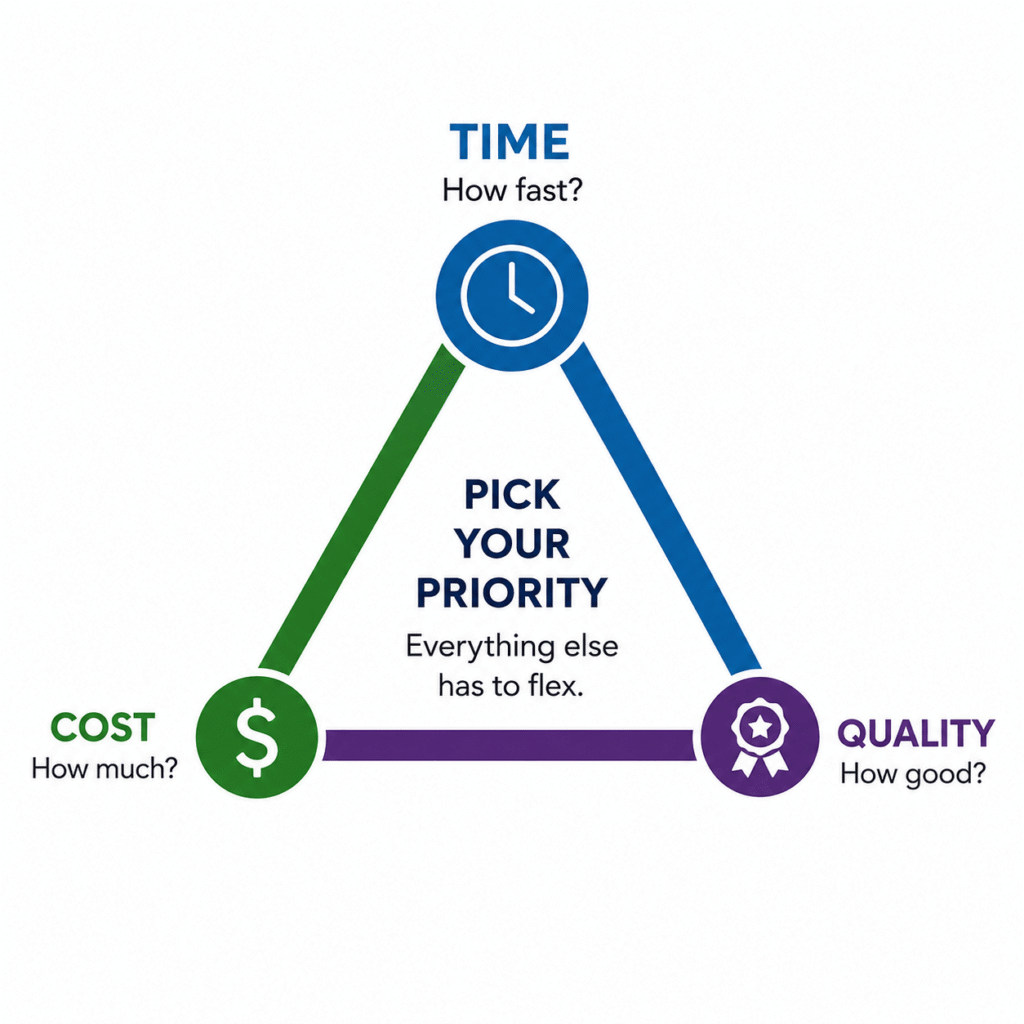
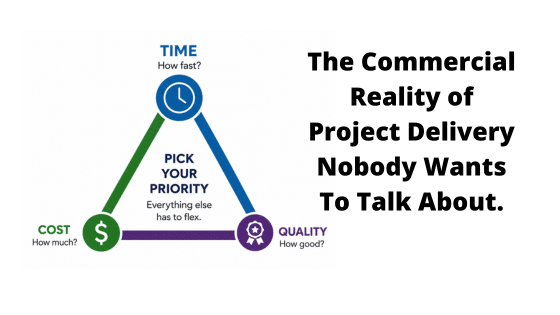
In a previous blog, I wrote about the Value Triangle, the idea that in business, you can normally only optimise for two things at the same time:
- Fast
- Cheap
- Good
You can have:
- good and fast,
- but it probably will not be cheap.
Or:
- cheap and fast,
- but quality will almost certainly suffer somewhere.
It is one of the simplest ways to explain the commercial reality behind pricing, delivery and customer expectations. The problem is that most people still believe they can somehow get all three simultaneously. Nowhere is this more obvious than in projects.
Whether we are talking about construction, software development, manufacturing, engineering, consulting or operational change, the same pressure appears over and over again: “Can we get it done quickly, cheaply and to a very high standard?”
In theory, everybody says yes. In reality, something eventually gives way. The interesting thing is that project management has had its own version of this concept for decades. Instead of:
- Fast,
- Cheap,
- Good,
The project world talks about:
- Time,
- Cost,
- Quality.
But fundamentally, they are the same triangle viewed through different lenses.
The customer thinks:
- fast,
- cheap,
- good.
The contractor or project manager thinks:
- programme,
- budget,
- quality control.
Different language. Same commercial reality. The mistake most people make is assuming the triangle is fixed and balanced. They picture it as a perfect equilateral triangle where all three sides are equal, and harmony exists between them. But real projects do not look like that.
Real projects are distorted. Some projects are dominated by time:
- emergency repairs,
- critical outages,
- last-minute deadlines,
- production shutdowns.
Others are dominated by cost:
- lowest-price tenders,
- cash-constrained developments,
- highly competitive procurement environments.
Others are dominated by quality:
- luxury builds,
- specialist engineering,
- flagship projects,
- mission-critical systems.
The priorities change. And when the priorities change, the shape of the triangle changes with them. That is the real insight. Most project triangles are not equilateral triangles. They are distorted shapes where one side stretches further than the others because one factor matters more than the rest.
In some cases, the distortion is small. In others, it becomes extreme.
A project with a highly compressed programme and unrealistic budget may become heavily distorted toward time and cost pressure, forcing quality, planning and certainty to absorb the strain. A premium project may deliberately stretch toward quality, accepting higher costs and longer delivery times in exchange for a superior outcome.
The shape tells you what the project is really optimising for. But there is another layer to this that makes projects even more complicated: Every stakeholder sees a different triangle.
- The client has one set of priorities.
- The contractor has another.
- The project manager has another.
The investor, end user, subcontractors and consultants all see the project through their own commercial lens. And this is where many projects start to fail. Not because people are incompetent. Not because the technical work cannot be done.
But because everybody believes they are working toward the same shape when in reality they are optimising completely different sides of the triangle.
That misalignment creates:
- unrealistic expectations,
- pricing pressure,
- programme compression,
- disputes,
- variation claims,
- quality problems,
- margin erosion,
- and operational chaos.
Most project failures do not begin on site. They begin much earlier, when people assume they are all looking at the same triangle.
2. The Two Triangles Are Actually One
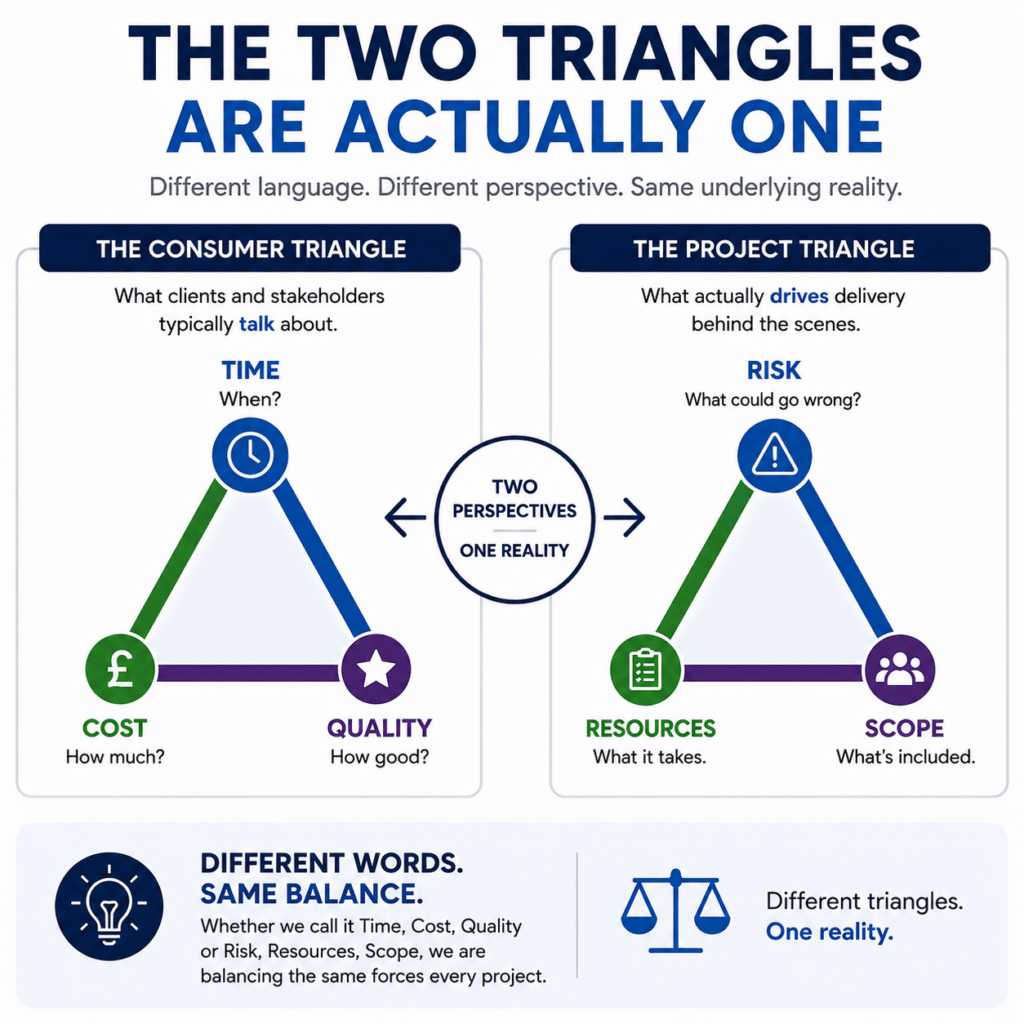
At first glance, the two triangles appear to be different concepts.
|
One feels commercial and customer-facing:
|
The other feels technical and operational:
|
But they are not different models at all.
They are simply two ways of describing the same underlying reality. In simple terms:
- Fast = Time
- Cheap = Cost
- Good = Quality
That is all that is happening. The customer uses emotional language. The project team uses operational language. But both are describing the exact same tensions.
- A client says, “We need this done quickly.”
- The project manager hears: “The programme is compressed.”
- A client says, “We need to keep costs down.”
- The commercial manager hears: “Margins and contingency are under pressure.”
- A client says, “We want a premium finish.”
- The delivery team hears: “Quality control, coordination and tolerances are now critical.”
Different words. Same commercial reality. This is important because many project problems are not caused by technical failures. They are caused by communication failures between people who think they are saying the same thing when they are not.
- The client often sees the project emotionally.
- The contractor sees it operationally.
- The project manager sees it structurally.
And those perspectives naturally create friction.
Clients Think Emotionally
Most clients are not analysing programme sequencing, procurement lead times or labour productivity rates. They are thinking about outcomes. They are thinking:
- “I need the building open by Christmas.”
- “I cannot exceed this budget.”
- “I do not want complaints from customers.”
- “I need this to look impressive.”
- “I need the problem gone.”
Their version of the triangle is usually driven by emotion, pressure or consequence. An operations director facing a factory shutdown may suddenly place enormous emotional value on speed because every day offline is costing tens of thousands of pounds.
A homeowner building a dream house may place emotional value on quality because the project is deeply personal. A startup founder running out of funding may become entirely cost-driven because cash survival outweighs everything else. The triangle becomes shaped by what matters most to them psychologically and commercially.
And often, they assume all three sides should still remain equal. That is where problems begin.
Contractors Think Operationally
Contractors tend to interpret the triangle through the lens of delivery reality. They think about:
- labour,
- materials,
- sequencing,
- subcontractors,
- logistics,
- risk,
- procurement,
- margin,
- and productivity.
When a client asks for something “faster,” the contractor immediately understands the operational implications:
- overtime,
- additional labour,
- acceleration costs,
- parallel working,
- reduced float,
- increased coordination pressure.
When a client demands lower costs, the contractor understands what may need to change:
- specification,
- labour allocation,
- programme duration,
- contingency,
- or scope.
This is why contractors often appear resistant or difficult during early project discussions. In reality, they are usually translating emotional demands into operational consequences. A good contractor understands that every movement in one side of the triangle creates pressure somewhere else. The problem is that many contractors still promise impossible combinations to win work. That is where commercial distortion starts.
Project Managers Think Structurally
Project managers sit somewhere in the middle. They are normally less emotionally attached to the outcome and more focused on system stability. Their job is to balance:
- programme,
- resources,
- scope,
- risk,
- sequencing,
- communication,
- dependencies,
- and stakeholder expectations.
In many ways, project management is the discipline of trying to stop the triangle from collapsing under pressure. Good project managers understand something many others do not:
- The triangle is not the problem.
- Unmanaged distortion is the problem.
A compressed programme is not automatically bad. A tight budget is not automatically bad. A premium quality expectation is not automatically bad. The issue is whether the project structure realistically supports those priorities. That is why experienced project managers ask difficult questions early:
- What matters most?
- What flexes if pressure appears?
- Where is the contingency?
- What are we protecting?
- What trade-offs are acceptable?
Those conversations are often uncomfortable because they force stakeholders to acknowledge reality. But they are essential. Because every project triangle eventually reveals its true shape, whether people discuss it openly or not. The only question is whether that discovery happens:
- early through planning,
or - Later, through conflict.
And unfortunately, many projects wait until delivery problems appear before they discover what the real priorities actually were.
3. Why The Triangle Changes Shape.
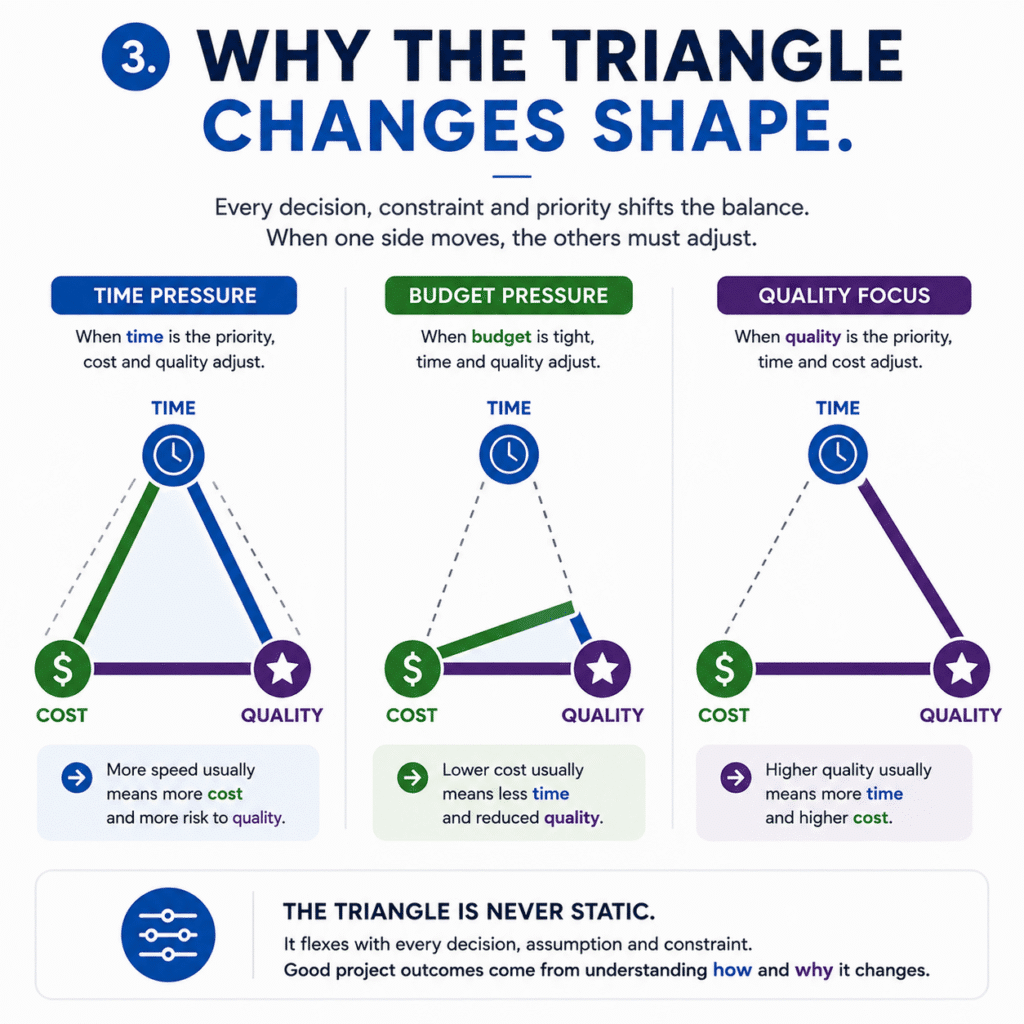
The mistake most people make is imagining the project triangle as a neat, balanced shape. Three equal sides.
- Time.
- Cost.
- Quality.
Everything in harmony. That is the textbook version. But it is not the real-world version. In real projects, the triangle changes shape because priorities are not equal. One factor usually matters more than the others. Sometimes slightly more. Sometimes overwhelmingly more.
That dominant factor stretches the triangle. If time is the priority, the triangle pulls toward speed. If cost is the priority, the triangle pulls toward budget. If quality is the priority, the triangle pulls toward standards, detail and finish. This is why I think the shape of the triangle is such a useful idea. It makes something invisible visible. It shows what the project is really optimising for.
The Equilateral Triangle: The Rare Balanced Project
In theory, the perfect project triangle is equilateral. That means all three sides are equal:
- time matters,
- cost matters,
- quality matters.
No one factor dominates the others. This can happen, but it is rare. It usually requires:
- a realistic budget,
- a sensible programme,
- a clear scope,
- experienced people,
- good planning,
- and a client who understands trade-offs.
In an equilateral project, nobody is pretending the impossible is possible. The client accepts that quality has a cost. The contractor accepts that cost control matters. The project manager accepts that time pressure needs to be managed.
There is balance. Not perfection, but balance. The problem is that most people talk as though every project should be like this. In reality, very few projects start from that position. Most projects begin with pressure already built in.
- The deadline is tight.
- The budget is fixed.
- The quality expectation is high.
- The scope is unclear.
- The procurement route is competitive.
- The client wants certainty, but also flexibility.
So the triangle starts to distort before the work even begins.
The Isosceles Triangle: The Normal Project
Most real projects are not equilateral. They are closer to an isosceles triangle. Two sides may be reasonably balanced, but one side stretches longer because one priority carries more weight.
For example, a client may say: “Quality matters, but we absolutely cannot miss the opening date.”
That is a time-dominant triangle.
Or they may say: “We want a good job, but the budget is the budget.”
That is a cost-dominant triangle.
Or they may say: “We are prepared to wait and pay more, but this has to be right.”
That is a quality-dominant triangle.
There is nothing wrong with this. In fact, it is normal. The problem is not that the triangle is distorted. The problem is when nobody admits it. Because once one side becomes dominant, the other sides must respond. You cannot stretch one side of the triangle and expect nothing else to move.
Highly Distorted Triangles: High-Pressure Projects
Some projects go beyond normal distortion. They become highly distorted. These are projects where one factor dominates so aggressively that the others are pushed into dangerous territory. For example:
- “It must be finished in four weeks.”
- “The budget cannot increase under any circumstances.”
- “There can be no compromise on quality.”
- “We need it fast, but we cannot pay any more.”
- “We want premium quality, but at a budget price.”
- “We need absolute certainty, but we have not finalised the scope.”
These are not just project constraints. They are warning signals. A highly distorted triangle creates pressure that has to go somewhere. If the programme is compressed, pressure goes into labour, sequencing, cost and quality control. If the budget is squeezed, pressure goes into specification, margin, contingency and scope. If the quality requirement is extreme, pressure goes into time, expertise, supervision and cost.
The triangle always absorbs the pressure somewhere. And if that pressure is not managed properly, it eventually shows up as:
- delays,
- disputes,
- defects,
- variations,
- rework,
- overspend,
- or margin erosion.
Speed-Dominant Projects
In a speed-dominant project, time is the longest side of the triangle. Everything is being pulled toward the deadline. These projects often sound like:
- “We need this done urgently.”
- “The opening date cannot move.”
- “Production has to restart by Monday.”
- “The client handover is fixed.”
Speed-dominant projects are common in:
- emergency repairs,
- shutdown works,
- retail openings,
- live operational environments,
- urgent compliance works,
- and recovery projects after failure.
The issue is not urgency itself. Urgency is often legitimate. The issue is pretending urgency has no cost. Fast projects normally require:
- more labour,
- longer working hours,
- faster procurement,
- quicker decisions,
- tighter coordination,
- and reduced room for error.
That has consequences. Speed stretches the triangle because acceleration is never neutral. It either increases cost, increases risk, or reduces quality control. Sometimes all three.
Cost-Dominant Projects
In a cost-dominant project, the budget is the longest side of the triangle. Everything is being pulled toward price. These projects often sound like:
- “We need to get the cost down.”
- “You are too expensive.”
- “Another contractor can do it cheaper.”
- “There is no more money in the budget.”
Cost-dominant projects are common in:
- lowest-price tendering,
- cash-constrained developments,
- public procurement,
- competitive contracting,
- and projects where the buyer sees little difference between suppliers.
Again, the issue is not cost control. Cost control is essential. The issue is when cost becomes the only serious priority. When cost dominates too heavily, the project starts looking for savings everywhere:
- cheaper materials,
- reduced supervision,
- thinner contingency,
- less experienced labour,
- vague scope,
- reduced testing,
- fewer quality checks,
- or aggressive assumptions.
Sometimes the saving is real. Often, it is just deferred. The cost appears later as:
- claims,
- variations,
- defects,
- delays,
- conflict,
- or operational disruption.
A cost-dominant triangle can look attractive at the tender stage. But it can become very expensive during delivery.
Quality-Dominant Projects
In a quality-dominant project, quality is the longest side of the triangle. Everything is being pulled toward the standard of the outcome. These projects often sound like:
- “This has to be right.”
- “The finish matters.”
- “We cannot afford defects.”
- “This is mission critical.”
- “This needs to last.”
Quality-dominant projects are common in:
- high-end residential work,
- specialist engineering,
- healthcare environments,
- complex mechanical and electrical systems,
- luxury hospitality,
- premium commercial spaces,
- and critical infrastructure.
Quality-dominant projects are not necessarily inefficient. But they do require more discipline. They normally need:
- better design coordination,
- more detailed planning,
- stronger supervision,
- higher-grade materials,
- skilled labour,
- tighter tolerances,
- more testing,
- and proper commissioning.
That takes time. It also costs money.
The mistake is trying to demand premium quality while still treating time and cost as though they should behave like a basic commodity project.
They will not.
If quality genuinely dominates, the triangle has to stretch toward quality. That means time and cost must be allowed to move in support of the standard required.
A Simple Way To Visualise It
This is how I would picture it.
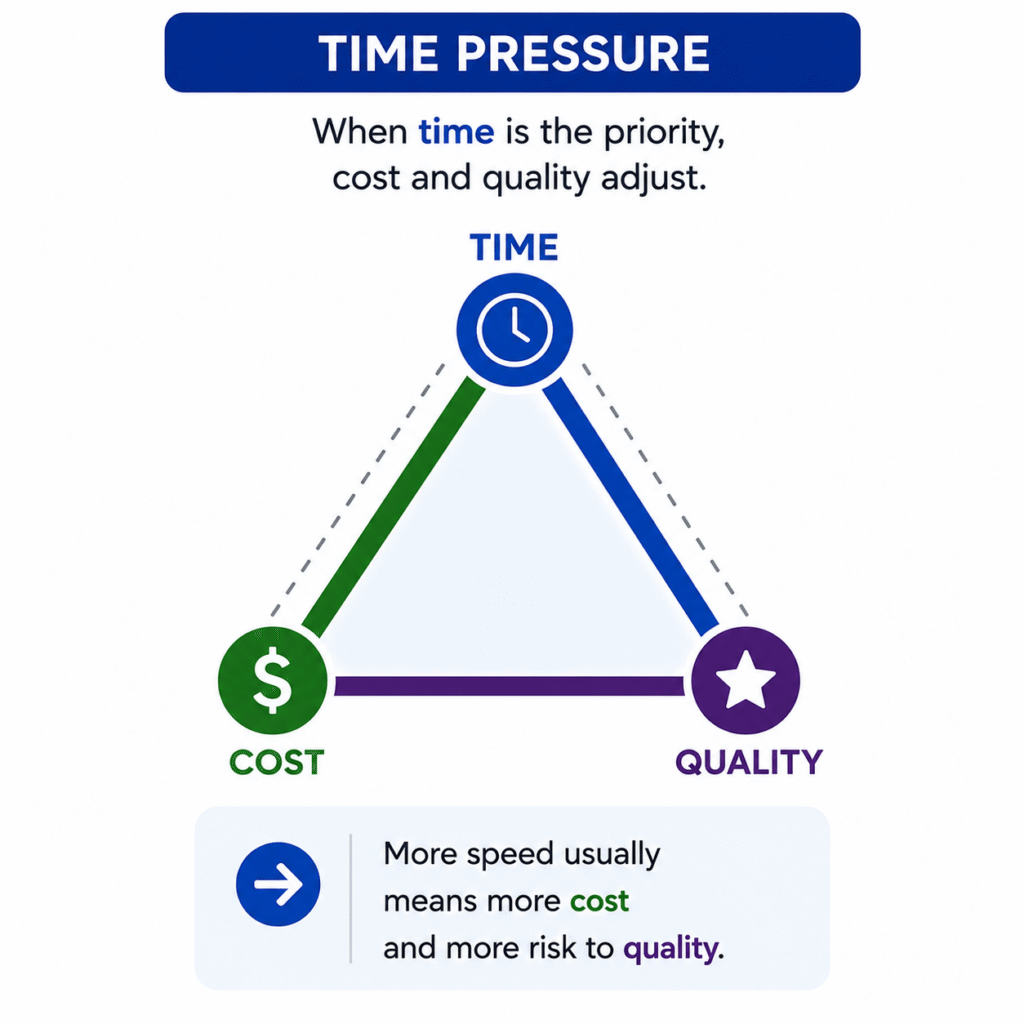
1. Speed-Dominant Triangle
The triangle is pulled toward time. The deadline is fixed. Cost and quality become pressure points. Useful for:
- emergency works,
- urgent repairs,
- fast-track delivery.
Risk:
- acceleration costs,
- coordination errors,
- reduced planning time.
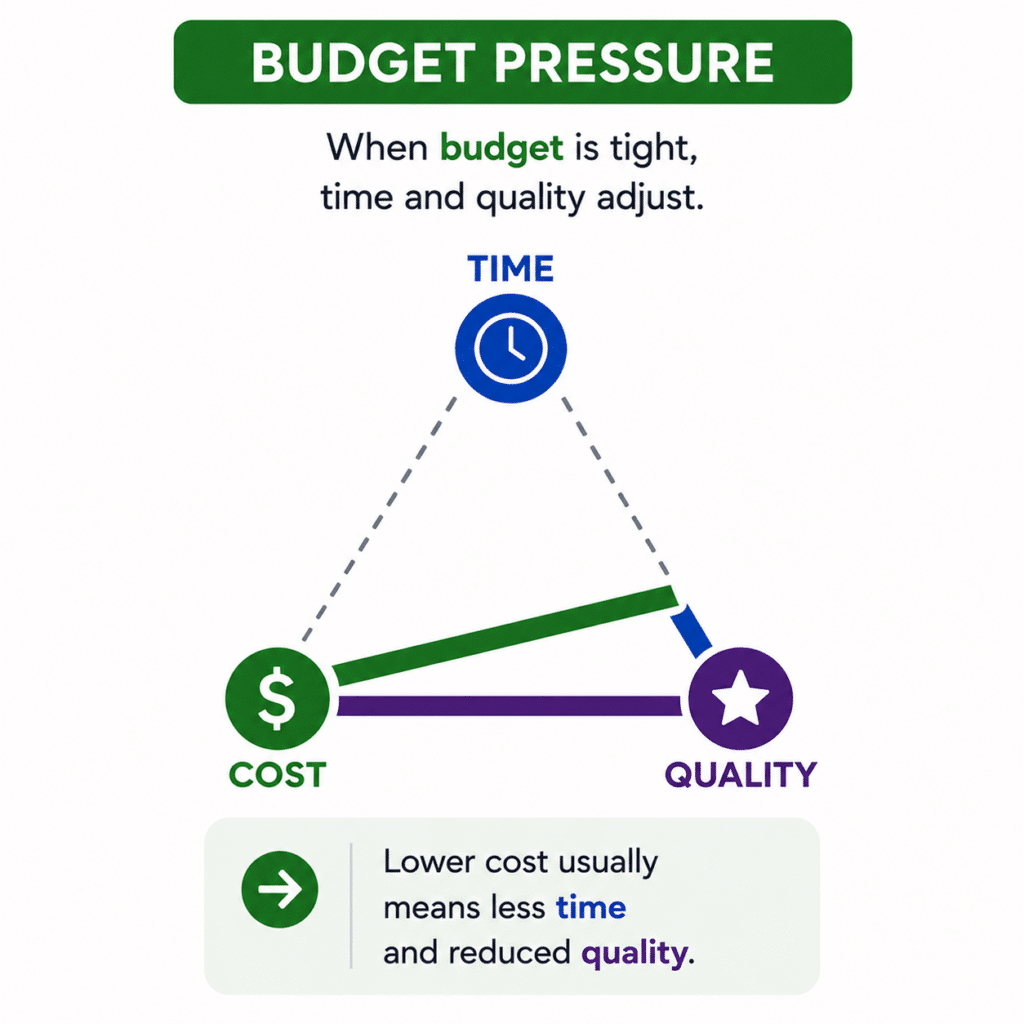
2. Cost-Dominant Triangle
The triangle is pulled toward the budget. Price is the main decision factor. Time and quality become pressure points. Useful for:
- simple work,
- clearly defined scope,
- low-complexity projects.
Risk:
- omissions,
- weak contingency,
- quality compromises,
- variation disputes.
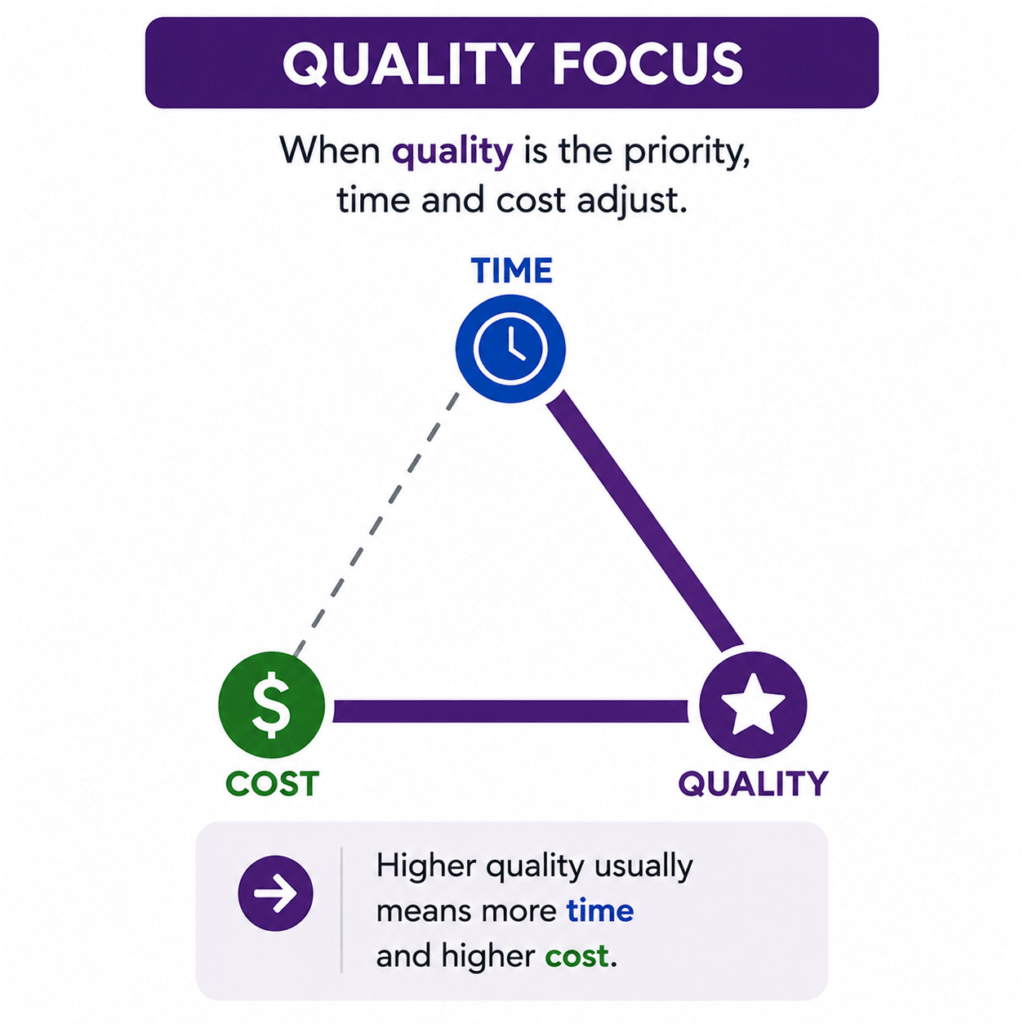
3. Quality-Dominant Triangle
The triangle is pulled toward standards. Outcome quality is protected. Time and cost become supporting factors. Useful for:
- specialist work,
- high-value environments,
- mission-critical systems.
Risk:
- slow decisions,
- cost escalation,
- overengineering,
- scope creep.
The important point is not that one shape is good and another is bad. The important point is that the shape must be understood. A speed-dominant project can succeed. A cost-dominant project can succeed. A quality-dominant project can succeed. But only if everyone knows which shape they are working with. The danger comes when the project is sold as one shape, priced as another, managed as another, and judged as another. That is when the triangle stops being a planning tool and becomes a source of conflict.
4. The Emergency Project – When Time Dominates Everything
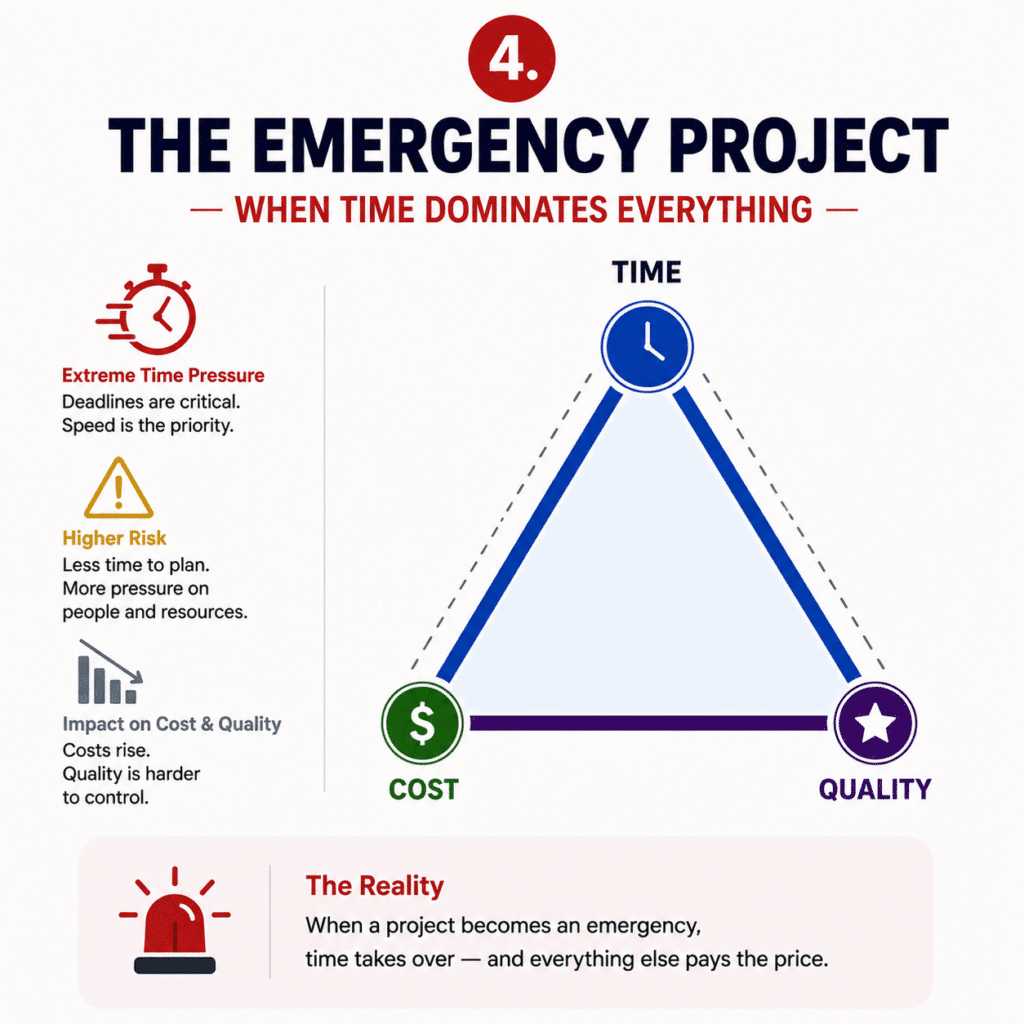
Some projects are planned carefully over months. Others begin with a phone call that starts with: “We need someone here immediately.” And in that moment, the shape of the triangle changes completely. Time becomes dominant. Not important. Dominant.
The project is no longer being optimised primarily around cost or even perfect quality control. It is being optimised around urgency, operational continuity and speed of response. This is the classic time-dominant triangle. And it appears everywhere.
The Reality of Emergency Projects
Emergency projects happen when the cost of delay becomes greater than the cost of acceleration. Examples include:
- a factory shutdown,
- a failed electrical system,
- a burst pipe,
- a collapsed server room cooling system,
- a retail store unable to open,
- a production line failure,
- a dangerous structural issue,
- or a compliance failure that stops operations.
At that point, the client’s priorities change almost instantly. Yesterday, they may have been focused on:
- competitive pricing,
- procurement processes,
- and budget approvals.
Today, they only care about one thing: “How quickly can this be fixed?”
That single shift stretches the triangle aggressively toward time. And once that happens, every other side of the triangle starts behaving differently.
When Time Becomes The Priority, Everything Else Moves
This is one of the most important commercial realities in project delivery: Acceleration is never neutral. If a project has to move faster, something has to absorb the pressure. Usually that means:
- increased labour,
- overtime,
- shift work,
- rapid procurement,
- expedited deliveries,
- parallel working,
- increased supervision,
- and compressed decision-making.
All of those things cost money. Many also increase risk. This is why emergency projects are rarely cheap. And it is why clients who normally focus heavily on price suddenly become far more flexible commercially during a crisis. Because the real cost is no longer the invoice. The real cost becomes downtime. For example:
If a manufacturing plant loses £50,000 per day while production is offline, then paying an additional £15,000 to accelerate repairs may become commercially insignificant compared to the operational losses being avoided.
The triangle has changed shape. Time now outweighs cost.
The Hidden Consequences of Speed
What makes emergency projects dangerous is that compressed time affects far more than the programme. It affects decision quality. Under heavy time pressure:
- decisions get made faster,
- information becomes incomplete,
- planning windows shrink,
- coordination suffers,
- And people start reacting instead of forecasting.
That is where the triangle becomes unstable. Because while clients often accept higher costs during emergencies, they do not always understand the hidden operational strain that acceleration creates. For example:
- Materials may need sourcing from alternative suppliers,
- labour may need reallocating from other projects,
- Subcontractors may need prioritising,
- inspections may become harder to coordinate,
- and sequencing may become compromised.
The faster the project moves, the less room exists for recovery when something goes wrong. In many ways, emergency projects remove the safety margin from delivery.
Speed Creates Commercial Distortion
One of the biggest mistakes businesses make is pretending that accelerated delivery should behave like normal delivery. It should not. Fast delivery changes the economics of a project completely. For example:
- labour productivity often falls under extended hours,
- fatigue increases error rates,
- Overtime premiums increase costs,
- Procurement costs rise,
- and management intensity increases dramatically.
This is why experienced contractors often become cautious when clients say, “We need this urgently.” Not because they do not want the work. But because they understand that urgency distorts the triangle and increases risk exposure across the entire project. A good contractor knows:
- The faster the programme,
- The smaller the tolerance for mistakes.
The Psychological Pressure of Emergency Projects
Emergency projects also create emotional pressure that does not exist in normal delivery environments.
- People become reactive.
- Clients panic.
- Teams become fatigued.
- Senior management becomes involved.
- Communication becomes more intense.
And under those conditions, expectations often become unrealistic. This creates one of the biggest contradictions in project delivery: The more urgent the project becomes, the more important control becomes.
But unfortunately, urgency often destroys control. That is why many emergency projects feel chaotic. Not because the people involved are incapable. But because the triangle has become so heavily distorted toward time, the normal balance between planning, coordination and execution starts to collapse.
The Difference Between Controlled Acceleration and Chaos
This is where experienced project teams separate themselves from inexperienced ones. The best firms understand that emergency delivery is not about panic. It is about controlled acceleration. That means:
- rapid but structured decision-making,
- clear communication,
- prioritisation,
- resource coordination,
- realistic risk assessment,
- and strong project leadership.
The objective is not simply to move faster. The objective is to prevent the triangle from collapsing while moving faster. That is a very different mindset. Anyone can create urgency. Very few people can manage it properly.
The Triangle Never Disappears
What fascinates me about emergency projects is that they expose the truth about the triangle more clearly than almost any other environment. Because suddenly everyone becomes honest. Nobody expects:
- the cheapest option,
- the perfect process,
- or endless procurement comparisons.
The priorities become visible immediately. The triangle reveals its true shape. Time dominates everything. And once that happens, everybody instinctively understands that:
- The cost will increase,
- pressure will increase,
- And risk will increase alongside it.
Which raises an important question: If everyone understands the trade-offs during a crisis, why do so many businesses pretend those trade-offs do not exist during normal projects?
That is where many delivery problems begin. Not because the triangle changes shape. But because people refuse to acknowledge that it already has.
5. The Lowest-Price Tender – When Cost Distorts The Triangle
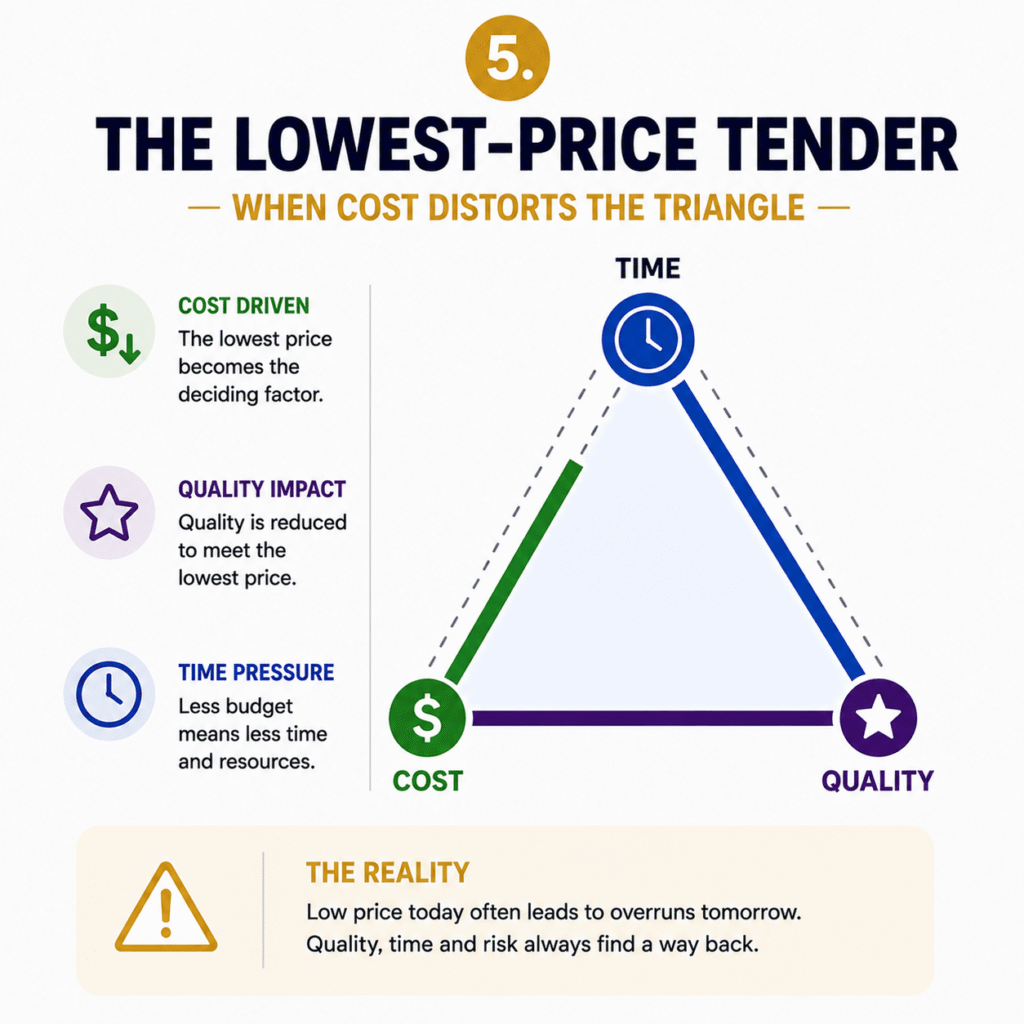
If emergency projects distort the triangle toward time, lowest-price tendering distorts it toward cost. This is probably the most common distortion in modern project delivery. And in many industries, it has become so normalised that people no longer recognise how dangerous it can be.
The process usually starts innocently enough. A client wants:
- competitive pricing,
- budget certainty,
- and value for money.
There is nothing unreasonable about that. Every business should care about cost. The problem begins when cost stops being one factor in the decision and becomes the only factor. Because once that happens, the triangle changes shape immediately. Everything starts bending toward price. And the pressure created by that distortion has to go somewhere.
The Illusion of the Cheapest Price
One of the biggest misconceptions in project delivery is the idea that the cheapest tender represents the lowest cost. Very often, it does not. It simply represents:
- the lowest visible upfront number.
Those are not the same thing.
In many competitive tenders, contractors know they are not pricing in a balanced environment. They know the commercial pressure is heavily weighted toward cost. And because they know that, their behaviour changes. The triangle changes shape before the project even starts. The contractor begins asking:
- What can be reduced?
- What assumptions can be made?
- What has been excluded?
- What level of risk are we carrying?
- Where are the grey areas in the scope?
- What might become a variation later?
This is where commercial distortion begins. Not necessarily through dishonesty. But through survival. Because when price becomes dominant, certainty often becomes negotiable.
The Dangerous Psychology of Lowest-Price Procurement
The problem with heavily cost-dominant projects is that they create the illusion that quality, time and certainty can remain fixed while cost is continually reduced. But the triangle does not work like that. If price is aggressively compressed:
- margins reduce,
- contingency disappears,
- flexibility reduces,
- and tolerance for mistakes collapses.
Eventually, the project starts looking for somewhere else to absorb the pressure. That pressure often appears as:
- reduced supervision,
- lower specification materials,
- thinner labour allocation,
- rushed sequencing,
- weaker subcontractors,
- delayed decisions,
- or increased claims and variations.
The project may still look financially attractive at the tender stage. But the distortion is already there beneath the surface. The triangle has stretched heavily toward cost. And the other sides are now under strain, whether anybody admits it or not.
The Scope Problem Nobody Talks About
One of the biggest consequences of cost-dominant procurement is scope ambiguity. This is something I see constantly. A client believes they are comparing:
- like-for-like tenders,
- identical specifications,
- and equal delivery capability.
But in reality, they are often comparing completely different assumptions hidden beneath a single number.
One contractor may have included:
- full testing,
- detailed commissioning,
- quality supervision,
- contingency,
- and programme protection.
Another may have assumed:
- minimal coordination,
- reduced allowances,
- provisional sums,
- or exclusions hidden deep in the tender documentation.
On paper, one price looks cheaper. Operationally, it may simply be less complete. This is one of the reasons lowest-price environments often generate:
- disputes,
- variation claims,
- relationship breakdowns,
- and margin conflict later in the project.
The project was never operating from the same triangle in the first place. The client believed they bought one shape. The contractor priced another. Reality eventually exposes the difference.
Cost Compression Creates Delivery Pressure
There is another important consequence of heavily cost-driven projects: Low prices remove recovery capacity. A healthy project normally contains some level of operational tolerance:
- contingency,
- float,
- management capacity,
- resource flexibility,
- and financial breathing room.
When margins become too thin, those buffers disappear. That means even small problems become commercially dangerous. For example:
- a delayed material delivery,
- a design change,
- unexpected remedial work,
- labour shortages,
- or coordination failures
can suddenly push the project into instability very quickly. Why? Because the project has no resilience left. The triangle has already been stretched too aggressively toward cost. There is nowhere left for the pressure to go.
The Race To The Bottom
This is where industries become trapped in destructive procurement cycles. One contractor cuts the margin to win the work. Another cuts further. Another removes contingency entirely. Another underprices risk. Eventually the market stops competing on:
- reliability,
- expertise,
- planning,
- or quality.
It competes almost entirely on:
- how much pain each contractor is willing to absorb.
That is not healthy competition. That is commercial erosion. And the long-term consequences are severe:
- contractor failures,
- poor delivery standards,
- high staff turnover,
- reduced investment,
- adversarial relationships,
- and declining trust across the supply chain.
Ironically, clients often suffer as well. Because while they may achieve a lower tender figure initially, they frequently experience:
- delays,
- claims,
- quality issues,
- operational disruption,
- and ongoing maintenance problems later.
The “saving” simply moves location within the lifecycle of the project.
Why Cheap Projects Often Become Expensive
One of the most important things to understand about cost-dominant triangles is this: Cheap projects often create expensive consequences. A low tender may eventually generate:
- rework,
- defects,
- programme overruns,
- legal disputes,
- lost operational revenue,
- reputational damage,
- or ongoing maintenance costs.
This is particularly dangerous in sectors where downtime or operational failure carries major commercial consequences. For example, A contractor saving £20,000 during procurement may later create:
- £100,000 of disruption,
- delayed openings,
- lost production,
- or years of maintenance issues.
The triangle always balances eventually. The question is simply where the cost appears.
WYSIWYP And The Cost-Dominant Triangle
This is one of the reasons I believe concepts like WYSIWYP (“What You See Is What You Pay”) are becoming increasingly important. Because many project problems do not come from malicious intent.
They come from misaligned assumptions hidden inside distorted triangles.If the project is genuinely cost-driven, then that needs to be openly acknowledged:
- What is included?
- What is excluded?
- What assumptions exist?
- What level of quality is expected?
- What flexibility exists in the programme and specification?
- What risks remain unresolved?
Clarity reduces distortion. Ambiguity amplifies it.
The Best Contractors Understand Something Important
Experienced contractors understand that not all cost-dominant projects are bad. Some projects genuinely should prioritise efficiency. Simple, repetitive or low-complexity works can often be delivered successfully within tight commercial constraints.
- The issue is not cost awareness.
- The issue is unrealistic expectations.
The problem starts when clients expect:
- premium quality,
- accelerated programmes,
- zero risk,
- full flexibility,
- and exceptional service
while simultaneously driving the triangle aggressively toward the cheapest possible number. At that point, the project is no longer commercially aligned. It becomes structurally unstable. And eventually, the distortion reveals itself somewhere during delivery. Because the triangle never disappears. It simply waits for reality to catch up with expectation.
6. The Premium Project – When Quality Becomes The Priority
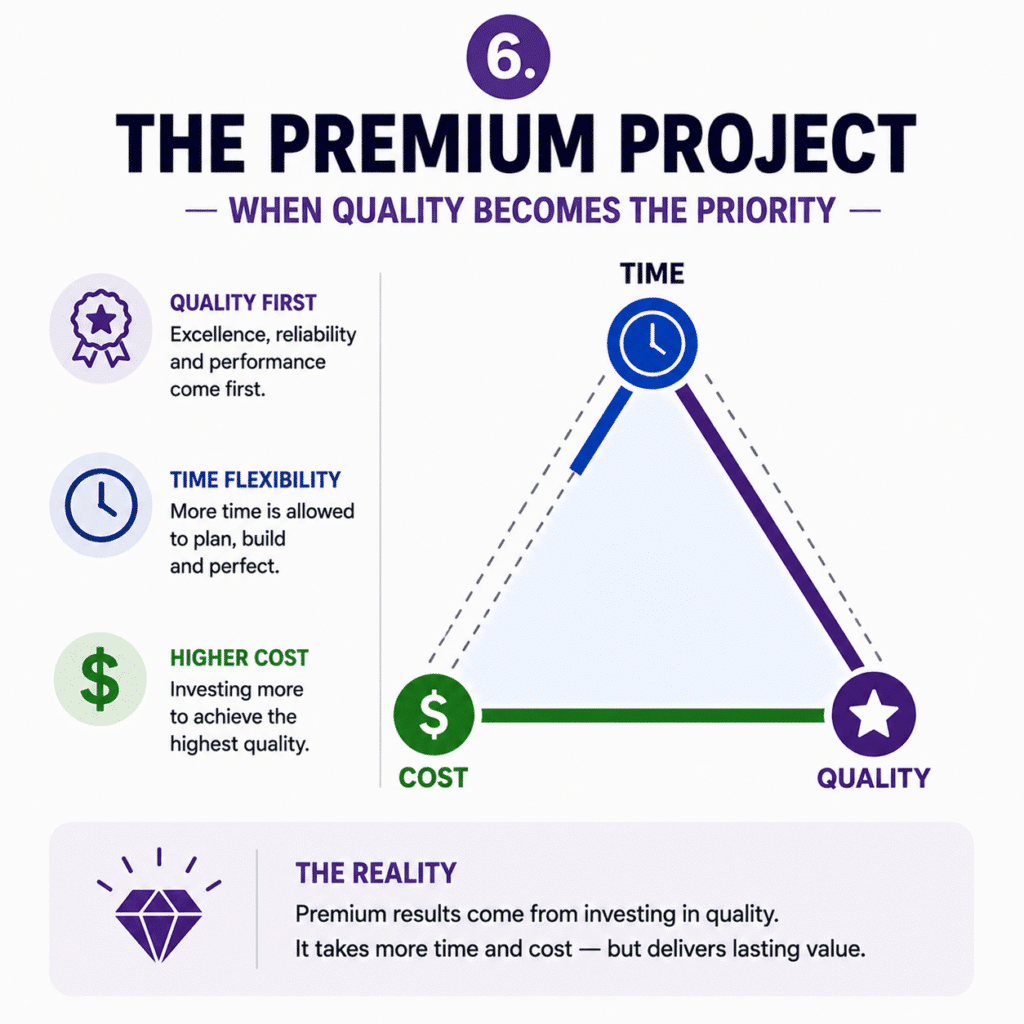
If emergency projects distort the triangle toward time, and lowest-price tenders distort it toward cost, premium projects distort it toward quality. These are the projects where the outcome matters more than speed or budget compression. The client is not simply buying completion. They are buying:
- precision,
- reliability,
- experience,
- appearance,
- longevity,
- performance,
- and confidence in the final result.
This creates a completely different project environment. Because once quality becomes the dominant side of the triangle, both time and cost start behaving differently.
Premium Projects Operate Under Different Rules
One of the biggest misunderstandings in project delivery is assuming all projects should behave the same way commercially. They should not. A premium project is fundamentally different from a commodity project.
- The client is not asking: “What is the cheapest way to achieve this?”
- They are asking: “What is the best way to achieve this properly?”
That changes everything. Because quality-led projects are normally prepared to accept:
- longer programmes,
- higher costs,
- increased planning,
- more coordination,
- better materials,
- stronger supervision,
- and greater attention to detail.
The triangle stretches toward quality deliberately. Not accidentally. And that distinction matters enormously.
Quality Is Not Just About Appearance
When people hear the word “quality,” they often think purely about finish or aesthetics. But in reality, quality is much broader than that. Quality can mean:
- reliability,
- precision,
- durability,
- performance,
- consistency,
- safety,
- maintainability,
- operational resilience,
- or reduced lifecycle cost.
For example:
- a hospital electrical system,
- a data centre cooling installation,
- a luxury hotel,
- or a high-end manufacturing environment
may all define “quality” very differently. But they all share one thing in common: Failure carries a very high consequence. That is why quality-dominant projects place such heavy emphasis on:
- planning,
- testing,
- commissioning,
- coordination,
- documentation,
- sequencing,
- and skilled execution.
Because in these environments, defects are not just inconvenient. They are commercially damaging.
Quality Requires Tolerance In Time And Cost
This is the commercial reality many clients struggle with: Premium outcomes require breathing room. You cannot normally compress:
- programme,
- budget,
- and quality standards
all at the same time without creating instability somewhere else. High-quality delivery requires time for:
- coordination,
- review,
- inspection,
- snagging,
- testing,
- refinement,
- and correction.
It also requires investment in:
- skilled labour,
- experienced supervision,
- premium materials,
- specialist subcontractors,
- and stronger project controls.
This is why experienced contractors often become cautious when clients demand:
- luxury outcomes,
- accelerated delivery,
- and tight budgets simultaneously.
Because those requirements pull the triangle in conflicting directions. The project starts asking for premium standards while behaving commercially like a commodity purchase. That rarely ends well.
Premium Delivery Is Usually Invisible
One of the interesting things about quality-dominant projects is that much of the value is invisible to the client during delivery. Clients often see:
- the finished space,
- the clean installation,
- The polished handover.
What they do not always see is the enormous amount of control required behind the scenes to make that outcome possible. For example:
- detailed coordination meetings,
- drawing reviews,
- sequencing workshops,
- commissioning strategies,
- procurement planning,
- inspection processes,
- testing protocols,
- and quality assurance systems.
That invisible structure is what protects the quality side of the triangle. Without it, premium outcomes become extremely difficult to achieve consistently. This is one of the reasons genuinely high-performing contractors often appear “more expensive” at the tender stage. They are not simply pricing labour and materials. They are pricing:
- management intensity,
- reduced risk,
- coordination,
- expertise,
- and delivery certainty.
That is a completely different proposition.
Quality-Dominant Projects Demand Better Decision-Making
Another important difference is that premium projects are normally less tolerant of rushed decisions. Cheap projects often prioritise speed of decision-making. Premium projects prioritise quality of decision-making. That means:
- more reviews,
- more collaboration,
- more detail,
- and more scrutiny.
This can frustrate people who are used to highly transactional projects. Because quality-led environments often move more deliberately. Not slower because they are inefficient. Slower because mistakes are more expensive later. This is a critical distinction.
A rushed decision on a low-complexity project may create minor inconvenience. A rushed decision on a premium or mission-critical project can create:
- major rework,
- operational failure,
- reputational damage,
- or long-term performance issues.
That is why the best premium contractors often appear calm rather than reactive. They understand that quality is usually lost gradually through small compromises, not dramatic failures.
The Relationship Between Quality And Trust
One of the most interesting commercial effects of quality-dominant projects is the relationship they create between trust and delivery. When quality genuinely matters: trust becomes more valuable than price.
- Clients stop asking: “Who is cheapest?”
- And start asking: “Who can we rely on?”
That changes the entire commercial dynamic. Because once reliability becomes valuable:
- communication matters more,
- planning matters more,
- transparency matters more,
- and reputation matters more.
This is where businesses begin separating themselves from commodity competitors. Not by simply charging more. But by reducing uncertainty. That is one of the hidden commercial advantages of premium positioning. A contractor known for:
- strong coordination,
- predictable delivery,
- high standards,
- and low operational drama
often creates far more long-term value than a contractor competing purely on the lowest price. Because in premium environments, certainty itself becomes part of the product.
The Hidden Danger In Quality-Dominant Projects
Interestingly, quality-focused projects can also become distorted in unhealthy ways. Sometimes projects become so obsessed with perfection that:
- decisions slow down excessively,
- scope expands constantly,
- Overengineering appears,
- budgets spiral,
- and delivery becomes paralysed by detail.
This is another form of triangle distortion. The quality side stretches so aggressively that:
- cost becomes unstable,
- and programme certainty disappears.
In other words: Even premium projects still require balance.
The goal is not perfection at any cost. The goal is to achieve the required level of quality while still maintaining commercial control. That is where experienced project leadership becomes critical.
The Best Premium Projects Understand The Trade-Offs Clearly
The strongest quality-dominant projects are not the ones pretending cost and time do not matter. They are the ones acknowledging openly that:
- quality is the primary driver,
- and therefore time and cost must flex appropriately in support of it.
Everybody understands the shape of the triangle from the start. The client understands:
- Why planning matters,
- Why coordination matters,
- And why proper execution cost more.
The contractor understands:
- the standards required,
- the tolerances expected,
- and the level of accountability involved.
The project manager understands:
- How to protect quality without losing control of the programme or the budget entirely.
That alignment creates stability. Because ultimately, premium projects succeed not because quality dominates the triangle. They succeed because everybody agrees that it does.
7. The Most Important Insight: Everyone Has A Different Triangle
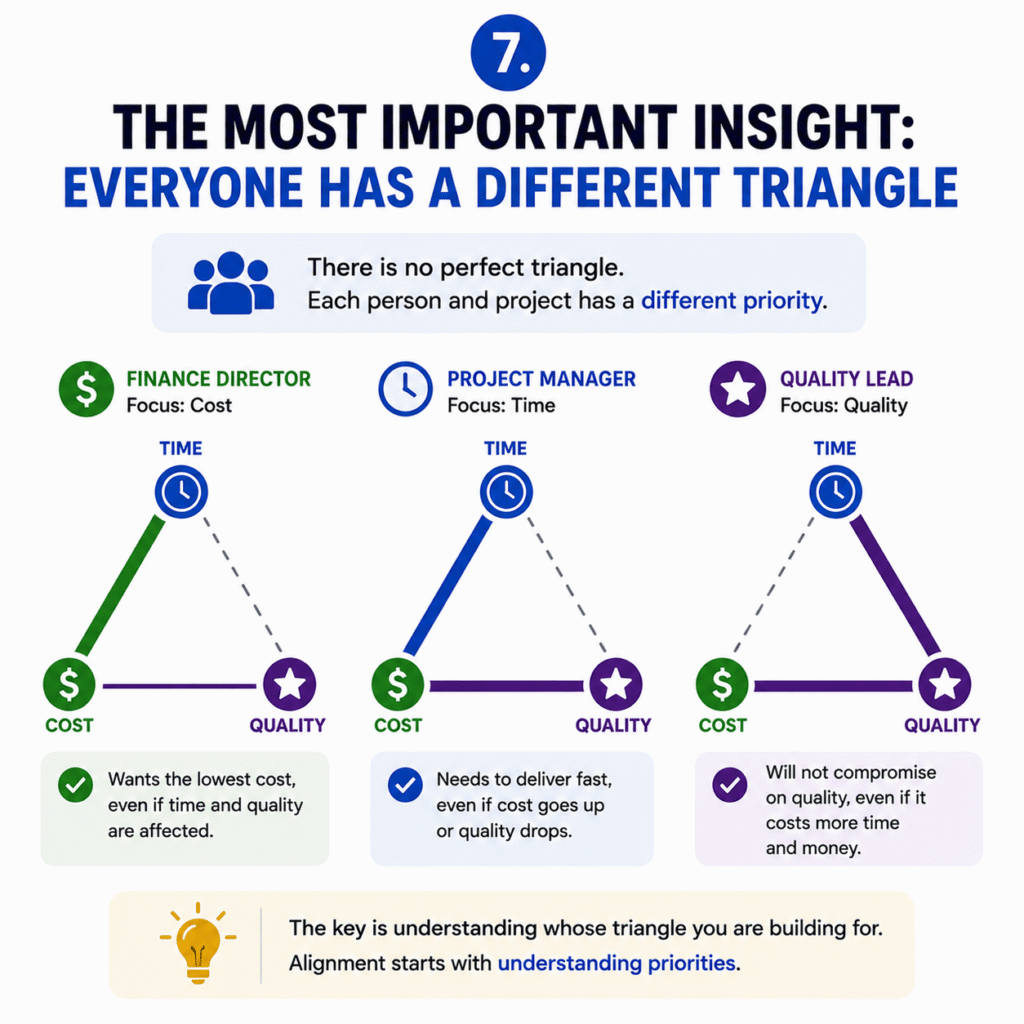
This is probably the most important part of the entire discussion. Because the real problem in project delivery is not simply that triangles become distorted. It is that:
Everybody involved is usually looking at a different triangle altogether.
That is where most commercial tension begins.
- The client has one set of priorities.
- The contractor has another.
- The project manager has another.
- The subcontractors have another.
The consultants, investors, procurement teams and end users all see the project through completely different lenses. And yet everybody often behaves as though they are working toward the same outcome.
They are not.
They are optimising different sides of the triangle based on:
- their incentives,
- their pressures,
- their risks,
- and the consequences they personally face if things go wrong.
That creates hidden misalignment from the very beginning.
The Client’s Triangle
Most clients do not wake up thinking about:
- procurement sequencing,
- labour productivity,
- commissioning schedules,
- or subcontractor coordination.
They are thinking about business outcomes. For example:
- A retailer wants the store open before peak trading season,
- A manufacturer wants production running again,
- A developer wants return on investment,
- A homeowner wants the finished result to feel exceptional,
- A facilities manager wants operational reliability.
Their triangle is shaped by consequence. What happens if the project fails for them personally or commercially? That usually determines which side becomes dominant.
For some clients:
- Time dominates because delay affects revenue.
For others:
- Cost dominates because cash flow is tight.
For others:
- Quality dominates because reputation or operational performance matters most.
The important point is this: Clients often assume their priorities are automatically understood. But many of those priorities are never explicitly communicated properly. Instead, they remain hidden assumptions sitting beneath the project.
The Contractor’s Triangle
The contractor sees the project completely differently. Their triangle is usually shaped around:
- delivery capability,
- operational pressure,
- margin,
- resource allocation,
- risk,
- and commercial exposure.
While the client may focus on the finished outcome, the contractor is thinking:
- Can we deliver this safely?
- Is the programme realistic?
- Do we have enough labour?
- Is the specification coordinated?
- Are the risks priced correctly?
- What happens if delays occur?
- How much contingency exists?
The contractor’s biggest fear is often not the work itself. It is an uncontrolled risk. This is why contractors frequently appear cautious when discussing:
- accelerated programmes,
- incomplete designs,
- tight budgets,
- or unrealistic expectations.
They are not simply resisting the project. They are seeing pressure points inside the triangle that others may not yet recognise. And in many cases, contractors also distort the triangle themselves. Particularly when competition becomes aggressive. A contractor desperate to win work may knowingly:
- underprice risk,
- accept unrealistic programmes,
- or overpromise capability.
At that point, the triangle becomes commercially unstable before the contract is even signed.
The Project Manager’s Triangle
The project manager usually sits in the middle of competing pressures. Their role is not simply to “manage the project.”
Their real role is to stop competing triangles from tearing the project apart. Because project managers see the interaction between all three sides simultaneously:
- programme pressure,
- budget pressure,
- and quality pressure.
They also see how different stakeholders distort those pressures differently. For example:
- The client may push speed,
- The contractor may push cost recovery,
- The design team may push quality,
- while operations teams push continuity.
The project manager becomes the balancing mechanism between competing distortions. This is why experienced project managers spend so much time on:
- communication,
- expectation management,
- change control,
- sequencing,
- stakeholder alignment,
- and forecasting.
They understand something many others do not: Projects rarely fail because of one big issue. They fail because competing priorities slowly destabilise the triangle over time.
The Subcontractor’s Triangle
Subcontractors often have an even narrower version of the triangle. They may care heavily about:
- access,
- sequencing,
- labour availability,
- payment timing,
- scope clarity,
- and productivity.
For example:
- A subcontractor may prioritise programme stability above almost everything else because disruption destroys efficiency.
- Another may focus heavily on commercial clarity because variation disputes create margin risk.
- Another may prioritise quality because a specialist’s reputation is critical to future work.
Yet subcontractors are frequently operating inside project environments shaped by decisions they did not make. That creates another layer of distortion. Particularly when:
- programmes become compressed,
- designs change late,
- or coordination breaks down.
The Investor’s Triangle
Investors and developers often see the triangle through the lens of:
- return on investment,
- financing costs,
- programme certainty,
- and risk exposure.
A delayed project may:
- increase borrowing costs,
- delay revenue generation,
- or affect investor confidence.
As a result, investors often become heavily time-driven even when other stakeholders are prioritising different things. This creates enormous pressure on the delivery environment. Because financial pressure at the investor level often translates into:
- compressed programmes,
- accelerated procurement,
- or reduced tolerance for delays lower down the chain.
Again, the triangle changes shape depending on perspective.
The End User’s Triangle
Interestingly, the end user often has the simplest triangle of all. They usually care about:
- usability,
- reliability,
- appearance,
- comfort,
- and performance.
They do not care how difficult procurement was. They do not care about tender margins. They do not care about subcontractor sequencing problems. They simply experience the outcome. And this creates one of the great ironies of project delivery:
The people most affected by the final quality of a project often have the least influence over the commercial pressures shaping it.
This Is Why Projects Become Dysfunctional
Once you understand that everybody has a different triangle, a lot of project behaviour suddenly makes sense. You start seeing why:
- clients think contractors are difficult,
- contractors think clients are unrealistic,
- project managers feel trapped,
- Subcontractors become frustrated,
- and delivery environments become adversarial.
Because everybody is optimising different sides of the triangle simultaneously.
The client may believe: “Cost is the priority.”
The contractor may believe: “Programme risk is becoming dangerous.”
The design team may believe: “Quality cannot be compromised.”
The investor may believe: “Delay is unacceptable.”
All of those perspectives can be valid at the same time. That is what makes project delivery so difficult.
The Most Dangerous Assumption In Project Delivery
The most dangerous assumption in any project is this: believing everyone shares the same priorities when they do not. That is where:
- disputes,
- frustration,
- claims,
- blame,
- and the delivery failures begin.
Because the project is no longer operating from a shared commercial reality. It is operating from competing versions of reality. And unless those competing priorities are identified early, the distortion grows quietly beneath the surface until pressure exposes it later during delivery.
Alignment Is More Important Than Perfection
This is why the best projects are not necessarily the ones with:
- the biggest budgets,
- the best teams,
- or the most sophisticated systems.
The best projects are usually the ones with:
- the clearest alignment.
Everybody understands:
- What matters most,
- What flexes under pressure,
- Where the risks sit,
- and what trade-offs are acceptable.
The triangle may still be distorted. But at least everyone is looking at the same shape. And that changes everything.
8. Why Most Project Problems Start Before Work Begins
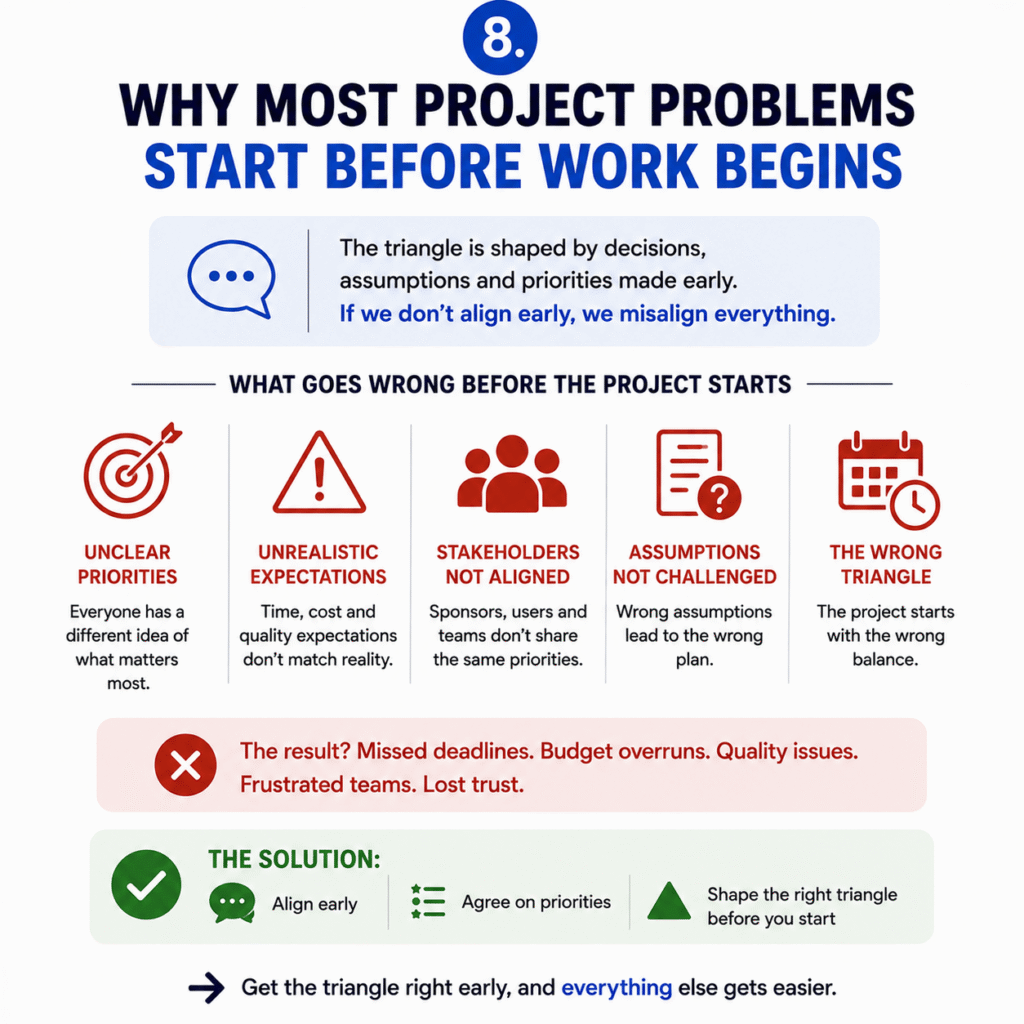
One of the biggest misconceptions in project delivery is the idea that projects fail during construction, implementation or execution. In reality, many projects fail long before the work actually begins. They fail during:
- briefing,
- pricing,
- procurement,
- planning,
- expectation setting,
- and commercial alignment.
The visible problems appear later:
- delays,
- disputes,
- defects,
- overspend,
- claims,
- programme slippage,
- and operational chaos.
But those are usually symptoms. The real failure often happened much earlier, when the project triangle became distorted without anybody openly acknowledging it. That is the critical point. Most project problems are not execution failures first. They are expectation failures first.
The Project Is Often Destabilised Before Mobilisation
By the time many projects reach site, the commercial instability is already built in. For example:
- the programme may already be unrealistic,
- the budget may already be too tight,
- the scope may still be unclear,
- the quality expectations may not align with the cost,
- or the procurement process may already have distorted the triangle heavily toward price.
At that point, the delivery team is no longer managing a stable project. They are managing accumulated pressure. The project starts carrying invisible strain from day one. And because that strain is hidden initially, everybody still behaves as though the project is healthy. Until reality starts exposing the distortion later.
The Optimism Bias Problem
One of the biggest causes of early project instability is optimism bias. Almost everybody involved in a project has an incentive to believe:
- the programme will work,
- the budget will hold,
- the coordination will improve,
- and the risks will somehow resolve themselves later.
Clients want reassurance. Contractors want to win work. Consultants want approvals. Investors want confidence. Project teams want momentum. As a result, uncomfortable conversations often get delayed or softened. People stop talking honestly about the shape of the triangle. Instead, they begin collectively pretending:
- the programme is achievable,
- the budget is sufficient,
- and the quality expectations are realistic simultaneously.
This creates a dangerous environment where the project becomes commercially misaligned before delivery even starts.
The Scope Clarity Problem
Another major issue is scope ambiguity. This is one of the most common sources of project instability I see.
The client believes: “Everything is included.”
The contractor believes: “Certain items are assumed or excluded.”
The consultant believes: “The detail will be resolved later.”
The subcontractor believes: “Access and sequencing will improve during delivery.”
Everybody is operating from slightly different assumptions. Which means everybody is effectively working from a different triangle. This is where projects become dangerous. Because uncertainty creates hidden distortion. The less defined the scope becomes:
- the harder pricing becomes,
- the harder planning becomes,
- and the harder quality control becomes.
Eventually, unresolved assumptions start turning into:
- variations,
- delays,
- claims,
- and commercial conflict.
Not because anybody necessarily acted maliciously. But because alignment never truly existed in the first place.
Unrealistic Programmes Create Structural Pressure
One of the clearest examples of pre-project instability is the unrealistic programme. This happens constantly. A completion date gets fixed early because:
- the client has operational pressure,
- investors need certainty,
- funding milestones exist,
- or public announcements have already been made.
The problem is that the date is often established before:
- the design is complete,
- procurement is understood,
- labour availability is confirmed,
- or delivery sequencing has been properly assessed.
In other words: the time side of the triangle becomes fixed before the rest of the triangle has stabilised. That creates immediate structural pressure across the project. Everything downstream now has less flexibility:
- procurement,
- coordination,
- commissioning,
- approvals,
- labour allocation,
- and contingency.
The project may still look achievable on paper. But operationally, the triangle is already distorted toward time. And the delivery team eventually inherits that pressure whether they created it or not.
Lowest-Price Procurement Often Locks In Future Problems
Cost-dominant procurement creates similar instability. At tender stage, heavily competitive pricing environments often reward:
- optimism,
- underpricing,
- reduced contingency,
- and aggressive assumptions.
The project may appear financially successful at award stage because the budget target has been achieved. But in reality, the triangle may already be severely distorted toward cost. That creates hidden fragility. The contractor may already know:
- margins are too tight,
- the programme is under pressure,
- allowances are insufficient,
- or the scope still contains uncertainty.
At that point, the project is not starting from a position of strength. It is starting from a position of survival. And survival-driven projects behave very differently operationally.
The Quality Assumption Trap
Quality expectations also create problems before delivery starts. Clients often use phrases like:
- “high quality,”
- “premium finish,”
- “best practice,”
- or “state-of-the-art.”
But those phrases are rarely defined with enough precision operationally. What does “high quality” actually mean?
- Higher specification?
- Better tolerances?
- More testing?
- Greater durability?
- Enhanced aesthetics?
- Increased reliability?
Because each of those things has:
- cost implications,
- time implications,
- and coordination implications.
If quality expectations are emotionally defined but operationally vague, the triangle becomes unstable immediately. The contractor prices one interpretation. The client expects another. Reality eventually exposes the gap.
Pressure Gets Transferred Down The Chain
One of the most important things to understand about projects is that pressure rarely disappears. It transfers. A compressed programme at client level becomes:
- delivery pressure for the contractor.
Thin contractor margins become:
- pressure on subcontractors.
Poor design coordination becomes:
- pressure during installation.
Delayed decisions become:
- acceleration pressure later.
The triangle acts almost like a pressure distribution system across the project lifecycle. And if the distortion is not identified early, it eventually concentrates somewhere operationally:
- on site,
- during commissioning,
- during handover,
- or during final commercial settlement.
That is why many projects feel increasingly chaotic as they progress. Not because the problems suddenly appeared. But because the original distortions are finally surfacing.
The Best Projects Have Difficult Conversations Early
This is one of the biggest differences between high-performing projects and dysfunctional ones. The best projects are willing to confront uncomfortable realities early.
They ask:
- What is the true priority?
- What happens if pressure appears?
- What flexes?
- What is fixed?
- What level of quality is genuinely expected?
- Where are the risks?
- What assumptions exist?
- What contingency do we actually have?
Those conversations are not always easy. But they create alignment. And alignment stabilises the triangle before delivery begins. Weak projects avoid these conversations because everyone wants:
- optimism,
- reassurance,
- momentum,
- and approval.
Unfortunately, avoided reality does not disappear. It simply waits until delivery to reveal itself.
Most Project Failure Is Slow-Building Misalignment
When people think about project failure, they often imagine:
- catastrophic mistakes,
- major technical defects,
- or dramatic operational breakdowns.
But many projects fail more quietly than that. They fail through gradual commercial erosion:
- expectations drifting apart,
- assumptions becoming exposed,
- pressure accumulating,
- and relationships deteriorating over time.
The project slowly loses alignment between:
- time,
- cost,
- quality,
- and stakeholder expectation.
Eventually the triangle becomes unstable enough that:
- claims increase,
- trust disappears,
- communication breaks down,
- and delivery becomes reactive instead of controlled.
At that point, the visible problems finally appear. But the real failure happened much earlier. Usually before the work even started.
The Triangle Should Be Discussed Explicitly
This is why I believe every serious project should begin with an honest conversation about the shape of the triangle. Not theoretically. Practically. What actually matters most?
- Time?
- Cost?
- Quality?
What happens if pressure appears? What are we genuinely willing to flex? Because whether those conversations happen or not, the triangle will still take shape. The only difference is whether:
- the distortion is managed intentionally,
or - discovered painfully during delivery.
9. The Role of Project Management: Stabilising The Triangle
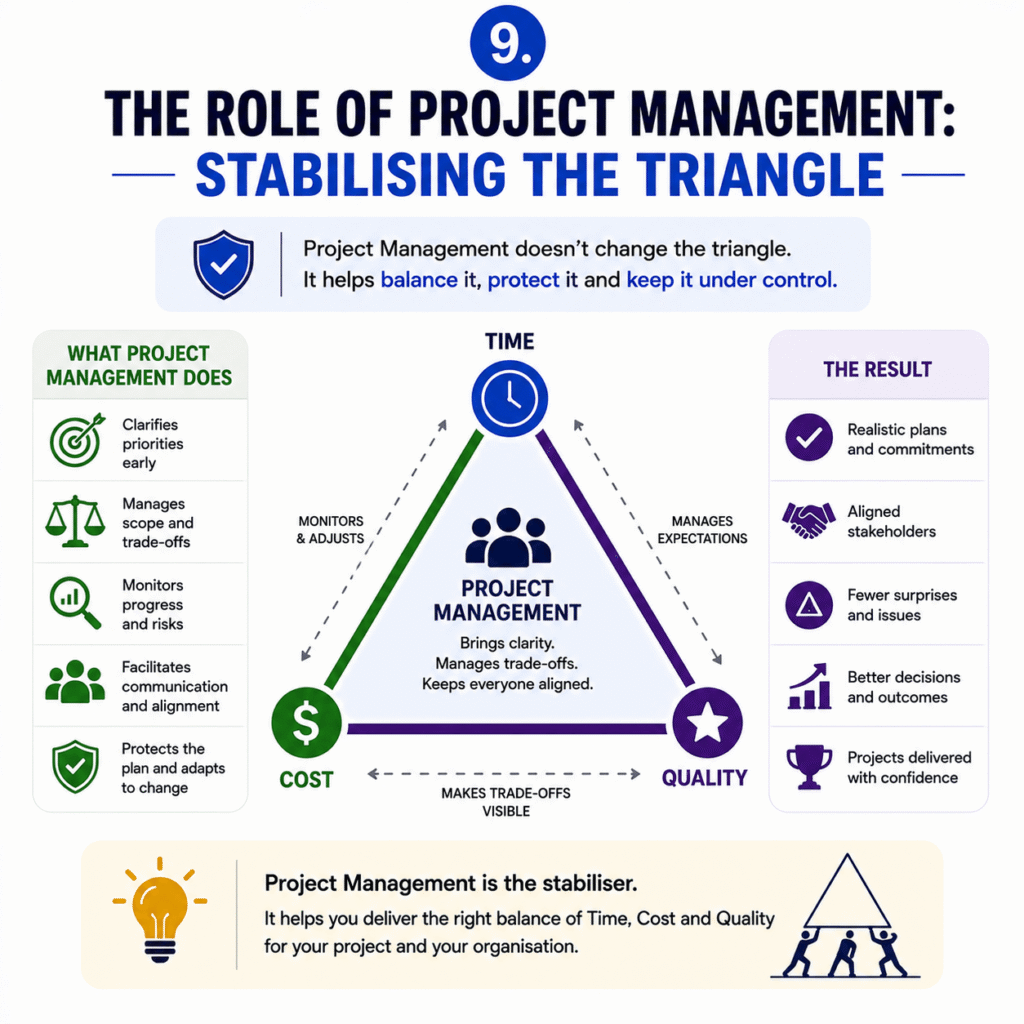
One of the biggest misunderstandings in business is what project management actually is. A lot of people think project management is:
- paperwork,
- progress meetings,
- gantt charts,
- reporting,
- spreadsheets,
- or someone chasing updates on email.
That is administration. Real project management is something much more important.
At its core, Project management is the discipline of stabilising the triangle.
It is the process of balancing:
- time pressure,
- cost pressure,
- quality pressure,
- stakeholder expectations,
- operational reality,
- and commercial risk
without allowing the project to collapse into chaos. That is a very different responsibility. Because once you understand that every stakeholder sees a different triangle, you also realise something else: The project manager is often the only person trying to see all of them simultaneously.
Projects Naturally Drift Toward Instability
One of the most important things I have learned is that projects do not naturally move toward order. They naturally drift toward disorder. Without active management:
- programmes slip,
- scope expands,
- costs increase,
- communication weakens,
- coordination breaks down,
- and pressure accumulates quietly beneath the surface.
This happens because projects are dynamic systems. Every decision affects something else. A delayed approval affects procurement. Procurement affects labour allocation. Labour allocation affects sequencing. Sequencing affects programme certainty. Programme pressure affects quality control.
Everything connects. That is why projects become unstable so easily. The triangle is constantly under pressure from competing forces trying to stretch it in different directions. Project management exists to absorb, balance and control those pressures before they become destructive.
The Triangle Is Always Trying To Distort
This is the reality that many people underestimate. The triangle never stays still. Clients push for speed. Commercial teams push for savings. Design teams push for quality. Operations teams push for continuity. Subcontractors push for access and efficiency. Investors push for certainty. Every one of those pressures stretches the triangle differently. And if nobody actively manages those distortions, the project starts behaving reactively instead of strategically.
This is why experienced project managers spend so much time on things that seem invisible from the outside:
- coordination,
- planning,
- communication,
- sequencing,
- forecasting,
- risk management,
- and expectation alignment.
Because good project management is largely preventative. The best project managers solve problems before they become visible to everyone else.
Good Project Management Is Really Risk Management
In many ways, project management is less about managing tasks and more about managing pressure. Because every project contains hidden tension between:
- what people want,
- what is possible,
- and what resources realistically allow.
The project manager’s job is to stop those tensions from becoming destructive. That means constantly asking:
- Where is the pressure building?
- Which side of the triangle is stretching?
- What assumptions are becoming dangerous?
- Where is contingency reducing?
- What risks are no longer being acknowledged?
- What decisions are being delayed?
- Which stakeholders are becoming misaligned?
This is why the best project managers are usually very commercially aware. They understand that operational problems are often commercial problems in disguise. For example:
- Poor sequencing may actually be caused by unrealistic procurement timelines,
- labour shortages may actually be caused by margin pressure,
- quality failures may actually be caused by programme compression,
- and disputes may actually be caused by unclear expectations established months earlier.
The visible issue is rarely the root issue. Good project managers understand the structural pressure underneath the symptom.
Stabilising The Time Side Of The Triangle
One of the major responsibilities of project management is protecting programme stability. This does not simply mean “keeping the project on schedule.” It means:
- building realistic sequencing,
- identifying dependencies,
- managing float,
- forecasting bottlenecks,
- coordinating trades,
- and reducing disruption before it spreads across the programme.
Because time pressure is contagious. A delay in one area rarely stays isolated. It ripples outward through:
- procurement,
- labour allocation,
- commissioning,
- testing,
- handover,
- and commercial settlement.
This is why poorly managed projects often accelerate aggressively near the end. The pressure that should have been managed gradually throughout delivery suddenly becomes concentrated in the final stages. The triangle distorts violently toward time. And once that happens:
- costs rise rapidly,
- quality control weakens,
- and stress levels explode across the project team.
Strong project management prevents this compression from occurring in the first place.
Stabilising The Cost Side Of The Triangle
Project management also plays a critical role in commercial stability. Again, this is not simply about “staying on budget.” It is about controlling the factors that create budget instability:
- scope changes,
- coordination failures,
- rework,
- procurement problems,
- delays,
- and unclear decision-making.
One of the biggest causes of cost escalation is unmanaged uncertainty. When projects lack:
- clarity,
- sequencing,
- communication,
- or accountability,
Small operational issues quickly become expensive commercial problems. This is why strong project management creates financial value far beyond administration. A well-managed project usually experiences:
- fewer surprises,
- fewer claims,
- fewer delays,
- less rework,
- and better operational efficiency.
That stabilises the cost side of the triangle. Ironically, some businesses still see project management as “overhead.” In reality, poor project management is often far more expensive than good project management ever will be.
Stabilising The Quality Side Of The Triangle
Quality pressure also needs active management. Because quality does not normally disappear suddenly. It erodes gradually through:
- rushed decisions,
- poor coordination,
- unclear scope,
- inadequate supervision,
- programme compression,
- and accumulated shortcuts.
The best project managers understand that quality is not just an inspection issue at the end of the project. It is something built progressively through:
- planning,
- sequencing,
- communication,
- accountability,
- and control.
This is why quality-led projects often require much stronger project management intensity. There are simply more variables to coordinate:
- interfaces,
- tolerances,
- testing,
- commissioning,
- specialist subcontractors,
- and stakeholder expectations.
Without strong control systems, the quality side of the triangle becomes unstable very quickly.
Project Management Is Really Expectation Management
One of the biggest hidden functions of project management is expectation alignment. Because many project problems are not technical failures.
- They are expectation failures.
- The client expects one outcome.
- The contractor assumes another.
- The subcontractors operate under different assumptions again.
The project manager becomes the translator between competing realities. This is why communication is so important. Not because meetings themselves matter. But because unmanaged assumptions become operational risk later. A good project manager constantly brings the project back to alignment:
- What are we prioritising?
- What has changed?
- What are the consequences?
- What trade-offs are now required?
- What pressure is building?
- What decisions are overdue?
Those conversations stabilise the triangle. Without them, distortion grows quietly until conflict eventually exposes it.
Strong Project Management Creates Commercial Confidence
One of the most overlooked commercial benefits of strong project management is confidence. Clients feel safer. Contractors operate with greater control. Teams make better decisions. Stakeholders become less reactive. The entire project environment becomes more stable. This matters because projects are not just technical systems. They are psychological systems as well.
When people lose confidence:
- communication deteriorates,
- blame increases,
- defensive behaviour appears,
- and decision-making quality falls rapidly.
Strong project management prevents panic from replacing structure. That is an enormous commercial advantage.
The Best Project Managers Understand Trade-Offs
The strongest project managers are not the ones pretending the triangle can remain perfectly balanced. They understand that distortion is inevitable. Their skill lies in:
- identifying it early,
- communicating it honestly,
- and controlling its consequences properly.
They understand:
- When acceleration is realistic,
- When budgets are becoming dangerous,
- When quality expectations are misaligned,
- And when stakeholder assumptions are drifting apart.
Most importantly, they force reality into the conversation before reality forces itself into the project. That is the real value of project management.
- Not paperwork.
- Not meetings.
- Not reporting.
But stabilising competing pressures before they become destructive. Because ultimately, Projects do not succeed because pressure disappears. They succeed because pressure is managed intelligently before the triangle collapses under it.
10. The Commercial Reality Nobody Likes Talking About
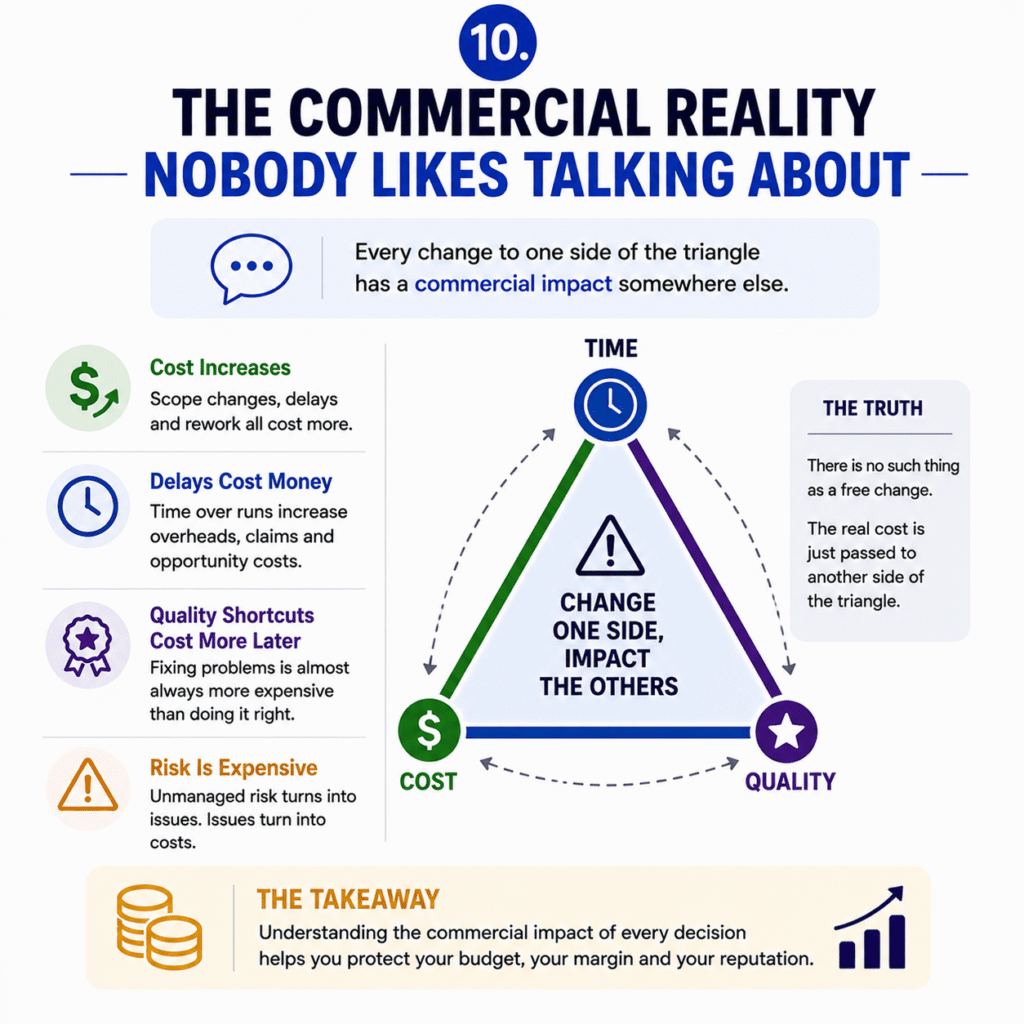
There is a part of project delivery that most people understand privately but rarely discuss openly. It sits underneath:
- procurement,
- pricing,
- delivery,
- and client relationships.
And it is this: Many projects begin with promises that everybody already knows are unrealistic. That is the uncomfortable commercial reality nobody likes talking about. Clients ask for:
- premium quality,
- accelerated delivery,
- minimal disruption,
- full flexibility,
- and low cost simultaneously.
Contractors promise:
- aggressive programmes,
- tight budgets,
- and seamless delivery to win the work.
Consultants reassure stakeholders. Investors demand certainty. And slowly, an alternative version of reality starts forming around the project.
A version where:
- the triangle somehow no longer applies.
But the triangle always applies. Always. The only difference is whether people acknowledge the trade-offs honestly or hide them behind optimism and commercial pressure.
The Sales Environment Distorts The Triangle Immediately
One of the biggest reasons projects become commercially unstable is because the sales environment rewards optimism. Think about what happens during competitive tendering. The contractor who says:
- “The programme is unrealistic,”
- “The budget is too tight,”
- or “The scope still contains major uncertainty”
often appears commercially weaker than the contractor saying:
- “We can make it work.”
Even when the cautious contractor may actually be more competent. This creates a dangerous incentive structure. Because businesses quickly learn that realism can lose work while optimism wins it. As a result, the triangle becomes distorted during procurement itself. Programmes get compressed. Risks get minimised. Contingencies disappear. Complexity gets underestimated. And uncomfortable truths get delayed until after award.
The project may look commercially successful at contract stage. But operational instability has already been built into the structure.
Clients Often Buy Certainty, Not Reality
This is another uncomfortable truth. Many clients are not actually buying the most realistic proposal. They are buying the proposal that makes them feel most comfortable. That does not mean clients are irrational.
Far from it.
Most clients are operating under enormous pressure themselves:
- budget pressure,
- investor pressure,
- operational deadlines,
- internal politics,
- board expectations,
- or revenue targets.
Under those conditions, certainty becomes emotionally valuable. The client wants to hear:
- “Yes, it can be done.”
- “Yes, we can hit the date.”
- “Yes, the budget works.”
- “Yes, there will not be problems.”
The issue is that certainty and realism are not always the same thing. And in some industries, commercial environments actively reward overconfidence.
The Contractor’s Dilemma
This creates one of the hardest commercial dilemmas for contractors.
Tell the truth too early: and you may lose the project.
Tell the client what they want to hear: and you may inherit enormous delivery risk later.
This is why many contractors end up trapped between:
- commercial survival,
and - operational reality.
Particularly in highly competitive markets. A contractor may know:
- the programme is too tight,
- the scope is incomplete,
- the budget is unrealistic,
- or the procurement route is flawed.
But if every competitor is still pricing aggressively and promising delivery certainty, resisting the distortion becomes commercially difficult. This is where many businesses slowly drift into unhealthy delivery environments. Not because they lack technical capability. But because the commercial system rewards unrealistic behaviour.
The “We’ll Deal With It Later” Culture
Another dangerous behaviour in projects is the habit of deferring difficult realities into the future. This happens constantly. People say things like:
- “We’ll resolve that during delivery.”
- “We’ll value engineer it later.”
- “We’ll make the programme work.”
- “We’ll recover the time.”
- “We’ll sort it out on site.”
Sometimes these statements are reasonable. But often they are simply ways of postponing conflict with reality. The issue is that unresolved pressure does not disappear. It accumulates. And the longer it remains unresolved:
- the fewer options remain available,
- the greater the pressure becomes,
- and the more violently the triangle eventually reacts.
This is why projects often feel relatively calm early on before suddenly becoming chaotic later. The instability was always there. It just had not fully surfaced yet.
Value Engineering Is Often Triangle Compression
“Value engineering” is another phrase that often hides triangle distortion. In theory, value engineering should mean:
- improving efficiency,
- reducing waste,
- and finding smarter delivery solutions.
Sometimes it genuinely does. But in many projects, value engineering really means:
“The triangle no longer works financially.”
The project is trying to force:
- quality,
- time,
- and cost
back into alignment after unrealistic expectations were established earlier. So:
- specifications get reduced,
- scope gets simplified,
- allowances get revisited,
- and compromises start appearing progressively throughout delivery.
Again, the triangle eventually reveals itself. The pressure simply moves location within the project.
The Hidden Cost Of Pretending
One of the most damaging things in project delivery is pretending trade-offs do not exist. Because pretending creates false expectation. And false expectation destroys trust faster than almost anything else. For example:
- promising impossible deadlines,
- hiding risk during procurement,
- understating complexity,
- minimising programme pressure,
- or oversimplifying delivery challenges
may help secure the project initially. But eventually reality catches up. And when it does, the commercial damage can be severe:
- disputes,
- strained relationships,
- loss of trust,
- margin erosion,
- staff burnout,
- reputational damage,
- and operational chaos.
Ironically, honesty early in the process is often commercially safer long-term than optimism that collapses later. But honesty requires confidence. Not every business has enough commercial stability to risk saying: “This triangle does not currently work.”
The Industry Often Confuses Aggression With Competence
This is another issue nobody likes discussing openly. In some sectors, aggressive promises are interpreted as confidence and capability. While caution is interpreted as weakness. The contractor saying:
“Yes, we can do it faster and cheaper”
often appears more commercially attractive than the contractor saying:
“There are significant risks attached to that expectation.”
Even when the second contractor may ultimately deliver a far better outcome. This creates a culture where:
- overpromising becomes normal,
- underpricing becomes normal,
- and operational pressure becomes accepted as part of the industry.
Eventually businesses start believing that constant firefighting is simply “how projects work.”
It is not. It is often the result of triangles being distorted beyond sustainable limits during procurement and planning.
The Best Businesses Handle This Differently
The strongest businesses eventually realise something important: Not all revenue is good revenue. A project built on:
- unrealistic assumptions,
- impossible programmes,
- misaligned expectations,
- or commercially dangerous pricing
can become deeply destructive operationally. Experienced firms learn to identify unstable triangles early. They become more disciplined about:
- pricing risk properly,
- defining scope clearly,
- challenging unrealistic expectations,
- and communicating trade-offs honestly.
That does not mean they avoid pressure. Every project contains pressure. But they stop pretending pressure has no consequences. That is a very different commercial mindset.
The Triangle Never Stops Existing
This is ultimately the central truth underneath all project delivery. You can ignore the triangle. You can disguise the triangle. You can delay conversations about the triangle. You can temporarily transfer pressure between:
- time,
- cost,
- and quality.
But you cannot remove the triangle completely. At some point:
- somebody pays,
- something stretches,
- or some part of the project absorbs the pressure.
Always.
The only real choice is whether those trade-offs are:
- identified early,
- managed intelligently,
- and communicated honestly,
or whether they are discovered later through:
- delays,
- conflict,
- claims,
- quality failures,
- and commercial damage.
Because the triangle does not disappear simply because nobody wants to talk about it.
11. How Elite Businesses Handle The Triangle Differently
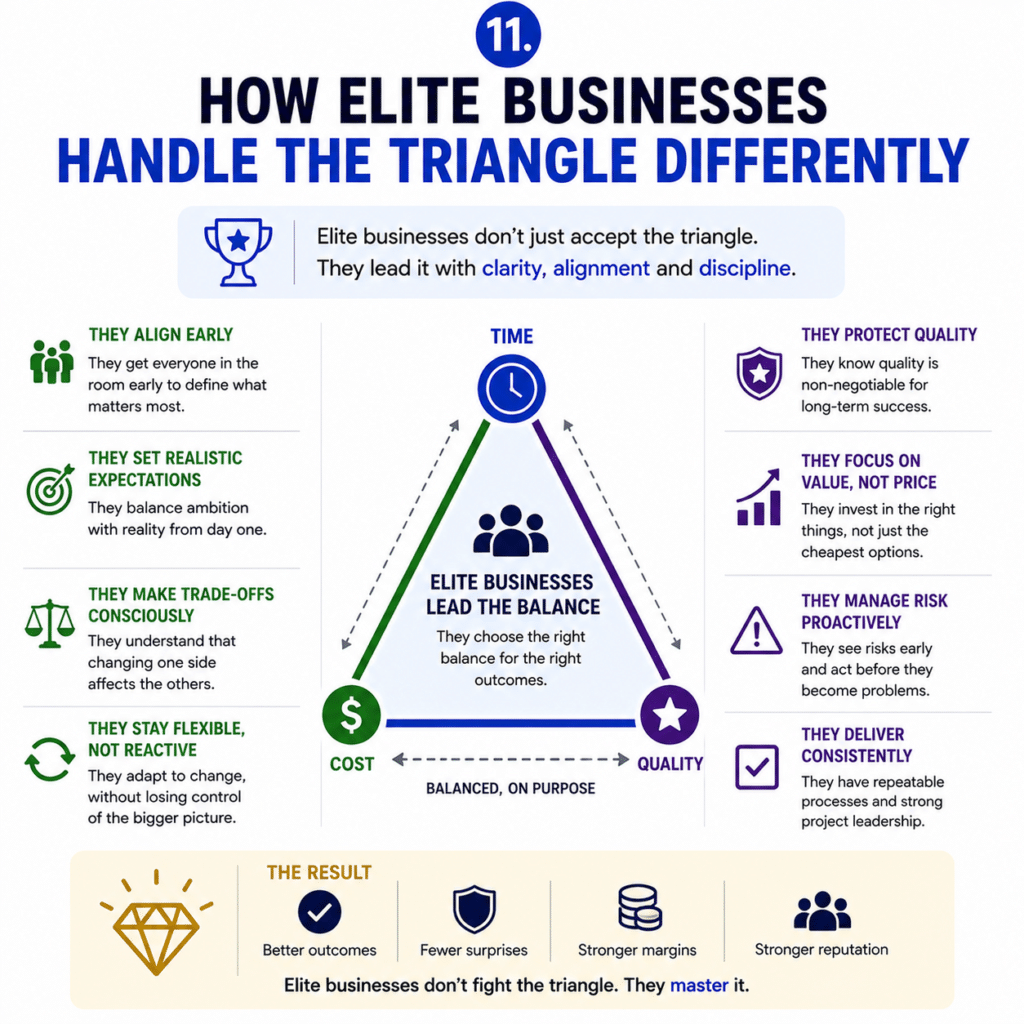
One of the most interesting things about highly successful businesses is that they usually do not operate under fundamentally different pressures from everyone else. They still deal with:
- difficult clients,
- tight programmes,
- commercial pressure,
- labour shortages,
- procurement issues,
- and operational risk.
The triangle still exists for them. Time still matters. Cost still matters. Quality still matters. The difference is not that elite businesses avoid pressure.
The difference is: they manage the triangle consciously instead of reactively.
That is a huge distinction. Because average businesses often allow the triangle to distort them. Elite businesses anticipate distortion early and control it deliberately.
They Define The Shape Early
One of the clearest differences in high-performing businesses is that they identify project priorities early and openly. They ask difficult questions at the beginning:
- What matters most?
- What is fixed?
- What can flex?
- Where is the real pressure?
- What level of quality is genuinely expected?
- What risks are acceptable?
- What happens if something changes?
This sounds simple. But it is surprisingly rare. Many projects begin with vague assumptions because people are uncomfortable discussing trade-offs openly. Elite businesses understand that avoiding those conversations creates instability later. So instead of pretending the triangle is perfectly balanced, they define the shape honestly from the start.
That creates alignment. And alignment creates control.
They Do Not Sell Fantasy
Average businesses often sell reassurance. Elite businesses sell clarity. That is a very important difference. Less experienced firms frequently feel pressured to say:
- “Yes, we can do it faster.”
- “Yes, we can reduce the price.”
- “Yes, there will not be issues.”
- “Yes, we can maintain the same quality.”
Elite businesses are usually more disciplined. Not because they are negative. But because they understand something important: unrealistic expectations create operational instability later. So instead of selling fantasy, they explain:
- the trade-offs,
- the risks,
- the constraints,
- and the consequences openly.
Ironically, this often creates more trust, not less. Because experienced clients quickly recognise the difference between:
- confidence,
and - empty reassurance.
They Protect Margin Differently
One of the strongest commercial behaviours elite businesses demonstrate is disciplined margin protection. This does not simply mean charging more. It means understanding that:
- margin creates stability.
Healthy margins allow businesses to:
- allocate stronger management,
- absorb disruption,
- maintain quality,
- invest in planning,
- retain better staff,
- and solve problems without immediate panic.
Thin margins remove tolerance from the system. That is why many low-cost delivery environments become reactive so quickly. There is no resilience built into the triangle. Elite firms understand that pricing is not just about profit extraction. It is about delivery capability. This is one of the reasons premium businesses often appear calmer operationally. They have created enough commercial stability to manage pressure properly instead of constantly reacting to it.
They Invest More In Planning
Average businesses often see planning as overhead. Elite businesses see planning as risk reduction. This is a massive mindset difference. High-performing firms understand:
- every hour spent clarifying scope,
- coordinating sequencing,
- identifying risk,
- or aligning expectations
usually saves multiple hours later during delivery. This is why elite businesses invest heavily in:
- pre-construction,
- design coordination,
- project controls,
- procurement planning,
- commissioning strategy,
- and communication systems.
To outsiders, this can sometimes look excessive. But the best businesses understand: projects rarely become chaotic suddenly. Chaos normally develops gradually from unmanaged uncertainty. Strong planning stabilises the triangle before pressure intensifies.
They Understand The Economics Of Certainty
One of the most important things elite businesses understand is that certainty has value. Many average businesses compete almost entirely on visible cost. Elite businesses compete on:
- reduced risk,
- delivery reliability,
- operational stability,
- communication,
- and predictability.
This changes the commercial conversation completely. Because sophisticated clients often realise something very important: The cheapest project is not always the lowest-risk project.
A business known for:
- hitting programmes,
- managing change properly,
- maintaining quality,
- communicating clearly,
- and avoiding operational drama
often creates enormous commercial value for the client beyond the contract price itself. For example:
- reduced downtime,
- smoother handovers,
- lower lifecycle costs,
- fewer disputes,
- and less management stress.
That certainty becomes part of the premium. And elite firms understand how to position themselves around it.
They Control Expectations Relentlessly
One of the hidden strengths of elite businesses is expectation management. They understand that:
- trust is usually lost through surprise.
So they communicate constantly about:
- programme pressure,
- cost changes,
- risk exposure,
- sequencing issues,
- procurement concerns,
- and quality implications.
Not because they enjoy difficult conversations. But because they know unmanaged expectation eventually becomes conflict. This is one of the reasons high-performing firms often appear highly transparent. They would rather deal with:
- difficult conversations early
than
- destructive surprises later.
Average businesses often delay uncomfortable conversations because they fear upsetting the client. Elite businesses understand that delayed reality is usually far more damaging.
They Refuse Certain Projects
This is another major difference. Elite businesses become increasingly selective over time. Not because they do not want growth. But because they understand: unstable triangles destroy good businesses.
Experienced firms learn to recognise projects where:
- expectations are unrealistic,
- budgets are dangerously tight,
- programmes are impossible,
- scope is unclear,
- or stakeholders are fundamentally misaligned.
And sometimes they walk away. This is difficult for many businesses because turning down revenue feels uncomfortable. But elite businesses understand that:
- bad projects consume disproportionate energy,
- damage operational performance,
- create staff burnout,
- erode margins,
- and weaken delivery capability elsewhere.
In other words:
- not every project strengthens the business simply because it generates turnover.
Some projects quietly damage the organisation from the inside.
They Build Systems Around Stability
One thing that separates elite businesses from reactive businesses is that they build operational systems designed to stabilise pressure. They invest in:
- project controls,
- reporting systems,
- communication frameworks,
- forecasting,
- commissioning procedures,
- QA systems,
- resource planning,
- and delivery processes.
Not because they love administration. But because systems reduce uncontrolled distortion inside the triangle. This becomes especially important as businesses grow. Smaller businesses often rely heavily on heroic individuals. Elite businesses build repeatable structures that stabilise delivery consistently across multiple projects. That creates scalability.
They Understand That Reputation Is Triangle Management
Most people think reputation is built through:
- marketing,
- branding,
- or presentation.
In reality, long-term reputation is often built through consistent triangle management. Clients remember businesses that:
- delivered predictably,
- communicated honestly,
- managed pressure calmly,
- and avoided operational chaos.
That reliability becomes commercially powerful. Because once a business becomes known for:
- stability,
- control,
- and delivery certainty,
it starts escaping commodity pricing environments. The conversation shifts away from:
“Who is cheapest?”
toward:
“Who can we trust to deliver this properly?”
That changes everything commercially.
The Best Businesses Accept Reality Earlier
Ultimately, this may be the biggest difference of all. Elite businesses accept commercial reality earlier than everyone else. They understand:
- pressure exists,
- trade-offs exist,
- distortion exists,
- and every project contains competing priorities.
Instead of denying those realities, they build systems, pricing, planning and communication around them. That is why they often appear calmer under pressure. Not because their projects contain less complexity. But because they have already acknowledged the shape of the triangle long before the pressure fully arrives. And once you understand the triangle honestly, you stop trying to eliminate tension completely. You start managing it intelligently instead.
Final Word.
The project triangle is not just a project management theory. It is a reflection of commercial reality. Every project is constantly balancing:
- time,
- cost,
- and quality,
whether people acknowledge it or not. The problem is not that the triangle changes shape. The problem is when stakeholders pretend it has not. That is when projects become unstable. Deadlines become unrealistic. Budgets become dangerous. Quality expectations drift away from operational reality. And slowly, pressure starts building beneath the surface until delivery problems eventually expose it.
The best businesses understand something many others do not: Successful projects are not created by eliminating trade-offs. They are created by identifying them early, communicating them honestly and managing them intelligently.
Because ultimately, the triangle never disappears. It simply reveals what the project truly prioritises.
Your Next Step. Book a 1-2-1 Project Delivery Review
Most project problems do not begin during delivery. They begin much earlier through:
- unrealistic expectations,
- pricing pressure,
- poor planning,
- unclear priorities,
- communication gaps,
- and hidden operational strain.
Over time, these pressures distort the project triangle until projects become reactive, stressful and commercially unstable. Our 1-2-1 Project Delivery Review is designed to help you step back and look at how your projects are really operating. Together, we will explore:
- where pressure is building,
- What is creating instability,
- where expectations may be misaligned,
- and how your current delivery approach is affecting profitability, quality and control.
This is not about theory or generic advice. It is a practical commercial conversation focused on:
- project delivery,
- operational pressure,
- pricing,
- planning,
- risk,
- communication,
- and long-term business stability.
Whether you are dealing with:
- constant firefighting,
- margin pressure,
- programme delays,
- difficult projects,
- client frustration,
- or growing operational complexity,
This session is designed to help you identify the underlying causes and create a clearer path forward. Book Your 1-2-1 Project Delivery Review
A focused conversation to help you better understand:
- how your projects are really performing,
- where the pressure points exist,
- and what needs to change to create more stable, profitable and predictable delivery.


