


Selling Has Changed. The Principles Haven’t.
Listen to the Audio version of this blog here.

Watch a brief summary video of this blog.
If you’ve been in business for any length of time, you’ll have noticed something important has changed. Prospects don’t pick up the phone like they used to. They don’t arrive “cold”. And by the time they do speak to you, they already have opinions about your price, your credibility, and whether you’re worth a conversation at all.
In many cases, the sale is either half won or half lost before you ever get involved.
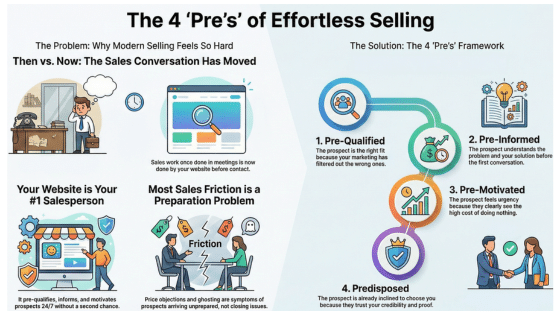
Years ago, most of the selling happened in the meeting. You qualified the prospect, explained what you did, created urgency, handled objections, and closed. Today, that entire process has largely moved upstream. Your website, your content, your emails, and your messaging are now doing the work that salespeople used to do face-to-face.
And this is where most businesses struggle.
I often hear business owners say things like, “We’re getting plenty of enquiries, but they’re not the right ones,” or “Everyone loves what we do until we mention the price,” or “People go quiet after the first call.” These aren’t closing problems. They’re preparation problems.
Selling becomes hard when prospects aren’t ready.
Over the years, I’ve found that easy sales almost always share the same characteristics. The prospect already understands the problem. They already see the value of solving it. They’re motivated to act. And crucially, they’re already inclined to choose you.
That’s what I call the 4 Pre’s:
- Pre-Qualified
- Pre-Informed
- Pre-Motivated
- Predisposed
When these are in place, selling feels natural. Conversations are shorter. Price becomes a secondary issue. Objections are minimal. In many cases, the prospect is simply asking you to confirm what they already believe.
When they’re missing, selling feels like hard work. You find yourself explaining from scratch, justifying your price, chasing decisions, and competing with “I’ll think about it” or “we’ve decided to do nothing for now”.
Here’s the critical shift.
In today’s market, the 4 Pre’s no longer happen primarily in the sales conversation. They happen before the conversation, or they don’t happen at all. Your website is now your first salesperson. And unlike a human salesperson, it never gets a second chance to explain itself.
If your website fails to pre-qualify, you attract the wrong enquiries.
- If it fails to pre-inform, prospects arrive confused.
- If it fails to pre-motivate, they procrastinate.
- If it fails to predispose, they default to price or choose someone else.
The good news is this: when you understand the 4 Pre’s and deliberately build them into your website and marketing, selling becomes dramatically easier. Not because you’re pushing harder, but because prospects are arriving better prepared.
In the sections that follow, I’ll break down each of the 4 Pre’s and show you how they apply to modern marketing, particularly your website. And by the end, you’ll be able to assess for yourself whether your site is helping your sales process… or quietly sabotaging it.


The 4 Pre’s Explained (A Quick Refresher)
Here’s the original blog post from 7 years ago.
Before we apply the 4 Pre’s to modern marketing and websites, it’s worth briefly clarifying what each one actually means, because although the language is simple, the impact is anything but.
The 4 Pre’s describe the state of mind a prospect needs to be in before a sale becomes easy. They are not sales techniques or closing tricks. They are conditions. When these conditions exist, selling feels straightforward. When they don’t, selling feels forced. Let’s start with a simple truth:
“People don’t like being sold to, but they love buying.”
The role of marketing, and increasingly, the role of your website, is to move prospects into a buying mindset before any direct sales interaction takes place. Here’s what the 4 Pre’s really mean in practice.
Pre-Qualified.
A pre-qualified prospect is someone who is genuinely a fit for what you offer. They have the right type of problem, the right level of urgency, and the ability (and willingness) to pay. Crucially, they are not simply “interested”, they are appropriate.
Pre-qualification isn’t about excluding people unfairly; it’s about focusing your time, energy, and attention where it has the highest return. Every unqualified enquiry you entertain adds friction to your sales process and increases the likelihood of price objections later on.
In modern marketing, pre-qualification should happen automatically. Your messaging, positioning, pricing signals, and structure should make it obvious who you help, and just as obvious who you don’t.
Pre-Informed.
A pre-informed prospect already understands the problem you solve and has a basic grasp of how you solve it. They’re not arriving at the first conversation asking, “So what do you actually do?” Instead, they’re asking, “Is this the right approach for me?” or “How does this work in my situation?” This is a subtle but critical difference.
When prospects are pre-informed, you’re no longer educating from scratch. You’re clarifying, tailoring, and confirming. That immediately elevates the quality of the conversation and reduces resistance.
Today, pre-informing happens long before contact, through your website, your content, your emails, and the clarity of your message. If those are vague, generic, or feature-heavy, prospects either arrive confused or don’t arrive at all.
Pre-Motivated.
A pre-motivated prospect wants the problem solved, not at some vague point in the future, but soon. They understand the consequences of inaction. They recognise the cost of delay, whether that’s financial, emotional, or strategic. They may not be in panic mode, but they are uncomfortable enough to act.
Without motivation, even the best product and the best pitch fall flat. Interest without urgency leads to long decision cycles, ghosting, and endless “just checking in” emails. Pre-motivation is about desire. It’s about helping prospects clearly see that their current situation is not where they want to stay and that staying there has a price.
Predisposed.
A predisposed prospect is already inclined to choose you. They trust your competence. They believe you understand their situation. They see you as a logical and safe option, if not the logical option.
This doesn’t mean they won’t compare. It means that comparison is happening through a favourable lens. When prospects are predisposed, they’re not asking, “Why are you more expensive?” They’re asking, “Help me understand the difference.”
Predisposition is built through consistency, credibility, clarity, and proof. It’s rarely achieved through a single claim or a clever slogan. Instead, it’s the accumulation of signals that say, “These people know what they’re doing.”
When all four of these conditions are in place, selling feels very different. The conversation shifts from persuasion to confirmation. From convincing to guiding. From pushing to helping. And that’s exactly how modern buyers prefer it.
In the next section, we’ll start with the first, and arguably most neglected, of the 4 Pre’s: Pre-Qualification, and why chasing “more leads” often makes selling harder, not easier.
Pre-Qualified: Why “More Leads” Is Often the Wrong Goal.
One of the most common mistakes I see in modern marketing is the obsession with more.
- More traffic.
- More enquiries.
- More leads.
On the surface, that sounds sensible. But in practice, chasing volume without qualification usually makes selling harder, not easier.
I regularly speak to business owners who tell me they’re “busy with enquiries”, yet they’re frustrated, worn down, and stuck in endless conversations that go nowhere. When we dig into it, the issue isn’t effort or even demand. It’s that the wrong people are raising their hand.
Pre-qualification is about designing your marketing so that the right people lean in and the wrong people quietly opt out. If everyone thinks you’re a good fit, you’re probably positioned too broadly. In the past, pre-qualification happened through questioning in a sales meeting. Today, it should happen before the meeting ever takes place. Your website should act as a filter, not a magnet for anyone with a pulse.
Why unqualified leads kill momentum.
Every unqualified enquiry creates friction:
- You spend time explaining basics that shouldn’t need explaining
- Price objections appear earlier and more aggressively
- Decision-making drags on
- Confidence drops, yours and theirs
Worse still, too many unqualified leads can distort your pricing and positioning. When you repeatedly hear, “That’s more than we expected,” it’s tempting to assume the price is wrong. Often, it isn’t. You’re just attracting people who were never a fit in the first place.
How modern pre-qualification really works
Pre-qualification today is subtle, but deliberate. It’s not about saying “no” loudly. It’s about saying “yes” clearly, to the right people.
Effective pre-qualification shows up in things like:
- Clear language about who you work with and who you don’t
- Contextual pricing signals (ranges, minimums, or investment framing)
- Specific examples and use cases
- Forms that ask the right questions
- Booking pages that set expectations
For example, a professional services firm that positions itself as working with businesses over a certain size will naturally deter micro-businesses without ever having to reject them directly. Likewise, a clear “starting from” price or a statement about typical client investment instantly changes the quality of enquiries.
Price as a qualification signal.
Price is one of the strongest pre-qualification tools available, yet it’s often hidden or softened out of fear. When price is absent, prospects fill in the gap themselves. They assume “cheap” or “expensive” based on design, language, and tone. If that assumption is wrong, the conversation becomes awkward later on.
Used correctly, price doesn’t repel good prospects; it reassures them. It says, “This is serious. This is established. This has value.” When price is avoided entirely, you invite misalignment.
Your website should answer one silent question.
Every visitor to your website is asking, usually subconsciously:
“Is this for someone like me?”
If the answer isn’t clear within seconds, one of two things happens:
- The right people hesitate
- The wrong people enquire
Both outcomes make selling harder.
Pre-qualification is not about arrogance or exclusion. It’s about respect for your prospect’s time and for your own. When done properly, it improves conversion rates, shortens sales cycles, and dramatically reduces price resistance.
In the next section, we’ll look at the second Pre (Pre-Informed) and why having to “explain what you do” is one of the clearest warning signs that your marketing isn’t doing its job.
Pre-Informed: If You’re Explaining from Scratch, You’re Already Losing.
One of the clearest signs that marketing isn’t doing its job is when a sales conversation starts with you explaining the basics.
- “So, what we do is…”
- “Let me explain how this works…”
- “Most people don’t realise…”
None of these is inherently bad, but they are expensive. Every minute spent educating from scratch is a minute not spent helping a prospect make a decision. In today’s market, buyers don’t want to be educated by a salesperson; they want to be confirmed by one.
By the time someone speaks to you, they should already understand the problem you solve, recognise that it applies to them, and have a working idea of how you approach it. If they don’t, the friction in the sales process increases dramatically.
Buyers now self-educate, whether you help them or not.
Modern buyers research first and contact later. They read websites, scan pages, watch videos, compare options, and form opinions long before they make an enquiry. The critical question is not whether they will be informed, it’s who will do the informing.
If your website clearly explains the problem, the consequences, and the solution, prospects arrive aligned. If it doesn’t, they’ll fill in the gaps themselves, often using assumptions, competitors’ messaging, or incomplete information.
When that happens, you don’t just have an information gap; you have a misalignment problem.
Pre-informing is not about features.
One of the biggest mistakes I see is businesses leading with features instead of understanding. Prospects don’t care about the mechanics of your service until they’re confident you understand their situation. Listing what you do, how long it takes, or how it’s delivered means very little if they haven’t yet recognised the problem you solve.
Pre-informing starts by helping prospects articulate their own issue:
- What’s not working?
- What’s being avoided?
- What’s costing them time, money, or peace of mind?
- What happens if nothing changes?
When prospects think, “That’s exactly our situation,” they’re pre-informed. When they think, “That sounds interesting,” they’re not.
Clarity beats cleverness every time.
A common trap in modern marketing is trying to sound impressive instead of being clear. Jargon, buzzwords, and vague promises might look good on a page, but they slow decision-making. Confused prospects don’t ask questions; they leave.
Your website should be able to answer three basic questions quickly and unambiguously:
- What problem do you solve?
- Who do you solve it for?
- What changes as a result?
If any of those are unclear, pre-informing hasn’t happened.
Content is a filter, not just a persuader.
Good content doesn’t just attract, it filters.
When your messaging is specific and grounded in real situations, the right people lean in, and the wrong people quietly disengage. That’s exactly what you want. Pre-informing reduces friction later. It shortens sales calls, improves conversion rates, and prevents the all-too-common scenario where a prospect reaches the end of a conversation only to say, “This isn’t quite what we were expecting.”
In the next section, we’ll move to Pre-Motivated and why understanding the problem is never enough on its own. Without urgency, even the most informed prospects will do nothing.
Pre-Motivated: Why Understanding Isn’t Enough.
One of the most dangerous assumptions in marketing is believing that understanding leads to action. It doesn’t.
I’ve seen countless prospects who fully understand the problem, agree that it needs fixing, and even acknowledge that the solution makes sense, yet still do nothing. Not because they disagree, but because nothing is pushing them to move now.
This is where pre-motivation comes in.
Pre-motivation is about urgency. Not manufactured pressure, not false scarcity, but a clear understanding that staying where they are has a cost. Without motivation, even the best messaging stalls.
“We’ll come back to this” is not a neutral response.
When a prospect says, “We’ll come back to this,” it often sounds reasonable. In reality, it usually means one of two things:
- The problem doesn’t feel painful enough yet
- The consequences of inaction aren’t clear
Doing nothing feels safe. It feels cheap. And it feels reversible, even when it isn’t. Your job is to make the hidden cost of inaction visible.
The real competitor is doing nothing.
Most businesses assume they’re competing against other providers. Often, they’re not. Their real competition is the status quo. Pre-motivation means showing prospects that “no decision” is still a decision, and usually the most expensive one over time. This could be:
- Lost revenue
- Increased risk
- Missed opportunities
- Ongoing stress
- Strategic drift
If your marketing doesn’t address this, prospects default to delay.
Benefits sell, but consequences move people.
Highlighting benefits is important, but benefits alone rarely create urgency. People act when the future they’re heading towards feels unacceptable. That doesn’t mean fear-mongering. It means being honest about trade-offs:
- What happens if this isn’t fixed?
- What gets worse over time?
- What opportunities close quietly?
When prospects can articulate the cost of staying the same, motivation increases naturally.
Urgency must be built in, not bolted on.
Many websites try to add urgency at the end, countdown timers, limited offers, and “book now” buttons. Without pre-motivation, these feel forced.
Real urgency is created earlier, through:
- Clear problem framing
- Real-world consequences
- Scenarios prospects recognise
- Language that reflects their internal conversation
When done properly, the call to action feels like relief, not pressure.
Motivation shortens sales cycles.
Pre-motivated prospects don’t need chasing. They ask better questions. They move faster. They don’t disappear after the first conversation. They might still compare options, but they do so with intent, not curiosity.
In the next section, we’ll look at the final Pre (Predisposed) and why even motivated prospects can still choose someone else if trust, clarity, and confidence aren’t already in place.
Predisposed: Why Being “Good” Is No Longer Enough.
Even when a prospect is qualified, informed, and motivated, the sale can still be lost.
- Not because they don’t want the outcome.
- Not because they don’t see the value.
- But because they don’t feel confident enough choosing you.
This is where predisposition matters.
A predisposed prospect is already leaning in your direction before any formal decision is made. They may still compare options, but they do so through a favourable lens. You’re not being judged from a standing start; you’re being judged as a credible default.
Most buying decisions are about risk, not price.
Contrary to popular belief, prospects rarely choose the cheapest option because it’s cheapest. They choose it because it feels safer.
Safety comes from:
- Trust
- Clarity
- Consistency
- Proof
When these are missing, price becomes the easiest comparison point. When they’re present, price becomes contextual. This is why price objections often appear late in the process. They’re not really about money; they’re about uncertainty.
Claims don’t create predisposition; signals do.
Many websites try to persuade with statements:
- “We’re experts”
- “We’re trusted”
- “We deliver exceptional results”
The problem is that everyone says the same thing.
Predisposition is built through signals, not slogans. These include:
- Clear processes
- Real examples
- Social proof that mirrors the prospect’s situation
- Consistent tone and messaging
- Professional presentation
Each signal on its own is small. Together, they create confidence.
Your delivery model matters more than you think.
One of the most overlooked elements of predisposition is how you deliver what you sell.
Prospects want to know:
- What happens next?
- What does the journey look like?
- Where are the risks?
- How are problems handled?
When your delivery model is unclear, prospects fill in the gaps, usually pessimistically. When it’s clear, structured, and predictable, trust increases. This is why businesses with well-defined processes often outperform equally skilled competitors. The work may be similar, but the experience feels safer.
Predisposition reduces price sensitivity.
When prospects feel confident in their choice, they stop shopping emotionally and start justifying logically.
This is the point where:
- Comparisons become nuanced
- Discounts become unnecessary
- Decisions speed up
Predisposition doesn’t eliminate competition, but it reframes it. You’re no longer one of many options; you’re a sensible one.
Consistency is the silent persuader.
Predisposition is rarely built in a single moment. It’s the result of consistency across everything a prospect sees:
- Website pages
- Emails
- Proposals
- Language
- Visual presentation
When everything aligns, prospects relax. When it doesn’t, doubt creeps in, even if they can’t articulate why.
In the next section, we’ll step back and look at the bigger picture. Why your website has quietly become your first and most important salesperson, and how small gaps across the 4 Pre’s can make selling feel far harder than it needs to be.
Your Website Is Now Your First Salesperson.
Whether you like it or not, your website is already selling for you. The only question is whether it’s helping or quietly making things harder.
Long before a prospect fills in a form, books a call, or replies to an email, they’ve already made a series of judgments. They’ve decided whether you’re relevant, whether you understand their problem, whether it feels urgent, and whether you’re a credible option.
All of that happens without you being present.
In effect, your website has become your first salesperson, and unlike a human salesperson, it doesn’t get to clarify, rephrase, or recover if it gets something wrong.
Every page either builds or erodes the 4 Pre’s.
This is where most businesses underestimate the damage. They assume that if the website “looks fine” and generates enquiries, it’s doing its job. In reality, every page, every headline, every section is either:
- Pre-qualifying or attracting the wrong people
- Pre-informing or creating confusion
- Pre-motivating or encouraging delay
- Predisposing or defaulting the decision to price
There is no neutral ground.
Small gaps at each stage compound. A little confusion here, a little doubt there, a missing signal elsewhere, and suddenly the sales team is dealing with price resistance, long decision cycles, and prospects who go quiet for no obvious reason.
Most sales friction is designed in
When selling feels hard, it’s tempting to look at tactics:
- Better closing techniques
- More follow-ups
- Stronger calls to action
- More persuasive proposals
Occasionally, these help. More often, they’re treating the symptom, not the cause. In my experience, most sales friction is designed into the process long before the sale begins. It’s built into vague positioning, unclear messaging, weak signals, and websites that try to appeal to everyone.
When those issues are fixed, selling doesn’t require more effort, it requires less.
A well-designed website reduces pressure, not increases it.
The best websites don’t shout. They don’t push. They don’t rely on tricks. Instead, they quietly do the work:
- They make it clear who the business is for
- They articulate the problem better than the prospect can
- They show why staying the same is costly
- They create confidence in the outcome and the provider
When this happens, sales conversations feel different. Prospects arrive prepared. They ask better questions. They move faster. And they’re far less focused on price.
If selling feels hard, look upstream.
When business owners tell me that selling feels difficult, I rarely start by looking at their sales script. I look at what happens before the conversation. If the website fails at the 4 Pre’s, the salesperson is forced to compensate, explaining more, persuading harder, and justifying price. If the website does its job properly, the salesperson’s role becomes confirmation, guidance, and reassurance.
In the final section, I’ll show you how to assess your own website against the 4 Pre’s and quickly identify where selling is being made harder than it needs to be.
The 4 Pre’s Website Checklist: A Simple Reality Check
At this point, most business owners can sense whether something is off. They recognise the patterns, plenty of interest, but the wrong enquiries, long sales cycles, price resistance, or prospects who seem engaged and then disappear. The challenge is identifying where the problem actually sits.
This is where the 4 Pre’s become genuinely useful.
Rather than guessing or endlessly tweaking tactics, you can assess your website against each of the four conditions that make selling easier. Not from a design perspective, but from a sales-readiness perspective.
The goal of this checklist isn’t to judge your website; it’s to diagnose it.
Why a checklist works better than opinions.
Most business owners have heard conflicting advice:
- “You need more traffic”
- “You need better copy”
- “You need stronger calls to action”
- “You need to show prices”
- “You shouldn’t show prices”
Individually, some of these may be true. Collectively, they’re confusing. The checklist cuts through opinion and focuses on outcomes. It asks simple, practical questions tied directly to the 4 Pre’s:
- Does this page attract the right people?
- Does it clearly explain the problem and solution?
- Does it create a reason to act now?
- Does it build confidence in choosing us?
If the answer is “no” or “I’m not sure”, that’s where selling is being made harder than it needs to be.
What the checklist is, and what it isn’t.
- This isn’t a technical audit.
- It’s not about SEO, page speed, or plugins.
- And it’s not about design trends.
It’s about whether your website is doing the job a good salesperson would do if they were standing there having the same conversation, over and over again, with every visitor.
A good salesperson wouldn’t:
- Speak vaguely
- Avoid difficult topics like price or fit
- Assume urgency without explaining why
- Expect trust without evidence
Your website shouldn’t either.
How to use the checklist.
The checklist is deliberately simple. You should be able to work through it in under ten minutes.
For each section of your website, particularly your homepage, key service pages, and enquiry journey, you ask a series of yes/no questions aligned to each Pre:
- Pre-Qualified
- Pre-Informed
- Pre-Motivated
- Predisposed
Where you answer “no” or hesitate, you’ve found friction.
And here’s the important part: you don’t need to fix everything. In most cases, improving just one or two of the Pre’s has a noticeable impact on the quality of enquiries and the ease of selling.
What happens next?
Once you can see where the gaps are, decisions become easier:
- What needs clarifying
- What needs strengthening
- What needs removing
And perhaps most importantly, what doesn’t need changing.
In the final section, I’ll leave you with a simple way to think about selling going forward, and why making small, deliberate improvements before the sale can have a bigger impact than any closing technique ever will.
Final Thought: Make Selling Easier by Fixing What Happens Before the Sale.
Selling doesn’t become easier because you try harder. It becomes easier when prospects arrive prepared.
- Prepared to understand what you do.
- Prepared to recognise the problem.
- Prepared to see the value.
- Prepared to choose.
The 4 Pre’s are not a sales trick or a marketing fad. They describe the conditions that make buying feel natural rather than forced. When those conditions exist, selling stops feeling like persuasion and starts feeling like alignment.
Most businesses focus their energy on the wrong end of the process. They refine scripts, tweak proposals, and chase follow-ups, all while ignoring what’s happening before the conversation ever takes place. If selling feels hard, look upstream.
Look at whether your website is:
- Attracting the right people
- Clearly explaining the problem you solve
- Creating a genuine reason to act
- Building confidence in choosing you
You don’t need to shout louder. You don’t need more pressure. And you don’t need clever closing lines. You need fewer surprises.
When prospects are pre-qualified, pre-informed, pre-motivated, and predisposed, the hardest part of the sale is already done. The conversation becomes confirmation, not convincing.
That’s when selling feels the way it should: straightforward, professional, and calm.
Is Your Website Making Selling Easier, or Harder?
Body copy:
You can assess your website against the 4 Pre’s in two ways:
-
Take the interactive online assessment for instant feedback
-
Or download the PDF checklist to review in your own time
Both will show you exactly where selling is being made harder than it needs to be.


