


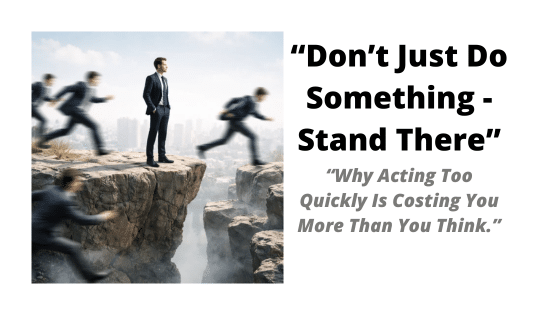
“You Don’t Have a Speed Problem; You Have a Thinking Problem”
Listen to the Audio version of this blog here.

Watch a brief summary video of this blog.
1. Introduction: The Dangerous Urge to Act
There’s a phrase we’ve all heard: “Don’t just stand there, do something.” It sounds right. It feels right. And in life, it often is. But in business? It’s one of the most dangerous pieces of advice you can follow.
Because most business owners don’t have a problem with inaction, they have the opposite problem. They act too quickly.
The Default Reaction.
Something goes wrong, and the instinct is immediate:
- Sales dip → “We need more leads”
- A deal falls through → “We’re too expensive”
- Cashflow tightens → “Cut costs or push sales harder”
So what happens? You move. You launch something. Change something. Fix something. Because doing something feels productive.
A Conversation I Have All the Time.
I’ll sit down with a business owner and ask: “What’s actually causing the problem?” And the answer is usually vague:
- “The market’s slow…”
- “Clients aren’t spending…”
- “We’re not getting the same traction…”
But the actions they’ve already taken? Very specific.
- Increased marketing spend
- Dropped prices
- Hired someone
- Changed the offer
They’ve already moved. Without fully understanding the problem.
Here’s the Real Issue.
“Action feels like control.”
When things become uncertain, doing something, anything, reduces that discomfort. It gives you momentum. It gives you the feeling of progress. But there’s a problem. Movement is not the same as progress.
Real-World Example.
I worked with a business owner recently who saw a slowdown in sales. Within a few weeks, they had:
- Increased their ad spend
- Adjusted their pricing
- Changed their messaging
- Started developing a new service
All logical actions. All wrong. Because when we stepped back and looked properly, the issue wasn’t leads, pricing, or the offer. It was conversion.
- They didn’t have a sales problem.
- They had a sales process problem.
So all the action they took? It didn’t fix the issue. It just made the business more complex.
The Bigger Problem.
This is where most businesses get into trouble. Not because they do nothing. But because:
“They do the wrong things… quickly.”
And when you act without fully understanding the system you’re operating in, something else happens: You don’t just fail to solve the problem. You create new ones.
This Is Where It Gets Expensive.
Every action has consequences. Some you expect. Most you don’t.
- Drop your price → win more work → margins collapse
- Hire too early → increase costs → cashflow pressure
- Increase marketing → attract poor-fit clients → lower conversion
You solved one problem. And created three more.
The Shift
What I’ve learned, both in my own businesses and working with others, is this:
- The best operators don’t rush to act.
- They pause to understand.
They resist the urge to move. They step back. They diagnose. They think. Because they know:
“The fastest way to fix a problem… is to understand it properly first.”
In this blog, I’m going to show you:
- Why the bias for action leads to bad decisions
- How unintended consequences quietly damage your business
- Why “standing still” is actually a strategic move
- And how to build the discipline to think before you act
Because sometimes…The most productive thing you can do is stop, stand still, and think properly.
2. The Bias for Action: Why We Jump Too Quickly.
Let’s put a name to the problem.
“Bias for action is the tendency to act quickly rather than think deeply, especially when under pressure.”
And in business, it shows up everywhere.
Why Business Owners Are Prone to It.
Most entrepreneurs are wired the same way. You didn’t build your business by sitting still. You built it by:
- Making decisions quickly
- Taking opportunities
- Moving faster than others
- Figuring things out as you go
That’s a strength. Until it isn’t.
When Strength Becomes Weakness.
The same instinct that helps you start a business can hold you back as it grows. Because at a certain point, speed stops being the advantage. Clarity becomes the advantage.
But most owners don’t make that shift. They keep applying startup behaviour to scaling problems. And that’s where action bias starts to cause damage.
The Psychological Drivers Behind It.
Bias for action isn’t random. It’s driven by very real psychological forces.
2.1. The Need for Control.
Uncertainty is uncomfortable. When things feel unclear, doing something, anything, restores a sense of control. Even if that “something” isn’t the right move.
2.2. Discomfort With Inaction.
Standing still feels wrong. It looks like:
- Indecision
- Weakness
- Lack of leadership
So you act, because action looks like leadership. Even when it isn’t.
2.3. Pressure to Respond.
Whether it’s from:
- Your team
- Your clients
- Your own expectations
There’s always a sense that you need to “do something”. So you do. Without fully thinking it through.
2.4. Identity as a “Doer”
Most business owners take pride in being proactive. You don’t want to be the person who hesitates. You want to be the person who moves. But here’s the problem: Being a doer doesn’t mean doing everything quickly. It means doing the right things at the right time.
2.5. Action Relieves Anxiety
This is the big one. When something’s wrong:
- Acting feels good
- Waiting feels uncomfortable
So you act, not because it’s correct…But because it reduces anxiety.
The Illusion of Progress.
Here’s where it gets dangerous.
“Action creates the illusion of progress.”
You feel like you’re moving forward:
- You’ve launched something
- Changed something
- Improved something
But underneath that activity, the core issue may still be untouched.
Real-World Pattern.
I see this pattern constantly:
- Problem appears → action taken quickly
- Short-term relief → “We’re doing something”
- Problem persists → more action
- Complexity increases → more problems
And before long, the business is busy…but not effective.
The Compounding Effect.
When you combine action bias with the law of unintended consequences, things escalate quickly:
- One action creates a new issue
- That issue triggers another action
- Which creates another issue
You’re no longer solving problems. You’re managing the consequences of previous decisions.
The Key Insight.
“Action bias doesn’t just waste effort.
It compounds problems.”
Because every action you take without clarity:
- Moves you further from the root cause
- Adds complexity
- Consumes time and resources
The Shift.
The best business owners I work with don’t remove action. They control it.
They create space between: Problem → Thought → Action
Instead of: Problem → Action
Bottom Line.
Bias for action isn’t the enemy. Uncontrolled action is. Because in business:
“The fastest way to fix a problem
is not to act quickly –
It’s to act correctly.”
3. Cautionary Tales: When Action Comes Before Thinking.
It’s easy to think this is just a small business problem. It’s not. Some of the biggest, most well-funded projects in the world have fallen into the exact same trap:
“Starting before the thinking is finished.”
And the results are always the same:
- Delays
- Cost overruns
- Rework
- Complexity
- Loss of control
Let’s look at two well-known examples.
Sydney Opera House.
One of the most iconic buildings in the world. But behind the architecture is a very different story. Construction began before the design was fully completed. (See my previous blog)
What happened next?
- Designs changed during construction
- Engineering challenges emerged late
- Work had to be redone
- Costs escalated dramatically
- Timelines extended far beyond expectations
What should have been a clear, structured project became a moving target.
The Lesson.
“Starting early didn’t speed things up.
It made everything harder.”
Because decisions that should have been made upfront were made during execution. And that’s always more expensive.
HS2.
Closer to home, we’ve seen the same pattern play out again.
- Pressure to act.
- Pressure to progress.
- Pressure to “get started.”
But underneath that momentum:
- Scope wasn’t fully defined
- Costs were uncertain
- Plans continued to evolve
- Political and strategic priorities shifted
The result?
- Billions in overruns
- Delays and redesigns
- Sections scaled back or cancelled
The Lesson.
“Momentum without clarity creates problems that are difficult and expensive to reverse.”
Once something is in motion, it’s far harder to stop, rethink, and correct course.
Why This Matters for Your Business.
You might be thinking: “That’s infrastructure. That’s government. That’s not me.” But the pattern is identical. Just on a smaller scale.
The Small Business Version.
Instead of billion-pound overruns, you get:
- Months spent on the wrong strategy
- Thousands wasted on ineffective marketing
- Hiring decisions that create more problems
- Pricing changes that reduce profit
- New services that add complexity without value
The scale is different. The mistake is the same.
The Hidden Pattern.
In every case:
- There’s pressure to act
- Action begins before clarity
- New information emerges
- Changes are made mid-execution
- Costs increase
- Complexity grows
And by the time you realise what’s happened…You’re already too far in.
The Real Cost.
“It’s not just that the first decision was wrong.
It’s that every decision after it becomes more difficult.”
Because now you’re not solving the original problem. You’re managing the consequences of earlier actions.
Bridge to What Comes Next.
And this is where it gets even more important. Because the damage isn’t just in the visible cost. It’s in what you didn’t anticipate. The knock-on effects. The second-order consequences. The problems created by the solution. This is where most businesses get caught out.
4. The Law of Unintended Consequences: The Hidden Cost of Action.
This is where things get really interesting. Because the problem with acting too quickly isn’t just that you might choose the wrong solution. It’s that:
“Every action you take changes the system you’re operating in.”
And when you don’t fully understand that system…You create consequences you didn’t plan for.
What Is the Law of Unintended Consequences?
Put simply:
“When you act without fully understanding the situation, your actions produce outcomes you didn’t expect, and often didn’t want.”
You solve one problem. But in doing so, you create others. And in business, those second-order effects are often more damaging than the original issue.
Why This Happens.
Most business problems aren’t isolated. They’re connected.
- Pricing affects demand
- Demand affects capacity
- Capacity affects delivery
- Delivery affects reputation
- Reputation affects future demand
It’s all linked. So when you change one part of the system without understanding the rest…You create ripple effects.
Real-World Business Examples.
Let’s make this practical.
Example 1: Dropping Prices to Win More Work.
Action: Lower prices to increase sales
Intended Outcome: More deals, more revenue
Unintended Consequences:
- Margins shrink
- More price-sensitive clients
- Increased workload for the same (or less) profit
- Pressure on your team
- Reduced ability to invest back into the business
You solved the “sales” problem…But created a profit problem.
Example 2: Hiring to Fix Capacity Issues.
Action: Bring in more staff to handle the workload
Intended Outcome: Increase output and reduce pressure
Unintended Consequences:
- Higher fixed costs
- Increased management complexity
- More reliance on consistent demand
- Cashflow pressure if work fluctuates
You solved the “capacity” issue…But created a cost and risk problem.
Example 3: Increasing Marketing Spend.
Action: Spend more on ads to generate leads
Intended Outcome: More enquiries
Unintended Consequences:
- More low-quality leads
- Lower conversion rates
- Sales team overwhelmed
- Wasted budget
- Frustration internally
You solved the “lead volume” problem…But created a lead quality and efficiency problem.
The Pattern;
Every time:
- A problem appears
- Action is taken quickly
- A new problem is created
And often, the new problem is harder to fix than the original one.
Why This Catches Business Owners Out.
Because the first effect is visible. The second effect isn’t. You see:
- More sales
- More staff
- More leads
You don’t immediately see:
- Lower margins
- Increased complexity
- Reduced control
Those show up later.
The Compounding Effect.
Here’s where it becomes dangerous. That second problem now needs solving. So you act again. Which creates another consequence. And before long, you’re no longer solving the original issue… you’re managing a chain of reactions.
The Key Insight.
“Every action solves one problem, and creates another.
The question is: do you understand both?”
Most business owners focus on the first. The best ones think through the second.
Why This Links to Action Bias.
Bias for action makes this worse. Because when you act quickly:
- You don’t map the system
- You don’t test assumptions
- You don’t consider consequences
You just move. And movement creates impact.
The Shift.
The goal isn’t to stop acting. It’s to act with awareness. To ask:
- What problem am I actually solving?
- What else will this change?
- What are the second-order effects?
- What new problems might this create?
That’s where better decisions come from.
Bottom Line.
The biggest danger in business isn’t inaction. It’s action taken without understanding the consequences. Because that’s how small problems turn into complex ones.
5. The Metaphor: Running in the Wrong Direction Faster.
Let’s simplify all of this. Imagine you’re lost in a forest. No map. No clear direction. Just uncertainty. You’ve got two choices:
- Stop. Look around. Get your bearings.
- Start running.
What Most People Do.
They run. Because standing still feels wrong. It feels like:
- Wasted time
- Lack of progress
- Indecision
Running feels better. It feels like action. Like momentum. Like you’re doing something.
But Here’s the Problem.
“If you’re going in the wrong direction, speed doesn’t help.”
It just gets you lost faster.
The Real Difference.
The person who pauses:
- Observes the environment
- Looks for clues
- Thinks about direction
- Chooses a path deliberately
They feel slower. But they move with purpose. The person who runs:
- Moves quickly
- Covers ground
- Feels productive
But without direction, every step could be taking them further away from where they need to be.
Business Is No Different.
This is exactly what happens in business. You don’t fully understand the problem…But you act anyway.
- Sales down → increase marketing
- Capacity tight → hire people
- Deals slow → reduce pricing
You’re running.
The Illusion of Progress.
From the outside, it looks like progress:
- More activity
- More output
- More movement
But underneath, you may be moving further away from the real solution.
Where It Gets Expensive.
Here’s the critical part:
The faster you move in the wrong direction, the harder it is to come back.
Because now:
- You’ve invested time
- You’ve committed resources
- You’ve built processes around the wrong assumption
- You’ve created unintended consequences
So stopping becomes harder. And you keep going.
The Trap.
This is where businesses get stuck. They don’t want to admit they’re heading in the wrong direction. So they double down. More action. More effort. More investment.
The Smarter Move.
The smarter operator does something different. They pause early. They ask:
- “What direction are we actually heading in?”
- “What problem are we solving?”
- “What assumptions are we making?”
And only then do they move.
Key Insight.
“Direction matters more than speed.”
And yet most business owners optimise for speed. Because it feels like progress.
Bring It Back to the Bigger Idea.
This is where everything connects:
- Bias for action → makes you run
- Lack of diagnosis → means you don’t know where you’re going
- Unintended consequences → make the journey harder to reverse
Bottom Line.
Standing still isn’t the opposite of progress. It’s what makes progress possible. Because without direction, action is just movement. And movement alone doesn’t build a better business.
6. The Cost of Acting Without Thinking.
At this point, you can probably see the pattern.
Act too quickly → misread the problem → create unintended consequences.
But let’s bring this down to where it really matters: What is this actually costing you?
Because in most businesses, the damage isn’t dramatic. It’s subtle. It’s cumulative. And it builds over time.
6.1. Wasted Time.
Every time you act on the wrong assumption, you invest time in the wrong direction.
- Campaigns that don’t convert
- Projects that don’t deliver
- Initiatives that don’t solve the problem
Weeks… sometimes months… go into things that were never going to work. And the worst part? You don’t get that time back.
6.2. Wasted Money.
Action bias is expensive.
- Marketing spend without clear targeting
- Hiring before systems are ready
- Tools, software, and consultants brought in too early
Individually, these decisions might seem manageable. But stacked together? They quietly drain cash.
6.3. Increased Complexity.
This is where it really starts to hurt. Every unnecessary action adds something:
- Another system
- Another process
- Another person
- Another layer
And complexity makes everything harder:
- Harder to manage
- Harder to scale
- Harder to fix
6.4. Team Confusion.
Your team feels it too.
- Direction changes frequently
- Priorities shift
- New initiatives appear without explanation
From their perspective, it feels like the business is constantly reacting. And that erodes confidence. People stop trusting the direction. Execution slows down. Energy drops.
6.5. Moving Further from the Real Problem.
This is the highest cost of all. Because every action you take without clarity:
- Takes you further from the root cause
- Creates distractions
- Masks the real issue
So instead of solving the problem…You build layers around it.
6.6. Decision Fatigue
The more unnecessary actions you take, the more decisions you create.
- More things to manage
- More things to fix
- More problems to react to
And eventually: You become busy… but ineffective.
Real-World Pattern.
I see this all the time. A business experiences a slowdown. They respond by:
- Increasing marketing
- Changing pricing
- Launching something new
- Hiring to “push growth”
Six months later:
- Revenue hasn’t improved significantly
- Costs have increased
- The business is more complex
- The original problem still exists
The Key Insight.
“Acting without thinking doesn’t just fail to solve problems; it makes them harder to solve.”
Because now you’re dealing with:
- The original issue
- Plus everything your actions created
The Compounding Effect.
This is where businesses get stuck. They’ve taken so many actions that:
- It’s hard to see what’s working
- It’s hard to isolate the problem
- It’s hard to unwind decisions
So they keep going. More action. More complexity. More cost.
The Shift.
The goal isn’t to eliminate action. It’s to make sure that every action is aligned to a clearly understood problem. That’s what separates:
- Busy businesses from
- Effective businesses
Bottom Line
Most businesses don’t fail because they do too little. They fail because they do too much… without clarity.
7. “Standing Still” Is Strategic, Not Passive.
This is the part most business owners struggle with. Because “standing still” sounds like:
- Doing nothing
- Delaying decisions
- Avoiding responsibility
And none of those feels like leadership. But that’s not what we’re talking about.
Let’s Redefine It.
“Standing still isn’t inactivity. It’s deliberate thinking before action.”
It’s the space between: Problem → Action, where most businesses go wrong.
What “Standing Still” Actually Looks Like.
It’s not sitting around waiting for things to improve. It’s doing the work that actually matters:
- Diagnosing the real problem
- Asking better questions
- Gathering the right data
- Challenging assumptions
- Understanding cause vs symptom
- Thinking through consequences
It’s quiet work. But it’s high-value work.
The Difference in Practice.
Let’s take a simple example.
Reactive Business:
Sales drop → Launch more ads → Lower prices → Push the team harder
Strategic Business:
Sales drop → Pause → Analyse conversion vs lead flow → Review client quality → Assess positioning and pricing signals. Then act.
Same situation. Very different outcome.
Why This Feels Uncomfortable.
Because standing still removes the illusion of progress. When you’re acting:
- You feel in control
- You feel productive
- You feel like you’re moving forward
When you pause:
- You’re forced to think
- You sit with uncertainty
- You don’t have immediate answers
That’s uncomfortable. But it’s necessary.
This Is Where Real Progress Happens.
Clarity is built in the pause. And once you have clarity:
- Your actions become sharper
- Your decisions become simpler
- Your execution becomes faster
- Your results improve
The Paradox.
Here’s the irony: The businesses that slow down to think… move faster overall. Because they avoid:
- Rework
- Wrong decisions
- Unnecessary complexity
- Wasted effort
Link Back to Unintended Consequences.
Standing still also protects you from something bigger: Acting without understanding the consequences. When you pause, you can ask:
- What will this action actually change?
- What problems might this create?
- Are we solving the root cause?
That’s how you avoid the chain reaction we talked about earlier.
What This Looks Like in Leadership.
Strong leaders don’t just act. They:
- Create thinking time
- Ask better questions
- Challenge assumptions
- Resist pressure to react immediately
They understand that: Speed without direction is risk.
The Key Insight.
“Standing still isn’t the opposite of progress. It’s what makes progress possible.”
Bottom Line.
If you’re constantly reacting, constantly changing, constantly moving…There’s a good chance you’re not actually moving forward. You’re just moving.
8. The Power of Diagnosis Before Action.
This is where everything comes together. If action without thinking creates problems… and standing still creates clarity…Then the real question is:
What do you actually do in that space before action?
The answer is simple: You diagnose.
Diagnosis Is the Missing Discipline.
Most business owners don’t have a structured way of thinking through problems. They rely on:
- Experience
- Instinct
- Gut feel
And while those things are useful…They’re not enough on their own. Because instinct is only as good as the information you’re feeding it.
What Diagnosis Actually Means.
Diagnosis isn’t complicated. But it is disciplined. It means:
- Defining the problem properly
- Separating symptoms from causes
- Identifying what’s really driving the issue
- Testing assumptions
- Understanding how different parts of the business connect
A Simple Example.
Let’s go back to a common scenario: Sales are down. Most businesses jump straight to action:
- “We need more leads”
- “Let’s increase marketing”
- “Let’s adjust pricing”
That’s a reaction.
A Diagnostic Approach Looks Like This:
Instead, you ask:
- Are leads actually down?
- Has conversion changed?
- Has client quality shifted?
- Has the sales process changed?
- Has pricing perception changed?
Now you’re not guessing. You’re narrowing the problem.
The Difference This Makes.
Without diagnosis:
- You take multiple actions
- You increase complexity
- You waste time and money
- You create unintended consequences
With diagnosis:
- You take fewer actions
- But they’re targeted
- They’re effective
- And they solve the real issue
Key Insight.
“Good decisions come from good diagnosis. Not from fast action.”
Diagnosis Creates Leverage.
This is where the real power is. When you understand the problem properly:
- A small change can have a big impact
- You avoid unnecessary work
- You fix the root cause, not the symptom
Real-World Pattern.
I’ve worked with businesses that:
- Increased marketing spend for months
- Changed pricing multiple times
- Tried new offers
All are trying to fix a “sales problem.” When we diagnosed it properly? It turned out to be a conversion issue in the sales process. One change fixed what months of activity couldn’t.
The Shift.
- Stop asking: “What should we do?”
- Start asking: “What’s actually going on?”
That’s the difference between reactive and strategic thinking.
Why This Links to Everything Else.
Diagnosis solves the problems we’ve talked about:
- It removes action bias
- It reduces unintended consequences
- It gives direction before movement
- It replaces guesswork with clarity
Bottom Line
Most businesses don’t need more action. They need a better understanding. Because once you understand the problem properly…The right action becomes obvious.
9. Why This Is Hard to Do Alone.
By now, the logic is clear: Pause. Diagnose. Then act.
Simple. But not easy.
You’re Too Close to It.
When it’s your business, everything is personal.
- The decisions
- The clients
- The outcomes
- The pressure
You’re not observing the business. You’re inside it. And when you’re inside the system, it’s incredibly hard to see it clearly.
You See Symptoms, Not Causes.
You experience problems as they show up:
- Sales slowing
- Cashflow tightening
- Team under pressure
But those are symptoms. Not causes. And when you’re dealing with symptoms every day, it’s natural to react to them. Instead of stepping back to ask: “What’s actually driving this?”
Your Assumptions Go Unchallenged.
Every business runs on assumptions.
- “Our pricing is the issue”
- “The market is slow”
- “We need more leads”
- “We need more people”
The problem? No one is questioning them. So they become accepted as truth. And decisions get built on top of them.
Emotion Clouds Judgement.
Let’s be honest. Business isn’t purely rational.
- You want to win
- You want validation
- You don’t want to be wrong
- You don’t want to lose momentum
So when a problem appears, there’s a strong pull to act quickly. Not because it’s the best decision…But because it feels better.
You’re Under Constant Pressure to Act.
There’s always pressure:
- From your team
- From your clients
- From your numbers
- From yourself
And that pressure pushes you toward action because action looks like leadership. Even when it isn’t.
You Don’t Have a Framework.
This is the big one. Most business owners don’t have a structured way to:
- Diagnose problems
- Analyse signals
- Test assumptions
- Prioritise actions
So they default to what they know: Experience + instinct + urgency
Which works… until it doesn’t.
The Result.
When you combine all of this:
- Proximity
- Assumptions
- Emotion
- Pressure
- Lack of structure
You end up with: Fast decisions… built on incomplete understanding.
Why External Perspective Changes Everything.
This is where things shift. Because someone outside your business:
- Isn’t emotionally attached
- Doesn’t carry your assumptions
- Isn’t under the same pressure
- Can see patterns you can’t
They can ask:
- “Why do you believe that?”
- “What’s the data behind it?”
- “What else could be causing this?”
- “What happens if you don’t act?”
Questions that create clarity.
Real Impact.
I’ve lost count of the number of times a client has come to me saying: “We need to do X.” And within 30 minutes, we’ve realised:
X isn’t the problem.
And more importantly:
Doing X would have made things worse.
The Key Insight.
“You can’t diagnose your business properly from inside the pressure of it.”
You need space. You need structure. You need challenge.
Bottom Line.
Most business owners don’t act too much because they lack discipline. They act too quickly because they lack clarity. And clarity is very hard to create on your own.
10. Final Word. The Role of Diagnostics: Turning Thinking Into Better Decisions.
At this point, the pattern should be clear.
- Acting too quickly creates problems
- Unintended consequences make things worse
- Standing still creates clarity
- Diagnosis leads to better decisions
So the real question becomes:
“How do you actually build this into your business?”
Because this isn’t about thinking more. It’s about thinking properly. And that requires structure.
This Is Where Diagnostics Comes In.
A proper diagnostic process gives you a way to:
- Step back from the noise
- Understand what’s actually happening
- Identify root causes
- Separate symptoms from problems
- Prioritise correctly
Instead of asking: “What should we do next?”
You start asking: “What’s actually going on here?”
What Happens Without Diagnostics.
Most businesses operate like this:
- Problem appears
- Immediate action
- Mixed results
- More action
- More complexity
It’s reactive. And over time, it becomes chaotic.
What Happens With Diagnostics.
The process changes completely:
- Problem appears
- Pause
- Diagnose
- Identify root cause
- Decide on the right action
- Execute with clarity
Fewer actions. Better outcomes.
The Power of Structured Thinking.
The key difference isn’t intelligence. Its structure. Diagnostics gives you a framework to:
- Challenge assumptions
- Interpret signals properly
- Think through consequences
- Focus on what actually matters
And once you have that…Decision-making becomes simpler.
What a Diagnostic Session Actually Delivers.
When we run a diagnostic session, the goal isn’t to give you more to do. It’s to give you clarity on:
- What’s really happening
- What’s not working (and why)
- What you can ignore
- What actually matters
- What will move the business forward
The Key Difference.
A diagnostic session doesn’t tell you what to do first. It tells you what’s actually worth doing. And that’s where the value is.
Why This Matters
Because once you have clarity:
- You stop reacting
- You stop second-guessing
- You stop wasting time
- You stop creating unnecessary complexity
And your actions become:
- Focused
- Efficient
- Effective
The Shift
Move from: “We need to do something.”
To: “We understand the problem, now we can act properly.”
That’s the difference between:
- Busy businesses and
- Effective businesses
Bottom Line.
Most businesses don’t need more action. They need better decisions. And better decisions come from better diagnosis.
Your Next Step.
If you recognise this pattern…If you’re constantly reacting, changing, adjusting, but not seeing the results you expect…Then it’s time to pause.
👉 Book a diagnostic session
We’ll:
- Step back from the day-to-day
- Analyse what’s really going on
- Challenge assumptions
- Identify root causes
- And give you a clear, practical path forward
No guesswork. No unnecessary action. Just clarity. Because the most valuable thing you can do for your business… is understand it properly before you try to fix it.


