
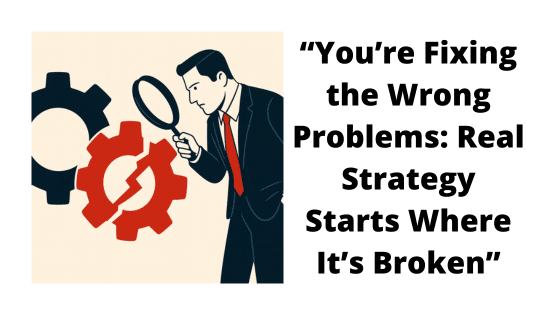
1. Introduction: Strategy Isn’t About What’s Working, It’s About What’s Broken.
When most business owners think about strategy, they start with their strengths.
“What are we good at?”
“What do we enjoy doing?”
“What’s working right now?”
That’s fine if you’re looking to survive. But if you want to grow, compete, or dominate, that line of thinking is far too safe.
Because real strategy doesn’t start with your strengths.
It starts with what’s broken.
Broken inside your business—and broken outside in the market.
Over the years, I’ve worked with countless business owners who couldn’t understand why they were stuck. They had a good product, a decent team, and loyal customers. But growth had stalled. Profit was patchy. Stress was high.
Every time, we found the same two issues:
- Hidden inefficiencies inside the business: slow systems, wasteful processes, and underperforming offers.
- A complete blind spot to inefficiencies in the market; gaps that their competitors were leaving wide open.
One client had a brilliant service, but their internal quoting process took 3 days. They were losing jobs because customers were getting quotes faster elsewhere. Another was working in a market where no competitor offered flexible pricing or weekend delivery. The customers hated it—but no one was solving it.
In both cases, the strategic opportunity was right there.
But they couldn’t see it, because they were too focused on what they thought they were good at.
Here’s the truth:
If you want to build a real strategy, you need to understand two things:
- What’s holding your business back internally
- What’s broken in the market that others aren’t fixing
When you align those two, when you fix what’s slowing you down and attack where others are weak, that’s when things start to click.
This blog is about doing exactly that.
I’ll show you:
- What business inefficiencies actually look like (not just what they feel like)
- How to spot inefficiencies in your market that others ignore
- And how to link the two together to create a strategy that doesn’t just sound good—it works
Let’s get into it.
2. What Are Business Inefficiencies?
Let’s start on the inside: your business.
Business inefficiencies are the things that are costing you time, money, energy, and opportunity, even if the business is ticking along.
They’re not always obvious. In fact, many are hidden behind phrases like:
- “It’s not perfect, but it works.”
- “We’ve always done it this way.”
- “We just need to push harder.”
- “It’s quicker to do it manually.”
But here’s the truth:
“If something in your business is slow, wasteful, unreliable, or unprofitable, it’s inefficient.”
And inefficiency compounds. It clogs up your delivery. It weakens your pricing power. It burns out your team. It gives competitors a chance to catch up or pass you.
Common Types of Business Inefficiencies.
Operational Inefficiencies:
- Repeating manual tasks that could be automated
- Double-handling work between departments
- Outdated tech that slows things down
Example: A construction firm still using paper-based job sheets, causing delays, lost time, and endless admin.
Financial Inefficiencies:
- Delivering services at a margin too tight to scale
- Not charging for extras or scope creep
- Losing money through poor stock control or over-servicing
Example: A marketing agency with fixed pricing but wildly variable client demands, leading to overwork and underpayment.
People Inefficiencies:
- Roles that aren’t clearly defined
- Decision-making bottlenecks (everything needs your approval)
- Team members doing work they’re not best at, or not trained for
Example: A business owner handling all customer support “because clients like talking to me”, while sales and strategy get ignored.
Strategic Inefficiencies:
- Chasing low-value customers who drain resources
- Offering too many things without focus
- Sticking with “legacy” offers that don’t match your current direction
Example: A web designer still offering £500 template sites when they’re trying to move upstream to £5,000 strategy-led builds.
Why It Matters.
These inefficiencies eat away at your ability to grow, compete, and deliver. They stop you from making the most of the market opportunities that are right in front of you, because you’re too busy fighting your own internal drag.
That’s why strategy doesn’t start with your vision or goals. It starts with clearing the internal mess that’s holding you back.
Goal for This Section:
By the time you finish your next 365/90 planning sprint, you should have a clear answer to this question:
“What internal inefficiencies are preventing us from reaching the next level?”
3. What Are Market Inefficiencies?
Now let’s turn outward, away from your business and toward your market.
While business inefficiencies are what’s holding you back…Market inefficiencies are what’s holding your competitors and customers back.
These are the gaps, blind spots, bottlenecks, and frustrations built into your industry or niche. They’re the places where the market is underperforming, where things are:-
- Overpriced,
- Overcomplicated,
- Underserved, or
- Just plain broken.
And these inefficiencies? This is where the opportunity lives.
So what exactly is a market inefficiency?
It’s any place where:
- Customers aren’t getting what they want or need, at the speed, price, or quality they expect.
- The industry norm is slow, sloppy, or outdated, but everyone just accepts it.
- Competitors create friction instead of removing it.
Types of Market Inefficiencies.
Speed Gaps:
- Competitors take too long to quote, deliver, or respond.
- “Normal turnaround” is slow, but no one’s challenging it.
Example: A commercial cleaning company that promises a quote in 24 hours wins business from others taking 3–5 days.
Price Confusion or Mismatch:
- Customers don’t understand what they’re paying for.
- High-end pricing for low-end delivery, or vice versa.
- The market forces customers into pricing tiers that don’t reflect their real needs.
Example: A software platform with bloated enterprise pricing while small businesses are desperate for a simpler, cheaper option.
Overcomplicated Processes:
- Too many steps to buy, sign up, or get started.
- Technical language, confusing packages, unclear promises.
Example: A design agency offering “brand strategy workshops” but can’t explain what you actually get, vs. a competitor that says “we build brands customers trust.”
Underserved Niches:
- Everyone’s targeting the same “middle of the market.”
- Specific types of customers are being ignored—by default, not by design.
Example: A freelancer who targets tradespeople instead of tech startups, because everyone else is chasing trendy industries.
Weak Messaging and Generic Positioning:
- Competitors all sound the same.
- Nobody’s saying anything bold, clear, or different.
- Customers can’t tell who to trust—so they default to price.
Example: A legal services firm that drops the jargon and explains pricing clearly will stand out instantly in a sea of vague competitors.
Why Market Inefficiencies Matter.
This is where real strategy gets interesting. You don’t need to “disrupt an industry.” You just need to notice where it’s failing customers, and solve it better. Most businesses spend so long copying competitors, they never question the market itself.
They assume:
“If everyone’s doing it this way, it must be right.”
But what if it’s not?
What if that slow delivery time, confusing service, or bloated pricing is your biggest strategic opening?
The Goal Here:
By the end of this blog (or your next 90-day sprint), you should be able to answer:
“Where is the market currently letting customers down, and how can we show up differently?”
That’s where positioning gets powerful. That’s where pricing gets bold. And that’s where your business starts to feel like the only real choice.
4. Why Most Business Owners Ignore Both.
Here’s the irony: The two things that matter most to building a smart strategy, internal inefficiencies and market inefficiencies, are also the two things most business owners never look at. Why?
Because they’re too busy being busy.
They’re caught in the day-to-day. Firefighting. Delivering. Chasing. Reacting. So instead of building a strategy, they build more activity. And instead of asking the hard questions, they just copy what everyone else is doing and hope it works.
Why Internal Inefficiencies Get Ignored.
- You’re too close to it. When you’re deep in your own business, chaos starts to look like normal.
- You get used to clunky. That CRM that’s slowing everyone down? You’ve been using it for 5 years, it’s just “how things are.”
- You’re solving symptoms, not causes. Sales drop? You try a new ad campaign, without fixing your broken onboarding, that’s turning customers off.
“You can’t fix inefficiency if you can’t even see it.”
Why Market Inefficiencies Get Missed.
- You assume the market is “right.” If every competitor does something, it must be the standard… right?
- You’ve been conditioned to copy. Most business owners don’t study customers; they study competitors.
- You don’t talk to real customers often enough. So you miss what’s frustrating them, or what they’re settling for.
You don’t win by being slightly better. You win by solving what no one else is solving.
The Strategic Trap Most Businesses Fall Into:
They built an “okay” business inside an “okay” market. Internally inefficient. Externally unremarkable. They’re not broken, but they’re not winning either. And that’s the most dangerous place to be, busy but stuck. No margin. No momentum. No real strategy. Just… grind.
The Fix?
You’ve got to look inward and outward, honestly.
“Where are we holding ourselves back?”
“Where is the market failing our ideal customer?”
“And how do we close that gap better than anyone else?”
That’s the foundation of strategy. Not mission statements. Not values walls. Not vision boards. Fix what’s broken. Attack what others ignore. That’s how you build a business that outperforms, outlasts, and outmanoeuvres everyone else.
5. Where Real Strategy Lives: Fixing Inside, Exploiting Outside.
Here’s the heart of it:
“Strategy isn’t just about what you do, it’s about where and how you play.”
And the smartest play is this:
Fix what’s broken inside your business… so you can exploit what’s broken in the market.
That’s where leverage lives.
- Not in “being better at everything.”
- Not in copying best practices.
- Not in reading another book on customer journeys.
Real leverage is when:
- Your internal operations are lean, sharp, and focused
- You can move faster, price better, or deliver more clearly than your competitors
- And you use that edge to attack the market where others are weak
Fix What’s Broken Inside.
Internal inefficiencies aren’t just costing you profit, they’re costing you opportunity.
- If your quoting process is slow, you can’t respond faster than your competitors.
- If your onboarding is messy, you can’t scale a new offer.
- If your team is stretched thin with low-margin work, you’ll never pivot when opportunity knocks.
Cleaning up your internal mess gives you:
- Bandwidth
- Headroom
- Focus
- Flexibility
It creates capacity, the strategic fuel most businesses are running without.
Exploit What’s Broken Outside.
Once your house is in order, you can look outward and ask:
- “Where is the market failing customers?”
- “What’s frustrating them?”
- “Where are our competitors lazy, bloated, or slow?”
You don’t need to invent something revolutionary. You just need to do what others aren’t willing to fix.
That could mean:
- Being the fastest to quote in a slow-moving industry
- Offering fixed pricing in a market full of confusion
- Communicating in plain English when everyone else is using jargon
- Serving a niche that everyone else overlooks
This is what creates positioning that sticks. Not gimmicks: gaps. You show up where others won’t. And because you’ve cleaned up your internal inefficiencies, you can.
Strategy = Internal Capability + External Opportunity.
This is what most “strategic planning” frameworks miss.
- They separate internal from external.
- They get lost in analysis.
- They talk about “alignment” without telling you what to align.
So let’s simplify it.
Real strategy =
- Fix what’s dragging you down inside
- Aim that capacity at the weak points in the market
- Create an offer, a process, or a position that feels inevitable to your ideal customer
That’s when things start to move.
6. Practical Framework: How to Map the Two Sides
You don’t need a 50-page strategic plan. You need a simple map that helps you do three things:
- See what’s broken inside your business
- Spot what’s broken outside in your market
- Align the two to build something that wins
Here’s how.
STEP 1: Run a Business Inefficiency Audit.
Fix the drag inside your business
Ask:
- Where are we slow?
- Where are we losing money?
- What do we keep doing manually that we could automate?
- What customer complaints or team frustrations come up over and over again?
- Where are we delivering work that feels more painful than it should?
Use this to spot:
- Broken processes
- Bottlenecks
- Low-margin offers
- Poor systems
- Underperforming roles
- Decision delays
Your goal: List the top 3–5 inefficiencies that are costing you the most in time, money, or energy.
STEP 2: Identify Market Inefficiencies.
Find where your competitors are failing customers, Ask:
- What frustrates customers in this industry?
- Where are competitors slow, vague, overpriced, or overcomplicated?
- What’s missing from the typical customer experience?
- Are there underserved customer segments no one is targeting?
- What language, pricing, delivery, or packaging does everyone just accept as “standard”?
Use this to spot:
- Gaps in service delivery
- Confusion in messaging or pricing
- Opportunities to be faster, clearer, more helpful
- Segments the market is ignoring
Your goal: List the top 3–5 inefficiencies in the market that your ideal customers are dealing with.
STEP 3: Find the Overlap and Turn It Into Strategy.
Connect what you’re improving internally to what customers are desperate for externally. This is where real strategic leverage happens.
Ask:
- What internal fix would unlock our ability to solve that market problem?
- If we improved X internally, how could we attack Y in the market better?
- What can we start doing, consistently, that competitors can’t match?
Examples:
- Fixing your quoting system → allows you to deliver estimates in 30 minutes vs. 3 days (speed gap in the market)
- Streamlining your onboarding → helps you serve small clients profitably while everyone else ignores them
- Improving team clarity → frees up bandwidth to launch a bold new offer where the market is stale
Your goal: Draw a direct line from what you’re fixing internally to the opportunity it unlocks externally.
| Internal Inefficiency | Fix / Improvement | Market Inefficiency | Strategic Action |
| Slow quoting process | Automate & train team | Competitors take 3–5 days to quote | Quote in 24 hours & market it as a key differentiator |
| High client churn | Improve onboarding | Customers feel “dumped” after sale | Introduce a 30-day onboarding experience with a named rep |
| Manual admin tasks | Implement CRM & automation | Market slow to follow up with leads | Run 7-day nurturing sequences with zero delay |
| No niche positioning | Refocus offer + messaging | Competitors are generic or copycat | Dominate a niche that’s overlooked (e.g. trades, solo founders) |
Bottom Line:
-
- Fix what’s slowing you down.
- Use that to attack where the market is weak.
That’s strategy. Most businesses only do one, or neither. That’s why they stall. But when you do both? You move faster, serve better, and stand out in a market that’s bloated with “meh.”
7. Final Word: Fix What’s Broken, Win Where Others Won’t.
If there’s one thing I’ve learned after decades of building, breaking, and rebuilding businesses, it’s this:
“Strategy is about problems, yours and the market’s.”
You don’t win by doing what everyone else is doing. You win by fixing what they ignore. Your internal inefficiencies are slowing you down. The market’s inefficiencies are leaving customers frustrated. Your job is to close that gap; faster, cleaner, and smarter than anyone else.
That’s what gives you pricing power. That’s what gives you clarity. That’s what makes your business harder to ignore, harder to compete with, and harder to copy. If this blog hit home, and you’re starting to realise you’ve been focused on the wrong things, I want to offer you something simple:
Your Next Step
In 60 minutes, we’ll:
- Audit the internal inefficiencies slowing you down
- Spot the external market gaps you’re not currently exploiting
- Build a no-fluff action plan to turn both into a competitive advantage
This isn’t coaching. It’s clarity. And it might be the most valuable hour you spend on your business this year.
 Twelve intensive half-day meetings.


