
The Dangerous Assumption Behind Almost Every Project Estimate
Listen to the Audio version of this blog here.
Watch a brief summary video of this blog.
1. Introduction – The Illusion of Certainty in Project Estimates.
Over the years, I’ve reviewed hundreds of project estimates. Some were for relatively small jobs worth a few thousand pounds. Others were multi-million-pound commercial projects involving multiple subcontractors, long programmes, and complex logistics. Almost all of them had one thing in common. They looked incredibly precise.
The spreadsheets were detailed. Labour schedules were carefully calculated. Material quantities were itemised down to the last unit. The total cost was presented as a single, definitive number.
£120,000. £480,000. £2.1 million.
And the programme often looked just as precise.
Twenty-four weeks. Thirty-six weeks. Forty days.
At first glance, it all feels reassuring. Precision creates the impression of control. It makes the estimate look professional and authoritative. But there’s a problem. Most project estimates are built on assumptions that quietly pretend the future is predictable.
For example, I once reviewed a commercial refurbishment project with a budget just over £2 million. The programme was scheduled for 26 weeks, and the estimate was supported by detailed supplier quotes and labour projections. On paper, it looked extremely solid. Yet when we started to examine the assumptions behind the numbers, the fragility of the estimate quickly became clear.
The estimate assumed:
- Materials would arrive exactly when scheduled
- Suppliers would honour quoted prices months later
- Labour productivity would match the planned schedule
- The client wouldn’t introduce significant design changes
- No unexpected structural issues would appear during the work
Of course, anyone who has worked on real projects knows how optimistic those assumptions are. And sure enough, within a few months, several things changed.
Steel prices increased unexpectedly. One key supplier delayed delivery by two weeks. A late design change required additional electrical work. And productivity slowed during a particularly difficult phase of the installation.
By the end of the project, the programme had slipped by five weeks, and the final cost had moved well beyond the original estimate. Now this wasn’t because the estimator was incompetent.
In fact, the estimate had been produced by someone very experienced.
The problem was much deeper than that. The estimate had been built as if the project were a game of chess, a world where every piece is visible, and every move can be analysed in advance. But real projects rarely behave like chess. They behave much more like poker.
- There are hidden variables.
- Incomplete information.
- Unexpected events.
In poker, you never know exactly what cards the other players are holding. You can’t predict the next card with certainty. All you can do is make decisions based on probability, what is most likely to happen given the information you have. Project estimating works the same way.
- Material prices fluctuate.
- Suppliers delay deliveries.
- Weather disrupts schedules.
- Clients change their minds.
- Productivity varies between teams and conditions.
In other words, uncertainty isn’t the exception. It’s the normal operating environment. Yet many businesses still produce estimates that assume certainty. A single number. A fixed timeline. A precise prediction of the future.
And that’s where the trouble begins. Because the real challenge in estimating isn’t calculating numbers, it’s understanding uncertainty. And that’s where probabilistic decision making becomes such a powerful tool.
2. What Is Probabilistic Decision Making?
Probabilistic decision making is simply the practice of making decisions based on likelihood rather than certainty. Instead of assuming that there is one predictable outcome, probabilistic thinking recognises that the future contains many possible outcomes, each with a different level of probability.
In other words, rather than asking: “What will happen?”
A probabilistic decision maker asks: “What is most likely to happen?”
This may sound like a small shift in thinking, but in practice, it changes how decisions are made, how risks are evaluated, and how projects are estimated.
The Traditional Approach: Single-Point Estimates.
In many businesses, decisions are based on single-point estimates. For example, a project estimate might say:
- The project will cost £120,000
- The project will take 10 weeks
- The installation will require 600 labour hours
Those numbers often appear precise and authoritative. But in reality, they are simply best guesses. The estimate assumes:
- Labour productivity will match expectations,
- materials will arrive on time,
- suppliers will not change their prices
- no unexpected problems will occur on site.
Anyone with real-world project experience knows how fragile those assumptions can be.
- Labour productivity varies.
- Materials get delayed.
- Weather interferes.
- Clients introduce changes.
Yet despite all of this uncertainty, many estimates are still presented as if the outcome were fixed.
The Probabilistic Approach: Thinking in Ranges.
Probabilistic decision making takes a very different approach. Instead of pretending the future can be predicted precisely, it recognises that multiple outcomes are possible, and some are more likely than others. So rather than saying:
“This project will cost £120,000.”
A probabilistic estimate might say:
- There is a 50% probability that the project costs around £120,000
- There is a 70% probability that the cost falls between £110,000 and £130,000
- There is a 90% probability that the cost stays below £145,000
This approach does not remove uncertainty. But it makes uncertainty visible and manageable.
Why This Matters.
When you think probabilistically, decisions become far more realistic. Instead of planning for a single outcome, you begin planning for a range of outcomes. This has several advantages. First, it improves risk awareness. You can identify scenarios where costs or timelines might drift outside the expected range. Second, it improves planning accuracy. Contingencies can be based on realistic probabilities rather than arbitrary allowances.
Third, it improves communication with clients and stakeholders. Rather than promising a level of certainty that may not exist, you can explain the likely range of outcomes. In other words, probabilistic decision making replaces false precision with informed judgment.
A Simple Way to Think About It.
A helpful way to understand probabilistic thinking is this: Traditional decision making assumes the future behaves like a straight line. Probabilistic decision-making recognises that the future behaves more like a distribution of possibilities.
- Some outcomes are unlikely.
- Some outcomes are highly probable.
- Most fall somewhere in the middle.
The goal of probabilistic thinking isn’t to predict the future perfectly. It’s to make better decisions in an uncertain world.
3. Probability vs Possibility – A Critical Distinction.
One of the most common mistakes I see in business decision-making is the confusion between possibility and probability. At first glance, the two words sound similar, but they represent very different ways of thinking about the future.
Understanding the distinction is essential if you want to make better decisions, estimate projects more realistically, and avoid unnecessary fear or optimism.
Possibility – Anything That Could Happen.
A possibility is simply something that can happen, regardless of how unlikely it might be. In business and project work, the list of possible events is almost endless. For example, it is possible that:
- A key supplier fails unexpectedly
- A shipment of materials is delayed at the port
- A major design change is introduced halfway through the project
- Labour productivity drops because of difficult site conditions
- A client suddenly cancels or pauses the project
All of these things are possible. In fact, if you spend enough time thinking about worst-case scenarios, you can quickly build a list of possibilities that seems frighteningly long. The problem is that the possibility alone tells us very little. Almost anything is possible.
- It’s possible that a project finishes two weeks early.
- It’s possible that it will overrun by three months.
- It’s possible that a supplier goes bankrupt tomorrow.
But simply knowing something is possible does not help us make better decisions.
Probability – What Is Likely to Happen.
Probability, on the other hand, measures how likely something is to occur. Instead of asking “Could this happen?” probabilistic thinking asks: “How likely is this to happen?”
This shifts the conversation from speculation to measurable likelihood. For example, instead of saying: A supplier delay is possible.
You might say: There is a 15% chance of supplier delay.
Instead of saying: Material costs could increase.
You might say: There is a 30% probability that material prices rise by more than 5%.
Instead of saying: The project might overrun.
You might say: There is a 70% probability that the project will be completed within 10–12 weeks.
This type of thinking forces us to evaluate risk in a far more disciplined way.
A Simple Example from Everyday Life.
Weather forecasts illustrate the difference perfectly. When the forecast says:
“There is a 20% chance of rain tomorrow.”
It does not mean rain is impossible. It simply means rain is unlikely but still possible. Most people understand this intuitively. If there’s a 20% chance of rain, you might leave the house without an umbrella.
If the forecast says there’s an 80% chance of rain, your behaviour changes immediately. You prepare differently because the probability has increased. The key point is that the possibility of rain exists in both scenarios. What changes is the probability.
Why This Matters in Business.
In business decision-making, people often focus on possibilities instead of probabilities. For example, I’ve seen business owners reject sensible investments because they focus on a low-probability risk.
- “It’s possible the market could collapse.”
- “It’s possible a competitor could undercut us.”
- “It’s possible the client might cancel.”
All of those things are possible. But the real question should always be:
How likely are they?
Good decision makers don’t ignore risks. But they don’t allow low-probability events to dominate their thinking either. Instead, they evaluate risks in terms of likelihood and impact.
The Real Value of Probabilistic Thinking.
Once you start thinking in probabilities, decision-making becomes far clearer. You begin to separate:
- realistic risks from remote ones
- meaningful uncertainty from pure speculation
- sensible caution from unnecessary fear.
This doesn’t eliminate uncertainty. But it helps you focus on what actually matters. Because in business, the goal isn’t to eliminate every possible risk. That would be impossible.
The goal is to understand what is most likely to happen and make the best decision based on that information.
4. Poker vs Chess – Two Completely Different Decision Worlds.
One of the most useful ways to understand probabilistic thinking is to compare two very different games: chess and poker. Both are games of strategy. Both reward intelligence and experience. But the way decisions are made in each game is fundamentally different.
And that difference mirrors the difference between deterministic thinking and probabilistic thinking.
Chess – A World of Complete Information.
Chess is a game of complete information. Every piece on the board is visible. Both players know exactly where every piece sits. Every possible move can be analysed. There is no randomness in chess. No dice rolls. No hidden cards. No unexpected external factors.
The only challenge in chess is complexity.
There are so many possible moves and counter-moves that calculating the best option becomes difficult for a human mind. But in principle, every possible outcome is knowable. That’s why modern chess engines can defeat even the best human players. With enough computing power, the machine can evaluate millions of possible positions and determine the strongest move.
Chess, therefore, is what economists call a deterministic system.
Given the same starting position and the same sequence of moves, the outcome will always be the same. In other words, chess rewards calculation and logic.
Poker – A World of Uncertainty.
Poker is completely different. In poker, players never have full information. You can see your own cards. You can see the cards on the table. But you cannot see the cards held by your opponents. This means every decision must be made under uncertainty. Good poker players constantly think in terms of probability:
- What are the odds my opponent has a stronger hand?
- What is the probability that the next card improves my position?
- What are the chances my opponent is bluffing?
- Is the potential reward worth the risk I’m taking?
Poker players do not expect certainty. Instead, they make decisions based on expected value, choosing the option that is most likely to produce the best long-term outcome. Even when they make the correct decision, they still sometimes lose the hand. That’s simply part of playing in a probabilistic environment.
The key point is that good decisions do not guarantee perfect outcomes. They simply increase the chances of success over time.
Why This Matters for Business Decisions.
Most businesses approach planning and estimating as if they are playing chess. They produce:
- precise cost estimates
- fixed project timelines
- detailed resource schedules.
These plans assume that the future will behave in a predictable and orderly way. But anyone who has managed real projects knows that reality is rarely so tidy.
- Suppliers miss delivery dates.
- Material prices fluctuate.
- Weather disrupts schedules.
- Clients change specifications.
- Unexpected problems appear during construction or installation.
These are not rare exceptions. They are normal features of the business environment. In other words, business decision-making is far closer to poker than chess. You rarely have complete information. You cannot see every variable that might influence the outcome. And random events can alter the course of a project in ways no plan anticipated.
The Implication for Project Estimating.
Once you recognise that projects operate in a poker-like environment, the limitations of traditional estimating become obvious. Producing a single number and presenting it as certainty is like a poker player assuming they know exactly what cards their opponent holds. It creates a false sense of control. A probabilistic approach, by contrast, acknowledges uncertainty from the start.
Instead of asking: “What will this project cost?”
A probabilistic estimator asks: “What range of outcomes is most likely, and what is the probability of each?”
That shift in thinking doesn’t eliminate uncertainty. But it allows you to manage it intelligently, just as skilled poker players manage uncertainty at the table. And in complex projects, that difference in thinking can be the difference between constant surprises and informed decision-making.
5. Why Traditional Project Estimating Often Fails.
If you spend enough time around projects, whether in construction, engineering, IT, or manufacturing, you start to notice a familiar pattern. Projects rarely finish exactly as estimated.
- Costs drift upward.
- Programmes slip.
- Unexpected problems appear along the way.
And yet, despite decades of experience and countless lessons learned, many organisations still rely on estimating methods that assume a level of certainty that simply doesn’t exist. The issue isn’t usually incompetence. Most estimators are skilled professionals doing the best they can with the information available. The problem is that traditional estimating methods often ignore the reality of uncertainty.
The Problem with Single-Number Estimates.
The most common issue is the use of single-point estimates. A project estimate might say:
- Total cost: £120,000
- Programme duration: 10 weeks
- Labour hours: 600 hours
These numbers look precise and authoritative. But in reality, they represent just one possible outcome among many. Every project involves variables that can move in different directions:
- Labour productivity can vary
- Materials can increase in price
- Supplier delivery times can change
- Unforeseen problems can emerge on-site.
Yet the estimate presents a single number as if it were the inevitable result. This creates what psychologists call the illusion of precision. The number looks accurate, but the uncertainty behind it remains hidden.
Optimism Bias.
Another major reason estimates fail is optimism bias. People naturally tend to assume that things will go according to plan. When estimating projects, this bias often appears in assumptions such as:
- Labour productivity will match ideal conditions
- Suppliers will deliver exactly when promised
- No unexpected complications will occur
- The client will not introduce major changes.
Anyone who has managed real projects knows that reality rarely behaves this way. Even small disruptions can cascade through a schedule and create knock-on effects that were never included in the original estimate.
Yet optimism bias pushes estimates toward the best-case scenario rather than the most likely scenario.
Ignoring Variability.
Traditional estimating methods often treat variables as fixed when they are actually variable. Take labour productivity as an example. An estimator might assume a certain number of hours to complete a task based on previous experience. But productivity can vary depending on many factors:
- site conditions
- weather
- team experience
- equipment availability
- coordination with other trades.
Even small variations in productivity can have a significant impact on the overall project cost and schedule. But traditional estimates often ignore this variability and assume the average value will occur exactly as planned.
Pressure to Appear Certain.
Another factor that contributes to poor estimates is organisational pressure to appear confident. Clients often expect definitive answers. They want to know:
- What will the project cost?
- When will it finish?
- Can you guarantee this number?
Faced with these expectations, estimators often feel compelled to present a precise figure even when the underlying uncertainty is obvious. The result is a number that appears certain on paper but hides a large amount of risk beneath the surface. In many cases, this false certainty creates more problems later when reality inevitably diverges from the estimate.
The Reality of Complex Projects.
The truth is that most projects operate in environments filled with uncertainty. Variables include:
- fluctuating material prices
- changing supplier availability
- labour productivity variation
- weather disruptions
- design changes
- unforeseen site conditions.
These uncertainties are not rare anomalies. They are normal characteristics of complex projects. When traditional estimating methods ignore these factors, the estimate becomes fragile. Even small deviations from the original assumptions can push the project outside its expected cost or schedule.
The Real Issue Isn’t the Estimate, It’s the Model.
The real problem isn’t that estimators lack skill or effort. The real issue is that traditional estimating models assume the future behaves in a predictable and linear way. But real-world projects behave more like complex systems, where many variables interact, and outcomes can vary significantly. In other words, the problem is not that estimates are sometimes wrong. The problem is that they often pretend uncertainty does not exist.
And that is exactly where probabilistic thinking begins to offer a far more realistic way of planning and estimating projects.
6. Real Example – Fixed Estimate vs Probabilistic Estimate.
To understand the difference between traditional estimating and probabilistic estimating, it helps to look at a simple real-world example. Imagine a contractor pricing a small commercial fit-out project. The scope involves electrical work, partitioning, flooring, and a number of finishing elements. The project isn’t particularly unusual, and similar jobs have been completed many times before.
Using a traditional estimating approach, the estimator breaks the project down into the main cost components.
- Labour is calculated based on expected productivity.
- Materials are priced using supplier quotes.
- Subcontractor costs are obtained from specialist trades.
The estimate might look something like this:
- Labour: £60,000
- Materials: £40,000
- Subcontractors: £20,000
Total project cost: £120,000
On paper, this looks clear and precise. The numbers appear well thought out, and the estimate feels definitive. But beneath the surface, the estimate is built on a series of assumptions that may or may not hold true once the project begins.
For example:
- Labour productivity might be slightly lower if site access is difficult.
- Material prices could increase before the order is placed.
- A subcontractor may encounter unforeseen complications.
- The client could request small design changes.
None of these issues is particularly dramatic on its own, but they all introduce variability into the final outcome. The traditional estimate effectively assumes that all of these variables will behave exactly as expected. It presents a single number as if the future were predictable.
The Probabilistic Approach.
Now consider how the same project might be estimated using probabilistic thinking. Instead of assuming a single fixed number for each cost category, the estimator recognises that each element contains a range of possible outcomes.
Labour might reasonably fall within a range such as: £55,000 – £70,000
Materials could vary depending on supplier pricing and market conditions: £35,000 – £50,000
Subcontractor costs might also fluctuate slightly depending on the complexity of the installation: £18,000 – £25,000
Rather than presenting a single total figure, the estimator models how these ranges might combine across the project. This produces a probability distribution showing the likely range of total project costs. For example:
- 20% probability: the project costs around £108,000
- 50% probability: the project costs around £122,000
- 80% probability: the project costs around £138,000
This tells us something far more useful than the traditional estimate. Instead of pretending the project will definitely cost £120,000, the estimator can now say:
There is a 50% probability that the project will cost approximately £122,000, and an 80% probability that the cost will remain below £138,000.
Why This Information Is More Useful.
At first glance, some people assume that probabilistic estimates look less precise because they present ranges instead of single numbers. In reality, they are far more informative. A probabilistic estimate allows decision makers to understand the level of uncertainty involved in the project.
For example:
- If a contractor wants to price aggressively to win the job, they might base their price around the 50% probability outcome.
- If they want a higher level of cost certainty, they might price closer to the 80% probability level.
Similarly, the client gains a clearer understanding of the potential cost variation and can plan contingencies more realistically.
Managing Risk Instead of Ignoring It.
The key difference between the two approaches is how they deal with uncertainty. Traditional estimating often hides uncertainty behind a single number. Probabilistic estimating exposes uncertainty and manages it intelligently. The goal isn’t to eliminate variability. That would be impossible.
The goal is to recognise that projects rarely produce one perfectly predictable outcome. Instead, they produce a range of possible outcomes, some more likely than others.
Once that reality is acknowledged, both contractors and clients can make better decisions based on the probability of different scenarios, rather than relying on a single number that may or may not survive contact with reality.
7. Visual Concept – Probability Distribution of Project Costs.
One of the biggest problems with traditional project estimates is that they present the future as if it were a single predictable point.
A cost estimate might say: “This project will cost £120,000.”
That number may look precise, but it hides an important reality.
In complex projects, the final outcome is rarely a single fixed value. Instead, it tends to fall somewhere within a range of possible outcomes. Understanding this idea becomes much easier when we visualise it.
The Traditional Estimate – A Single Point.
Traditional estimating methods effectively treat project cost as a single fixed number. Visually, this looks like a single vertical line on a chart.
Traditional Estimate
|
|
£120k
|
|
This representation suggests certainty.
It implies that if the estimate is done correctly, the final cost should land exactly on that number. But in reality, projects rarely behave this way. Even well-managed projects experience variations caused by factors such as:
- small changes in labour productivity
- fluctuations in material prices
- minor delays in deliveries
- design adjustments during construction.
Each of these variations can push the final cost slightly higher or lower than the original estimate.
The Probabilistic Estimate – A Range of Outcomes.
When we recognise that uncertainty exists, the estimate begins to look very different. Instead of a single point, the project cost becomes a distribution of possible outcomes. This is often represented visually as a bell-shaped curve, sometimes called a probability distribution.
Probability Distribution of Project Costs
/\
/ \
/ \
/ \
£100k £120k £140k
In this example:
- Some outcomes fall toward the lower end of the range
- Some fall toward the higher end
- Most outcomes cluster around the centre.
The middle of the curve represents the most likely outcome, while the edges represent less likely scenarios.
Why Most Outcomes Cluster in the Middle.
In many projects, multiple variables interact at the same time. For example:
- Labour productivity might be slightly higher than expected
- Material costs might increase slightly
- A small delay might occur in one phase, but be recovered later.
Because these variables push the final outcome in different directions, the overall result tends to settle somewhere near the middle of the range. Extreme outcomes, either very low or very high, are usually less common. This is why probability distributions often take on the familiar bell-shaped pattern.
What the Curve Actually Tells Us.
A probability distribution does something a single estimate cannot do. It shows how likely different outcomes are. For example, the distribution might indicate:
- A 50% probability that the project cost will be close to the central estimate
- A 70% probability that the cost falls within a moderate range
- A 90% probability that the cost remains within a wider range.
This information allows decision makers to evaluate risk more intelligently.
Instead of asking: “What will this project cost?”
They can now ask: “What level of certainty do we want before committing to a price or budget?”
Why This Matters for Project Planning.
Once project costs are viewed as probability distributions rather than fixed numbers, several things change. First, contingency planning becomes more rational. Instead of adding arbitrary buffers, reserves can be based on realistic probability thresholds.
Second, pricing decisions become clearer. Contractors can decide whether to price aggressively or conservatively depending on the risk they are willing to accept. Third, communication improves. Clients gain a clearer understanding of the uncertainty involved in complex projects.
The important point is that the probability curve does not weaken the estimate. In fact, it strengthens it. Instead of pretending the future can be predicted perfectly, it shows the range of outcomes that real projects are most likely to produce.
8. Monte Carlo Simulation – A Powerful Forecasting Tool.
Once you begin thinking probabilistically, the next natural question is: How do we actually calculate the probability of different outcomes?
One of the most powerful tools used for this purpose is the Monte Carlo simulation. Despite the intimidating name, the concept is surprisingly straightforward. Monte Carlo simulation is simply a method of analysing uncertainty by running thousands of possible scenarios to see how outcomes might vary.
Instead of assuming one fixed result, the model repeatedly tests what could happen when uncertain variables change. The result is a much clearer picture of the range of possible outcomes and their probabilities.
Why It’s Called Monte Carlo.
The technique takes its name from the famous Monte Carlo casino in Monaco.
The reason is simple: the method relies on repeated random sampling, much like rolling dice or drawing cards in a game of chance. Each simulation run represents a different combination of possible events. By running the simulation thousands of times, the model begins to reveal the statistical pattern of likely outcomes.
How Monte Carlo Simulation Works in Project Estimating.
To see how this works in practice, imagine a project where several key variables are uncertain.
For example:
- Labour productivity may vary between 550 and 700 hours
- Material costs may range between £35,000 and £50,000
- Subcontractor costs may fall between £18,000 and £25,000
In a traditional estimate, an estimator might simply choose the middle value for each variable and produce a single total figure. Monte Carlo simulation takes a different approach. The model randomly selects values within each range and calculates the total project cost.
Then it repeats this process thousands of times. Each simulation run represents one possible version of how the project might unfold. After thousands of iterations, the model produces a distribution showing:
- the most likely outcome
- the range of typical outcomes
- the probability of extreme scenarios.
What the Results Look Like.
The output of a Monte Carlo simulation typically appears as a probability distribution similar to the one discussed earlier. But now the distribution is based on thousands of simulated project outcomes, rather than a simple estimate.
For example, the simulation might show:
- 50% probability that the project costs around £122,000
- 70% probability that the cost remains below £130,000
- 90% probability that the cost remains below £145,000
This gives decision makers a far clearer understanding of the potential variability involved in the project. Instead of relying on a single number, they can evaluate the likelihood of different outcomes and plan accordingly.
Why Monte Carlo Simulation Is So Powerful.
Monte Carlo analysis provides several major advantages for project planning. First, it captures the combined effect of multiple uncertainties. Individual risks may appear small on their own, but when several variables interact, the combined impact can become significant. Simulation helps reveal these interactions.
Second, it improves risk awareness. Decision makers can see not only the most likely outcome but also the probability of worst-case scenarios.
Third, it supports better contingency planning. Instead of adding arbitrary buffers, contingencies can be based on a chosen probability level, for example, budgeting for the cost that has an 80% probability of not being exceeded.
Where Monte Carlo Is Used Today.
Although the technique sounds complex, it is widely used in industries where uncertainty is unavoidable.
Monte Carlo simulation is commonly used in:
- engineering and construction projects
- financial modelling
- investment risk analysis
- aerospace and defence planning
- oil and gas project forecasting.
These industries rely on probabilistic models because they recognise that complex systems cannot be predicted perfectly. Instead, they focus on understanding how outcomes are likely to vary.
The Key Insight.
Monte Carlo simulation does not eliminate uncertainty. That would be impossible. What it does is transform uncertainty from something vague and uncomfortable into something measurable and manageable.
Rather than guessing what might happen, decision makers gain a clear statistical picture of the risks they are facing. And in complex projects, that level of insight can make the difference between reacting to surprises and planning for them in advance.
9. The Risk–Probability Matrix.
Once you begin thinking probabilistically, another useful tool quickly emerges: the Risk–Probability Matrix. This framework helps project managers and decision makers prioritise risks by evaluating two simple factors:
- How likely the risk is to occur (probability)
- How serious the consequences would be if it did occur (impact)
Not all risks deserve the same level of attention. Some risks are highly likely but have only minor consequences. Others may be extremely unlikely but catastrophic if they occur. The risk–probability matrix helps distinguish between these scenarios so that time, resources, and contingency planning can be focused where they matter most.
The Two Dimensions of Risk.
Every potential risk can be evaluated along two dimensions.
Probability.
This represents the likelihood that the event will occur.
For example:
- A supplier delivering a day late might be fairly common.
- A total supplier failure might be very rare.
Both are possible, but their probabilities differ significantly.
Impact.
Impact measures the severity of the consequences if the risk occurs.
Some events may have only a minor effect: A short delivery delay that can be absorbed into the schedule.
Others may have major consequences: A structural issue discovered during construction that requires redesign.
The purpose of the matrix is to combine these two factors.
The Risk–Probability Matrix.
Visually, risks can be mapped onto a simple grid.
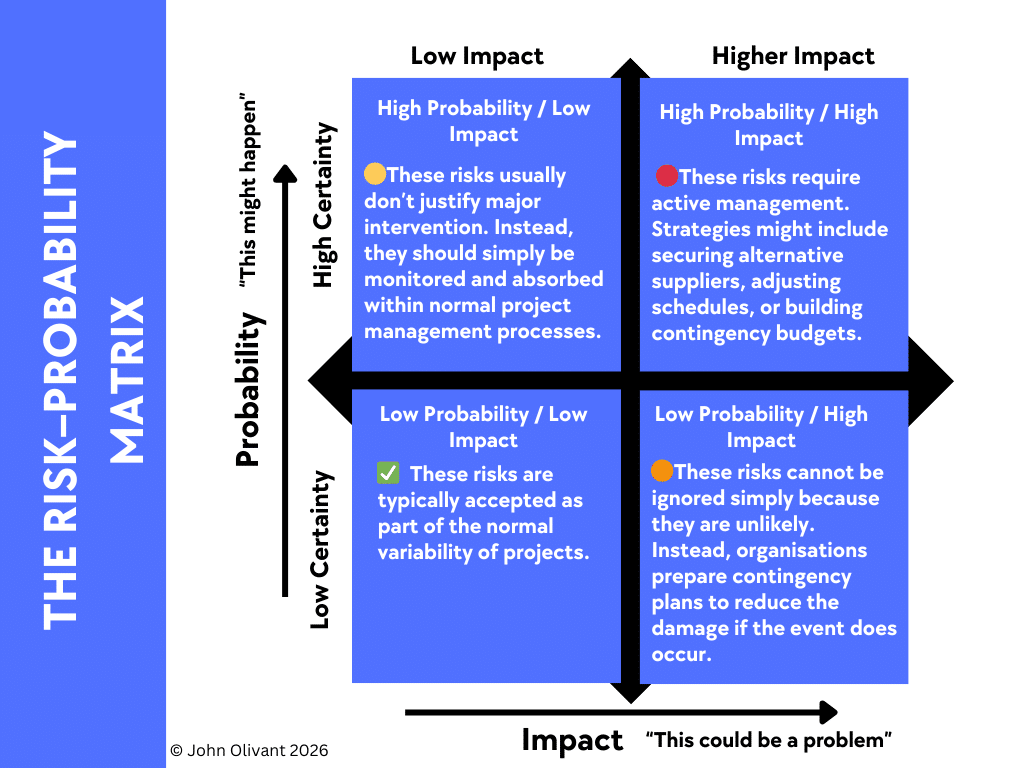
High Probability / High Impact – Manage Closely.
These are the risks that demand the most attention. They are both likely to occur and capable of causing serious disruption.
Examples might include:
- Known supply chain bottlenecks
- Highly volatile material prices
- Labour shortages in specialised trades
These risks require active management. Strategies might include securing alternative suppliers, adjusting schedules, or building contingency budgets.
High Probability / Low Impact – Monitor.
Some risks occur frequently but have limited consequences. Examples might include:
- Minor delivery delays
- Small variations in labour productivity
- Minor scope clarifications.
These risks usually don’t justify major intervention. Instead, they should simply be monitored and absorbed within normal project management processes.
Low Probability / High Impact – Plan Contingency.
Some risks are unlikely but potentially very serious. Examples include:
- major structural defects discovered during construction
- regulatory approval delays
- catastrophic supplier failure.
These risks cannot be ignored simply because they are unlikely. Instead, organisations prepare contingency plans to reduce the damage if the event does occur.
Low Probability / Low Impact – Ignore.
Finally, some risks are both unlikely and insignificant. Attempting to plan for every possible minor risk would consume time and resources unnecessarily. These risks are typically accepted as part of the normal variability of projects.
The Value of the Matrix.
The real power of the risk–probability matrix lies in its simplicity. It forces project teams to move beyond vague statements like:
- “This might happen”
- “That could be a problem”
Instead, risks are evaluated more systematically by asking:
- How likely is this risk?
- What would the consequences be if it occurred?
Once risks are classified this way, management attention can be focused on the areas where it will make the greatest difference.
Turning Uncertainty into Structured Risk Management.
Complex projects always involve uncertainty. The goal of good project management isn’t to eliminate that uncertainty entirely. That would be impossible. The goal is to understand uncertainty well enough to prioritise risks intelligently.
The risk–probability matrix is one of the simplest and most effective ways to achieve that. By identifying which risks deserve attention, which require monitoring, and which can safely be ignored, project teams can focus their energy where it matters most, improving the probability of successful project outcomes.
10. Three Mistakes Estimators Commonly Make; And a Practical 5-Step Probabilistic Estimating Framework.
Over the years, I’ve reviewed many project estimates across construction, engineering, and commercial work. Most of them were prepared by competent professionals who understood their trade and had plenty of practical experience.
Yet the same problems appear again and again.
Interestingly, the issue usually isn’t poor arithmetic or lack of technical knowledge. The real problem is the mental model used when estimating. Traditional estimating methods often assume a level of certainty that simply doesn’t exist in real projects.
Below are three of the most common mistakes I see estimators make, followed by a simple framework that can dramatically improve the accuracy and usefulness of project estimates.
Mistake 1 – Treating Estimates as Certainties.
The first and most common mistake is presenting estimates as fixed numbers.
A typical estimate might say:
- Project cost: £120,000
- Programme duration: 10 weeks
- Labour requirement: 600 hours
The number appears precise, but in reality, it represents only one possible outcome. The estimate assumes that every variable behaves exactly as expected:
- Labour productivity matches the schedule
- Suppliers deliver on time
- Material prices remain stable
- No unexpected issues arise on site.
In other words, the estimate quietly assumes the future behaves like a predictable system. But real projects rarely behave that way. Even small variations in productivity, logistics, or material pricing can shift the final outcome significantly.
When estimates are treated as certainties, they create false confidence and leave no room for understanding how outcomes might vary.
Mistake 2 – Ignoring Variability in Key Inputs.
The second mistake is assuming that key variables are fixed when they are actually variable. Take labour productivity as an example. An estimator might assume a certain number of hours based on previous experience. But productivity can vary depending on:
- site access
- weather conditions
- coordination with other trades
- crew experience
- equipment availability.
Material prices also fluctuate. Supplier availability changes. Transport delays occur. Yet traditional estimates often use a single value for each variable rather than recognising that each variable has a realistic range. Ignoring variability hides risk rather than managing it.
Mistake 3 – Adding Arbitrary Contingencies.
The third mistake appears when estimators try to compensate for uncertainty by adding a blanket contingency.
For example:
- add 10% contingency
- add 15% for safety
- round the total cost up.
While this approach acknowledges uncertainty, it does so in a very crude way. The contingency isn’t based on probability or risk analysis. It’s simply a buffer intended to protect the estimate from surprises. Sometimes the contingency is too small and the project overruns anyway. Other times, it is unnecessarily large, and the price becomes uncompetitive.
Either way, the contingency is guesswork rather than structured risk management.
A Simple 5-Step Probabilistic Estimating Framework.
Instead of relying on fixed numbers and arbitrary contingencies, estimators can adopt a probabilistic framework that recognises uncertainty from the start. The goal isn’t to eliminate uncertainty; that would be impossible. The goal is to understand and manage it intelligently.
Step 1 – Identify the Key Uncertain Variables.
Start by identifying the inputs that are most likely to vary during the project. Typical variables include:
- labour productivity
- material costs
- supplier delivery times
- subcontractor pricing
- programme duration.
Not every variable needs detailed modelling. Focus on the factors that have the greatest influence on cost or schedule.
Step 2 – Estimate Realistic Ranges.
Instead of assigning a single value to each variable, estimate a range of plausible values. For example:
Labour cost: £55,000 – £70,000
Materials: £35,000 – £50,000
Subcontractors: £18,000 – £25,000
These ranges reflect the natural variability that occurs in real projects.
Step 3 – Assign Probabilities
Next, estimate how likely different outcomes are within those ranges.
For example:
- 60% probability that the labour cost falls near the middle of the range
- 25% probability it runs slightly higher
- 15% probability it runs lower.
This step forces estimators to think explicitly about likelihood rather than relying purely on instinct.
Step 4 – Model the Combined Outcomes
Once the ranges and probabilities are defined, the next step is to combine them.
This can be done through:
- scenario planning
- sensitivity analysis
- Monte Carlo simulation.
By modelling many possible combinations of inputs, the estimator can see how the total project cost might vary across different scenarios.
Instead of one estimate, the result becomes a probability distribution of outcomes.
Step 5 – Plan Contingency Based on Probability
Finally, contingency can be set based on the level of certainty required.
For example:
- Budgeting at the 50% probability level provides a competitive estimate but carries higher risk
- Budgeting at the 80% probability level provides greater certainty but may increase cost.
This approach turns contingency planning into a structured decision rather than a guess.
The Real Benefit of This Approach.
What this framework does is shift estimating away from pretending the future is predictable. Instead, it recognises that projects produce a range of outcomes, some more likely than others. By identifying variability, assigning probabilities, and modelling different scenarios, estimators gain a far clearer picture of the risks involved.
And once those risks are visible, they can be managed intelligently. The estimate stops being a fragile prediction and becomes something far more valuable:
A probabilistic forecast of how the project is most likely to unfold.
11. Why Probabilistic Thinking Creates Better Leaders.
One of the most powerful benefits of probabilistic thinking is that it changes how leaders approach uncertainty. In many organisations, leaders feel pressure to appear certain. They are expected to provide clear answers, precise forecasts, and confident predictions about the future.
But experienced leaders eventually discover an uncomfortable truth: certainty in complex environments is often an illusion.
- Markets change.
- Costs fluctuate.
- Projects evolve.
- Unexpected events occur.
Leaders who rely on deterministic thinking, assuming the future will unfold exactly as planned, often struggle when reality deviates from those assumptions. Probabilistic thinkers approach the problem differently. Instead of asking “What will happen?” they ask:
“What outcomes are most likely, and how should we prepare for them?”
This shift in mindset produces better leadership in several ways.
- First, it improves decision quality. Leaders who think probabilistically weigh risks and rewards more carefully and avoid overconfidence in single predictions.
- Second, it encourages better planning. By considering ranges of outcomes, leaders can prepare for both likely scenarios and unexpected disruptions.
- Third, it improves communication and credibility. Rather than promising unrealistic certainty, probabilistic leaders communicate expectations honestly, explaining both the most likely outcomes and the associated risks.
Finally, probabilistic thinking promotes adaptability. When leaders recognise that outcomes exist within ranges rather than fixed points, they become more comfortable adjusting strategy as new information emerges. In uncertain environments, which is to say, in most real businesses, the goal of leadership is not to eliminate uncertainty. It is to make better decisions despite it.
Final Word – Stop Pretending Business Is Chess.
One of the biggest mistakes organisations make is assuming that the future can be predicted with precision. Estimates are presented as single numbers, programmes are defined to the exact week, and decisions are made as if the environment will behave exactly as planned.
But real-world projects rarely unfold that neatly.
- Costs fluctuate.
- Schedules shift.
- Unexpected problems emerge.
- Clients introduce changes.
- External factors disrupt carefully prepared plans.
None of this is unusual. In fact, it is the normal operating environment for most businesses.
The problem is not that estimates are sometimes wrong. The real problem is that many estimates are built on the assumption that uncertainty does not exist. They are treated as if the business environment behaves like a game of chess, where every piece is visible, and every move can be calculated in advance.
But in reality, most business decisions look far more like poker.
- Information is incomplete.
- Variables interact in unpredictable ways.
- And chance always plays a role.
Once you accept this, the purpose of estimating changes. The goal is no longer to produce a single number that claims to predict the future with certainty. Instead, the goal becomes understanding the range of possible outcomes and the probability of each.
This shift in thinking has powerful implications.
- It encourages more realistic planning.
- It improves risk awareness.
- It allows organisations to set smarter contingencies.
And it helps leaders communicate uncertainty honestly rather than hiding it behind false precision. Probabilistic thinking does not eliminate uncertainty. That would be impossible. What it does is transform uncertainty from something vague and uncomfortable into something structured and measurable.
Instead of guessing what might happen, decision makers can evaluate what is most likely to happen and prepare accordingly. And in complex projects, that difference can be the difference between constantly reacting to surprises and managing risk with confidence.
The smartest organisations understand this. They stop pretending the future is predictable. And they start making decisions based on probability rather than certainty.
Your Next Step – A Better Way to Make Decisions.
If you’re like most business owners or project managers I speak to, your estimating process probably evolved over time. It’s based on experience. Past projects. Supplier quotes. And a good amount of professional judgement.
There’s nothing wrong with that. In fact, experience is one of the most valuable tools in estimating.
But what many businesses discover is that their process still relies heavily on single-number estimates, assumptions, and instinct, rather than structured probabilistic thinking. That’s where a small shift in approach can make a big difference. By introducing probabilistic decision-making into your estimating process, you can begin to:
- understand the real range of possible project outcomes
- Identify the risks that are most likely to affect cost and schedule
- build smarter contingencies rather than arbitrary buffers
- improve the reliability of your forecasts
- make decisions with greater confidence.
This doesn’t require complex software or academic models. In many cases, it simply involves reframing how estimates are structured and how uncertainty is evaluated. If you’d like to explore how this could work in your business, I offer a 1-to-1 decision and estimating review session.
During the session, we will:
- Review how your current estimates are produced
- Identify the key variables that introduce uncertainty into your projects,
- explore how probabilistic thinking could improve forecasting accuracy
- Look at practical ways to build better decision models into your planning.
The goal isn’t to turn your business into a statistics laboratory. It’s to help you make better decisions in an uncertain world. If that sounds useful, the next step is simple.
Book a 1-to-1 session, and we’ll walk through your current estimating process together.
You’ll leave with practical ideas you can immediately apply to improve the way your business plans, prices, and manages risk.
 Twelve intensive half-day meetings.


