
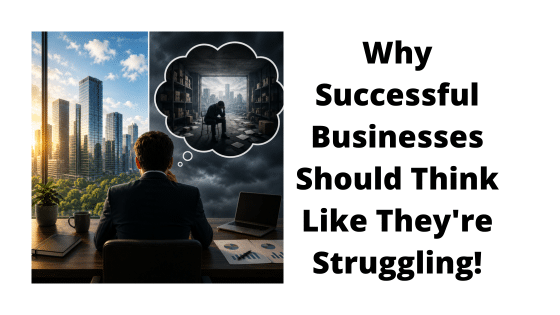
The Best Business Decisions Are Made Before You Need to Make Them.
Listen to the Audio version of this blog here.
Watch a brief summary video of this blog.
Introduction – When Every Movement Becomes a Decision
A week ago, I had surgery to repair an abdominal hernia. Thankfully, everything went well, but recovery has been a real eye-opener.
Before the operation, I never gave a second thought to how I moved. If I dropped my car keys, I bent down and picked them up. If I needed something from the top shelf, I reached for it. Standing up from the sofa, getting out of bed, carrying the shopping, loading the dishwasher or walking up the stairs were all completely automatic. I moved with gay abandon because I’d never had a reason not to.
After the surgery, everything changed. Now, every movement is a conscious decision.
Getting out of a chair isn’t simply a case of standing up. I have to shuffle to the edge of the seat, position my feet, brace my stomach, push with my arms and stand slowly. Something as simple as picking up a dropped pen involves stopping to think about whether I should squat, kneel or ask someone else to pick it up. Even coughing or sneezing has become an event that requires preparation.
It’s surprising how much of everyday life relies on muscles you never normally notice until they stop working properly.
The reason for all this caution is simple. Every movement now has a cost. Move carelessly, and I know I’ll pay for it with pain. Stretch too far, lift something that’s a little too heavy or twist awkwardly, and I’ll immediately regret it. So instead of acting instinctively, I think before I move. Every action has become deliberate.
As I was recovering, it struck me that businesses behave in exactly the same way after they’ve been hurt.
When a business is healthy, decisions often happen almost without thought. Money is spent, projects are started, and opportunities are pursued because they seem like a good idea at the time.
But when a business has been wounded, perhaps by losing a major customer, suffering a cash flow crisis or navigating a difficult economy, everything changes. Suddenly, every decision is questioned. Every pound spent is scrutinised. Every commitment is carefully weighed up.
Just like recovering from surgery, every movement becomes deliberate.
2. Healthy People Don’t Think About Walking
Recovery has made me realise something else. Pain changes the way you think. When every movement has consequences, you naturally become more careful. You stop acting on instinct and start considering the cost of every action before you take it.
Businesses are no different.
When a business is healthy, profitable and enjoying strong cash flow, it also begins to operate on instinct. Decisions are made quickly because there’s no immediate consequence if one or two turn out to be wrong.
A marketing campaign doesn’t generate the enquiries you hoped for? Disappointing, but you’ll survive.
- A new piece of software turns out to be a waste of money? Cancel the subscription and move on.
- You recruit someone who isn’t quite the right fit? Costly, but manageable.
- You sponsor an event that produces no business? Chalk it up to experience.
- A new product launch falls flat? Try something different next time.
When the business is performing well, these mistakes are frustrating, but they’re rarely fatal. Now, don’t get me wrong. Growing businesses need to invest if they’re going to continue growing, and taking calculated risks is part of building a successful company.
The problem is that not every decision is made because it’s the best use of time or money. Quite often, it’s made simply because the business can afford it. That’s a subtle but important difference. When there’s plenty of cash in the bank, discipline has a habit of quietly slipping away. The awkward questions stop being asked.
- Do we really need this?
- Will this generate a return?
- Is this the best use of our resources?
Instead, the decision becomes, “We’ve got the money, so let’s do it.”
It’s exactly the same as recovering from surgery. When you’re fit and healthy, you don’t think about every movement because there’s no penalty for getting it wrong. Businesses often stop thinking because success makes decisions feel just as effortless. The healthier they become, the easier it is to mistake the ability to spend money for the wisdom to spend it.
The discipline disappears because the pain has disappeared.
There’s another thing I’ve noticed during my recovery.
Doorways.
Before my operation, walking through a doorway wasn’t something I ever thought about. If I’d forgotten my phone, I’d simply turn around, twist, walk back into the room and pick it up. If I’d taken the wrong thing upstairs, I’d come straight back down again. Changing my mind cost me virtually nothing. Now it’s different. Every unnecessary journey matters.
If I walk upstairs and realise I’ve forgotten something, I don’t immediately turn around and go back. I stop and ask myself, “Do I really need it right now?” If I do have to go back, I move more slowly and much more carefully because every extra movement puts strain on muscles that are still healing. In other words, I think before I go through the doorway.
Businesses have their own doorways.
Some decisions are easy to reverse. You can cancel a software subscription, stop an advertising campaign or postpone a project with relatively little consequence.
Others are much harder. Signing a long-term lease on bigger premises, taking on permanent staff, borrowing significant amounts of money or investing heavily in equipment are decisions that aren’t so easy to undo. Once you’ve walked through those doors, turning around becomes much more difficult.
Healthy businesses often assume every decision is reversible because, with strong cash flow and healthy profits, they can usually absorb the cost of changing their minds.
But wounded businesses know better. When cash is tight, every doorway matters. Before stepping through it, they stop and ask, “If this doesn’t work, can we get back?” It’s a question every business should ask, whether it’s thriving or struggling.
3. Then Something Happens.
Of course, nobody chooses to have a business injury. Just as I didn’t plan on having surgery, very few business owners set out expecting to be hit by something that changes the way they operate. But sooner or later, something happens.
- Perhaps a major customer leaves unexpectedly and takes 30% of your turnover with them.
- Maybe a recession causes new orders to dry up.
- Cash flow becomes tighter than it’s ever been.
- Costs continue to rise while customers become more cautious.
- A large tax bill lands at exactly the wrong time.
- An important supplier goes bust.
Or perhaps it’s simply a series of smaller setbacks that, on their own, are manageable but together leave the business under real pressure. Whatever the cause, the effect is remarkably similar.
The business has been wounded. And just like recovering from surgery, everything changes. The carefree confidence disappears almost overnight. Decisions that once took minutes now take days. Purchases that would previously have been approved without hesitation are discussed at length.
- Recruitment is postponed.
- Investment plans are delayed.
- Every invoice is watched.
- Every payment is questioned.
- Cash in the bank suddenly feels far more valuable than another new idea.
Even those “doorways” I talked about earlier start to look very different. When the business was healthy, stepping through a doorway didn’t seem like much of a risk because you assumed you could always turn around if things didn’t work out. Now you realise that some doors are much harder to come back through.
- Signing a five-year lease.
- Taking on debt.
- Buying expensive equipment.
- Recruiting another member of staff.
- Launching a new product.
None of those decisions feels quite so easy anymore because the cost of getting them wrong has become painfully obvious. Ironically, that’s often when businesses start making some of their best decisions. Not because they’re suddenly smarter than they were before, but because they’ve been forced to slow down. They’re no longer reacting on instinct.
They’re thinking carefully about every step, every investment and every doorway before they commit. It’s exactly what I’ve found during my recovery. Being wounded hasn’t stopped me from moving. It’s simply made me much more deliberate about how I move. Perhaps businesses need the same mindset, not just when they’re recovering, but all the time.
4. Every Decision Suddenly Becomes Deliberate
One of the unexpected things about recovering from surgery is that it forces you to become intentional. Nothing happens automatically anymore. Before I bend down, I think. Before I lift something, I ask myself whether I really need to. Before I walk upstairs, I make sure I’m taking everything with me because I don’t want to make another unnecessary journey. Every movement is planned. Not because I want life to be more complicated, but because every unnecessary movement has a cost.
Business works in exactly the same way.
When a business has been wounded, every decision suddenly becomes deliberate. The conversations in the boardroom change almost overnight.
Instead of asking, “Wouldn’t it be nice if…”, people start asking much harder questions.
- Do we really need this?
- Can it wait another six months?
- Is there a simpler or cheaper way of achieving the same result?
- What return will we actually get?
- What happens if we don’t spend the money at all?
Those are very different conversations. Every purchase is scrutinised. Every new employee has to justify their cost. Every marketing campaign is expected to deliver measurable results. Every software subscription is reviewed. Every investment is challenged. Nothing is taken for granted.
I often see this with businesses that are experiencing cash flow difficulties.
Six months earlier, spending £500 on a piece of software barely warranted a discussion. Now it’s debated for half an hour. Recruitment that once seemed urgent is postponed while existing staff find more efficient ways of working. Marketing activity becomes far more targeted because every pound has to produce a return. The irony is that many of these decisions are actually better decisions. The business becomes sharper. Waste disappears. Priorities become clearer. Resources are allocated more effectively.
The business starts behaving with the discipline it perhaps should have had all along.
That’s exactly where I find myself during recovery. Yesterday, I wanted to move a heavy box in the garage. Before the operation, I’d have picked it up without thinking. This time, I stopped. Did it really need moving today? Could somebody else help? Could I split it into two lighter loads? Or could it simply stay where it was for another week?
The answer was simple. It could wait.
Before surgery, I probably wouldn’t even have considered those alternatives because I didn’t need to. Pain has a remarkable way of making you think. The challenge for business owners is this:
“Why wait until your business is hurting before asking the questions that lead to better decisions?”
5. Pain Creates Clarity
One of the biggest lessons I’ve learned during my recovery is that pain has an incredible ability to create clarity. When something hurts, you quickly stop wasting energy on things that don’t matter. My priorities have become remarkably simple. Recover properly.
Don’t do anything that risks setting my recovery back. Focus on what I can do rather than what I can’t. Everything else can wait.
It’s amazing how quickly your perspective changes. Jobs around the house that once felt urgent suddenly aren’t. The garage doesn’t need tidying today. The lawn can wait another week. That DIY project I’ve been meaning to start? It’ll still be there when I’m fully recovered. When every movement has a cost, you naturally become much better at separating what’s important from what’s merely urgent.
Businesses go through exactly the same transformation. When times are good, it’s surprisingly easy to fill the diary with activity. Meetings are arranged because people think they should have them. Projects are started because they sound like a good idea. New initiatives are launched before the previous ones have delivered results. Money is spent because it’s available. Everyone is busy, but not always productive.
Then the business comes under pressure. Suddenly, the questions change. Does this meeting actually need to happen? Is this project creating value? Will this investment help us generate more profit or improve cash flow? If we stopped doing this tomorrow, would anybody even notice?
It’s remarkable how many things disappear when the business can no longer afford to carry them. The endless meetings become shorter, or disappear altogether.
- The vanity projects quietly come to an end.
- The “nice to have” software subscriptions are cancelled.
- The distractions fall away.
What’s left is the work that genuinely moves the business forward.
I’ve seen businesses emerge from difficult periods stronger than they were before, not because they enjoyed the experience, but because the experience forced them to become brutally honest about what really mattered.
- Pain stripped away the unnecessary.
- It exposed the waste.
- It sharpened priorities.
- It created focus.
Of course, none of us would choose pain as a management strategy. I certainly wouldn’t recommend abdominal surgery as a route to greater productivity! But there’s an important lesson hidden within it.
Pain forces clarity.
The smartest business owners don’t wait for a crisis to achieve that clarity. They create it deliberately. They regularly challenge their own assumptions, question how resources are being used and ask whether every meeting, every project, and every pound being spent is genuinely helping them build a better business.
Because if pain teaches us anything, it’s that focus isn’t created by having more resources. It’s created by recognising what matters most.
6. The Problem Comes When Recovery Begins
Here’s the interesting part. Recovery itself can become the danger. As my body heals, I’m already noticing little changes. I stand up a little quicker than I did a week ago. I reach for things without quite as much thought. I occasionally catch myself starting to bend in the old way before reminding myself that I’m not fully recovered yet. As the pain fades, so does the discipline that the pain created.
That’s perfectly natural. After all, the whole point of recovery is to get back to normal. But it also carries a risk. The very habits that kept me safe during the early stages of recovery begin to disappear.
- I stop planning every movement.
- I stop thinking before I act.
- I start relying on instinct again.
Businesses do exactly the same thing. After a difficult period, sales begin to recover.
- Cash flow improves.
- Customers start placing orders again.
- The bank balance becomes healthier.
- The immediate pressure begins to ease.
And with it, the discipline that helped the business survive starts to fade. The software subscriptions start creeping back. Recruitment plans are dusted off. The diary fills up with meetings again. Projects that were parked suddenly come back to life. Marketing budgets increase.
People stop asking the difficult questions because they no longer feel they have to. The business slowly drifts back into old habits. I’ve seen this happen more than once.
A business goes through a difficult period, strips out unnecessary costs, improves its processes and becomes incredibly focused. Profitability improves, cash flow stabilises, and everyone breathes a sigh of relief.
Then, almost without noticing, the unnecessary costs begin to return.
- Not all at once.
- One subscription here.
- Another meeting there.
- An extra system that looked useful.
- A project that isn’t really aligned with the strategy.
None of these decisions is particularly significant on its own. But together they slowly recreate the complexity, inefficiency and cost that caused many of the original problems. It’s a bit like putting weight back on after a successful diet. Nobody wakes up one morning ten kilograms heavier. It happens gradually, one small decision at a time. Business is no different.
- Success has a habit of making us comfortable.
- Comfort makes us less disciplined.
And less discipline often leads us back to the very place we worked so hard to escape. Perhaps the real lesson from recovery isn’t simply to heal. It’s to remember the habits that helped you heal in the first place.
7. Great Businesses Stay Deliberate
For me, this is the real lesson.
- The goal isn’t to become a better business because you’ve been through a crisis.
- The goal is to think like a business that’s been through one, even when everything is going well.
- The best businesses I’ve worked with have one thing in common.
They don’t wait until they’re under pressure before becoming disciplined. They don’t need falling sales or a cash flow crisis to start asking difficult questions. They ask them anyway. Every significant decision is challenged.
- Is this the best use of our cash?
- Will this genuinely create value for the business?
- Are we investing because it’s part of our strategy, or simply because we can afford to?
- Are we doing this because it works, or because we’ve always done it this way?
- If business suddenly became much tougher tomorrow, would we still make this decision today?
They’re powerful questions because they force you to think beyond the excitement of the moment. Take recruitment as an example. Many businesses recruit because everyone is busy. The best businesses ask a different question.
“Is another person really the answer, or is the problem that our processes are inefficient?”
The same applies to technology.
It’s easy to be attracted by the latest software promising to transform your business. But before signing up, great businesses ask whether it solves a genuine problem or simply creates another monthly subscription.
Marketing is no different.
Rather than chasing every new trend or platform, they focus on the activities that consistently generate profitable customers and quietly stop doing the things that don’t. In other words, they stay deliberate.
That doesn’t mean they’re afraid to invest. Far from it. The best businesses are often the ones making the biggest investments. The difference is that those investments are intentional. They support a clear strategy. They’ve been thought through. They have a purpose. They’re not simply the result of optimism or momentum.
Over the years, I’ve noticed something else. Businesses that build this habit tend to remain calmer when difficult times do arrive. Because they’ve been making disciplined decisions all along, they don’t have to reinvent the way they operate when the economy slows down or a major customer leaves.
They’re already running a leaner, sharper and more focused business. The discipline isn’t something they switch on during a crisis. It’s simply how they operate every day. Perhaps that’s the biggest lesson my recovery has taught me.
Being careful isn’t a sign of weakness. It’s a sign that you understand the consequences of your actions. The strongest businesses don’t become deliberate because they’ve been wounded. They become successful because they’ve made deliberate thinking a habit.
8. Deliberate Doesn’t Mean Fearful
At this point, it’s worth making an important distinction. Being deliberate doesn’t mean becoming fearful. Recovering from surgery doesn’t mean I stop moving altogether. If I did that, I’d never recover. In fact, one of the things the doctors have encouraged me to do is keep moving. Walking is good for me. Gradually increasing my activity is an important part of the healing process.
The difference is that I don’t move carelessly anymore. I move with purpose.
- If I need to walk upstairs, I do.
- If I need to go for a walk, I do.
If there’s something that genuinely needs doing, I do it. But I think first.
- I don’t make unnecessary journeys.
- I don’t lift things simply because I can.
- I don’t take risks that offer little reward but could easily set my recovery back.
Business is exactly the same. Being deliberate isn’t about refusing to spend money. It’s about making sure every pound has a job to do. Great businesses still invest.
- They still recruit talented people.
- They still launch new products.
- They still buy equipment.
- They still enter new markets.
- They still take calculated risks.
In many cases, they invest more than their competitors. The difference is that every decision is conscious. It’s aligned with a clear strategy. It’s supported by evidence. It’s designed to move the business forward rather than simply keep everyone busy. That’s a world away from cutting costs for the sake of it.
I’ve seen businesses slash marketing budgets, stop investing in staff and cancel worthwhile projects simply because they’re frightened of spending money. That’s not discipline. That’s fear. Fear causes businesses to retreat.
Discipline allows businesses to move forward with confidence. There’s a huge difference between confidence and complacency. Confident businesses invest because they’ve thought it through. Complacent businesses invest because everything seems to be going well.
One approach builds stronger businesses. The other often creates problems that only become obvious when times get tougher. Perhaps that’s the mindset we should all be aiming for.
- Move forward.
- Keep growing.
- Keep investing.
But make every important decision as deliberately as if the consequences really mattered. Because they do.
9. Final Word – Don’t Wait Until You’re Hurt
If there’s one thing this recovery has taught me, it’s that pain changes the way we think.
- It slows us down.
- It forces us to question things we’d previously taken for granted.
- It encourages us to focus on what really matters and ignore everything that doesn’t.
In many ways, that’s been one of the unexpected benefits of the whole experience. I certainly wouldn’t have chosen to have surgery, but I can’t deny that it’s made me much more aware of how I move through the day.
- Every journey has a purpose.
- Every movement has a reason.
- Every doorway makes me stop and think before I walk through it.
Businesses often experience exactly the same transformation. A recession. A cash flow crisis. The loss of a major customer. An unexpected tax bill. Any one of these can force a business to become more disciplined almost overnight.
The irony is that many businesses emerge from these difficult periods stronger than they were before. They’ve cut out the waste, simplified their operations, focused on what really creates value and started making better decisions.
The tragedy is that they often needed to be wounded before they changed. My hope is that I don’t lose the lessons I’ve learned once I’m fully recovered. One day, I’ll be able to bend down without thinking, lift heavy boxes, twist, stretch and climb the stairs exactly as I did before.
But I hope I don’t lose the habit of stopping to think before making unnecessary movements. I think businesses should aim for exactly the same thing.
- Don’t wait until cash flow is under pressure before questioning your costs.
- Don’t wait until sales fall before reviewing your marketing.
- Don’t wait until you’re struggling before asking whether every meeting, every project and every investment is genuinely helping you build a better business.
The strongest businesses aren’t the ones that never suffer setbacks. They’re the ones who develop the discipline to make deliberate decisions long before hardship forces them to. Because when every important decision is intentional, success becomes far less dependent on luck.
And perhaps that’s the biggest lesson my recovery has taught me.
- Move with purpose.
- Think before you act.
And don’t wait until you’re wounded to start making better decisions.
Your Next Step – How Deliberate Are Your Business Decisions?
One of the biggest lessons I’ve taken from my recovery is that pain has a remarkable way of improving decision-making. When every movement has a cost, you naturally become more thoughtful about where you invest your time and energy.
The same is true in business.
When a business comes under pressure, every pound is questioned, every investment is scrutinised, and every decision is made with greater care. Ironically, it’s often during the good times that unnecessary costs, inefficient processes and poor habits quietly creep into the business. Small decisions that seem insignificant on their own gradually accumulate until complexity, waste and reduced profitability become the norm.
The challenge is this: don’t wait until your business is wounded before becoming more deliberate.
The most successful businesses regularly step back and ask difficult questions.
- Are we investing our money in the right places?
- Are our processes as efficient as they could be?
- Are we spending time on activities that genuinely create value?
- Have unnecessary costs crept into the business over time?
- Are we making decisions because they’re strategically right, or simply because we’ve always done things that way?
Our Business Diagnostic is designed to answer those questions.
We’ll take an objective look at every aspect of your business, from strategy and operations to financial performance and commercial effectiveness, to identify where time, money and effort could be used more effectively. More importantly, we’ll show you the practical changes that can help you build a stronger, more resilient and more profitable business.
You don’t need to wait for a recession, a cash flow crisis or the loss of a major customer before improving the way your business operates.
The best time to become more deliberate is while your business is healthy.
Book your Business Diagnostic today and discover how a more deliberate approach to decision-making can help you build a better business.
 Twelve intensive half-day meetings.


